Rights Through Play: Play, Respect, Include
Children in Kakanj learned about their rights through games and sports

- Bosanski/Hrvatski/Srpski
- English
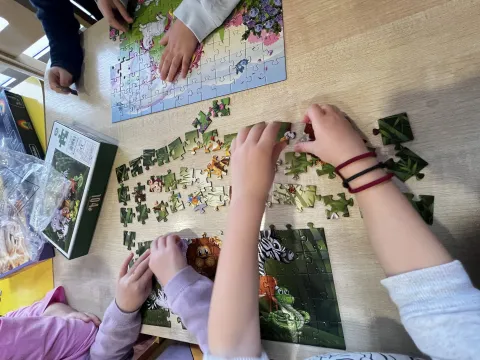
With plenty of laughter and play, students of “Hamdija Kreševljaković” Primary School in Kakanj learned about children’s rights during a workshop held as part of the project “Rights Through Play – Safe and Inclusive Childhood.”
“Besides learning a lot about my rights, today’s workshop made me curious to learn even more. I understood better how much we are worth and how important our rights are. I really liked the workshop because it revolves around children’s rights, and I think this way of learning is great for helping children expand their knowledge and become interested in learning more about their rights,” Ena, a ninth-grade student, told us after the workshop.
Ishak, a seventh grader at the same school, said he also enjoyed the workshop. He believes the rights of students are extremely important and something we should talk about constantly:
“No one should be left out or excluded. It’s important that we talk to children about their rights, so they know what their rights are and can stand up for them. No one should violate someone else’s rights or tell anyone they are worth less just because they are different — nobody wants to hear that about themselves.”
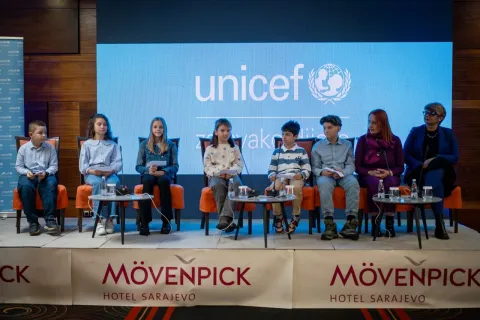
The workshop in Kakanj is one of several regional “Rights Through Play – Play, Respect, Include” workshops held within the project aimed at strengthening equal rights for all children — no matter where they live — using play as a space where children learn, grow, and feel they belong.
The workshop was led in a fun, engaging and age-appropriate way by psychologist Sanela Šehić Bajramović, trainer and educator Nejra Šabeta from “Hamdija Kreševljaković” Primary School, and Amina Duraković, a moderator with the Youth Sports Games. Using the “house of rights” concept, they worked with children on the rights to safety and protection, non-discrimination, participation and opinion, play and rest, as well as health and development.


“These five rights fit perfectly from a psychological perspective because sport naturally offers a space for them: safety, inclusion, expression, play, and rest. That’s how I designed the ‘house of rights’: the foundation is the right to non-discrimination, the walls are safety and protection of boundaries, and only when a child feels safe can they express their opinion and be heard. That leads to play, teamwork, and mental and physical health,” says Sanela Šehić Bajramović, psychologist and Gestalt psychotherapist, adding that she tries to use everyday examples when working with children:
“With new generations, attention works better through play, experiential tasks, and situations where they ask themselves: ‘Does this apply to us or not?’ I think this model is functional, engaging, and that it would be great to include more groups — it’s visual and easy to remember. This is my fifth city, and I really see how well both teachers and students respond. Sometimes the teachers get even more excited than the kids, but the children also really get involved, especially when we talk about rights violations.”
She also developed the handbook “The Architecture of Children’s Rights: From Foundation to Roof” as part of the project — intended for teachers who also attended the workshops:
“Teachers in the schools received the handbook and will be holding workshops using the same model — the ‘house of rights’ and a set of age-appropriate games. They’ll be applying all of this in their classrooms, and the goal is for the programme to expand and reach as many children and schools as possible.”
The workshop was also completed by Nejra Šabeta, a physical and health education teacher at “Hamdija Kreševljaković” Primary School and “Muhsin Rizvić” Gymnasium in Kakanj, who now took on the role of educator:
“This way of talking about children and children’s rights — using workshops and real-life examples — is by far the most useful and the best I’ve come across. The language was adapted to children, and the workshop left such a strong impression on me that I even considered organising something similar privately — with parents of the children I coach, and more broadly in the local community. We talked about things we experience every day, not just through presentations and slides,” says Nejra Šabeta, adding that the knowledge gained, along with the handbook, will be extremely valuable in her work:
“Of course I’ll use the handbook in school. It’s especially important because it’s designed for sports teachers and trainers. I’ve already been applying many of these things, and the workshop confirmed that I’ve mostly been on the right track. But we all need to correct ourselves, adapt, bring in new approaches — and I will, for sure. I also coach volleyball, I’m constantly in contact with children, their needs and their rights, and I believe that with people who are aware, trained, and capable, we can apply these rights in a positive way, protect sport and return its real value, and introduce children to sport in the best possible way.”