“Children’s rights should be kept in a safe”
The event “Communities in Action: Commitment and Collective Action for Every Child” held in Sarajevo, marked World Children’s Day.
- Bosanski/Hrvatski/Srpski
- English
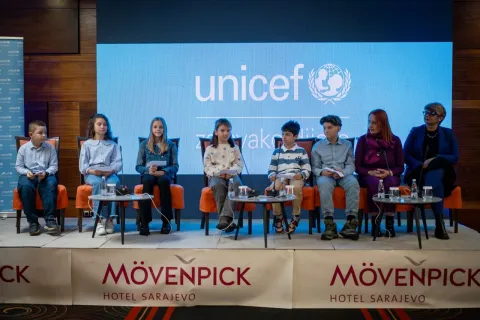
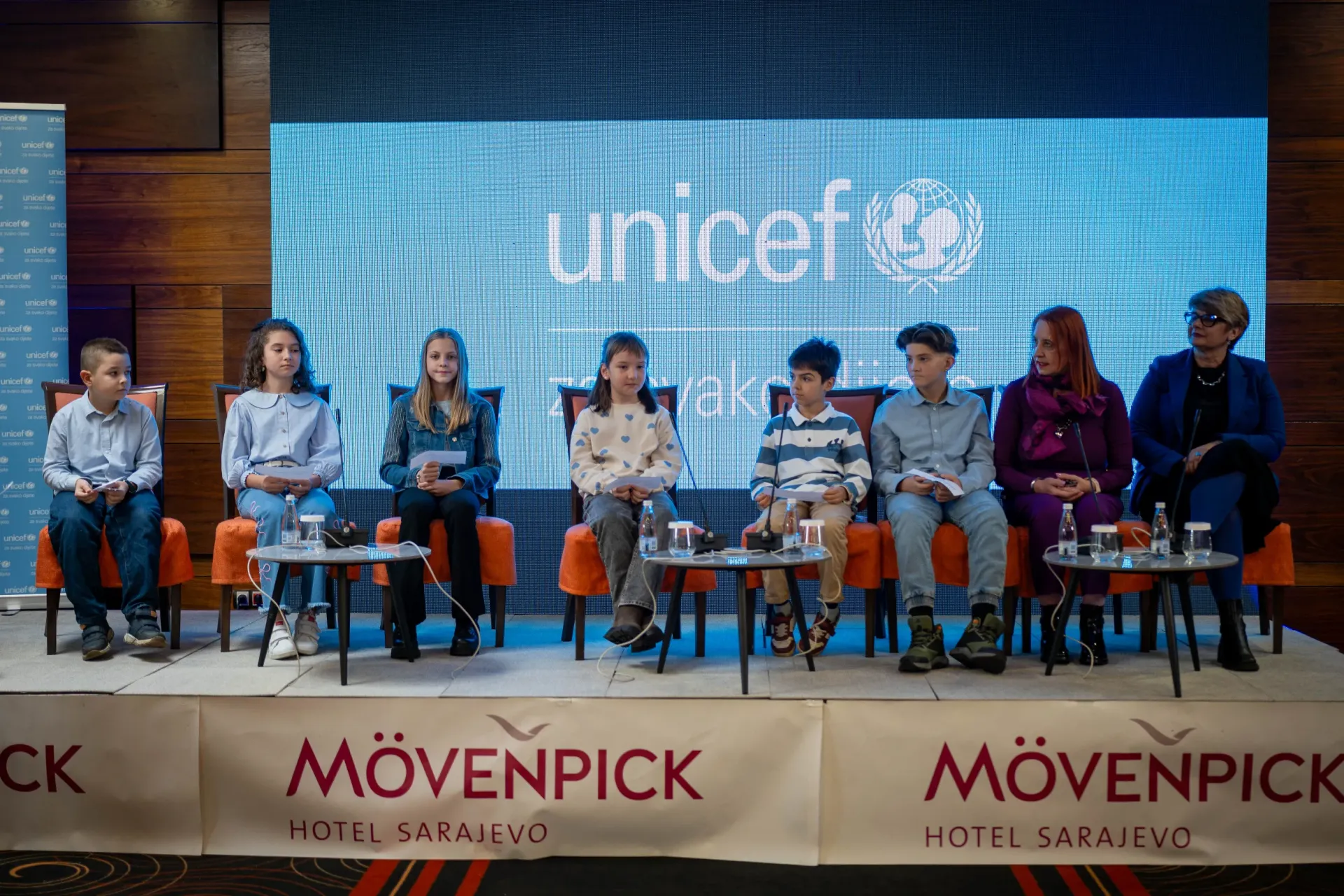
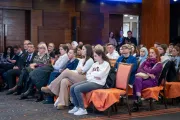
“Children’s rights should be kept in a safe, because they are something very important in our lives,” said Vedad Kerić, a student of “Kovačići” Primary School and peer educator, speaking at the Child Panel of the event “Communities in Action: Commitment and Collective Action for Every Child” which marked World Children’s Day in Sarajevo. The event brought together representatives of institutions, international organizations, civil society, academia, children and young people, as well as advocates for children’s rights.
This year’s theme, “Growing Together: From Voices to Action,” put the spotlight on involving children and young people in decision-making, and on strengthening joint commitment to the realization of every child’s rights in Bosnia and Herzegovina. Key findings of the Situation Analysis of Children and Adolescents in BiH 2025 and guidelines of the UNICEF Country Programme 2026–2030 were presented, while special attention was given to the Youth Declaration “Our Vision for the Next Decade,” voiced through child and youth advocates.
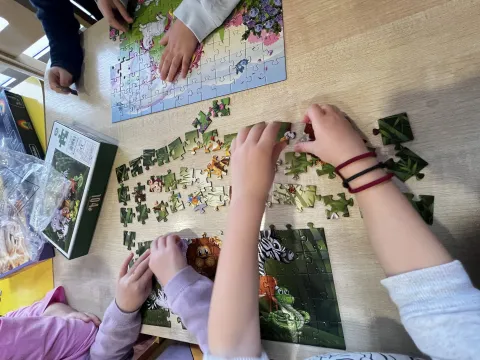
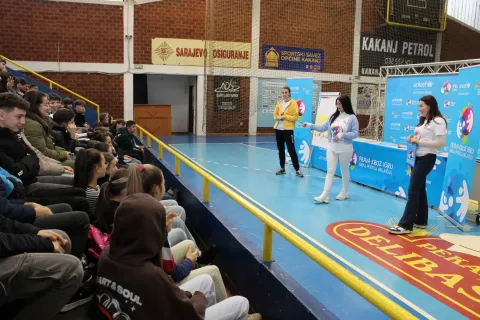
The programme included a musical and artistic performance by children from the Centre for Blind and Visually Impaired Children, an exhibition of children’s drawings and student projects, as well as stands showcasing local initiatives from the programme “Communities That Listen, Learn and Care.” The event offered space for dialogue, networking and joint advocacy, highlighting the importance of shared responsibility and institutional commitment to a better future for children.
Speaking on behalf of children and young people living with hearing and speech difficulties, Lejla Trakić from the School for Rehabilitation of Listening and Speech said:
“Today I speak on behalf of children and young people whom society often doesn’t see and doesn’t hear. We are not ‘less valuable,’ but every day we face prejudice, misunderstanding and closed doors – from education to employment. Inclusion is not just a word – it means equal rights, open opportunities and the possibility to work in jobs we are capable of performing, together with hearing colleagues. The adoption of the Law on Professional Rehabilitation has created the conditions for persons with disabilities to have equal access to education, employment and career advancement, but it is now crucial that these rights do not remain just words on paper. Our voice – different, quieter, or expressed through hands – deserves to be heard and respected.”
At the Child Panel, primary school students participating in the “Child Rights Education Project” spoke about what they have learned and presented their “Youth Declaration – Our Vision for the Next Decade.” Their messages clearly showed how important it is not only to listen to children, but to truly respect what they say.
Tarik Kardaš from “Osman Nakaš” Primary School said that students in his school have the right to play and learn, and that any violation can be reported to the school support services.
“If we ignore just one right, a child will not feel well – if we remove the right to education, a child is left without school and knowledge,” he said.
A similar point was made by Kanita Bašić, emphasizing that children’s rights around the world are still often violated, and that children must have freedom, play, socializing and education.
“There must be no violence – adults should respect children, but children should also respect adults,” she added.
Ilma Turić underlined that respecting children’s rights supports children’s development and freedom, while lack of respect leads to neglect.
“A peer educator is not only someone who transfers knowledge – but someone who inspires others to protect children’s rights and advocates for a future without violence,” she said.
Ajna Pozderac from “Kovačići” Primary School pointed out that honesty protects both one's own rights and respect toward others.
“If children’s rights are not respected, this affects the state of education. All children must have the same rights, because we are all equal.”
Emin Bajrović reminded that children also have responsibilities.
“We have the right to education, but we must study, read, and be good friends. Without adult support, we would not feel this level of safety.”
Altijana Alić, Senior Associate for Professional Development of Educators, Teachers and School Staff at the Institute for Pre-University Education Development, said that children must learn about their rights from the earliest age, and that rights always come together with responsibilities.
“I hope these children will spread that knowledge further, and that society will increasingly discuss the importance of respecting children’s rights,” she said.
Samela Alagić, Senior Associate for Student Wellbeing at the Institute, added that peer educators are the best promoters of children’s rights, and that child rights will be included in training catalogues to ensure equal access to support for every child in Sarajevo Canton.
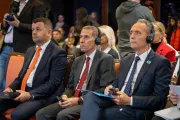
The second panel gathered representatives of institutions, international organizations, experts and young people, who discussed policies for children and youth, implementation of the UN Committee on the Rights of the Child recommendations, and the necessary steps for creating more stable, inclusive and fair policies. The discussion made it clear that joint action across all sectors is essential for real change.
Kemo Sarač, Assistant Minister for Human Rights and Refugees of BiH, underlined that strong institutional engagement is needed to ensure a high level of child-rights protection.
“The Council for Children is not an NGO body, but an expert and advisory body to the Council of Ministers, and it is crucial for monitoring the implementation of the Convention on the Rights of the Child,” he said.










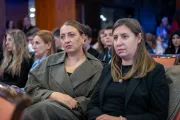

Dragana Bulić from World Vision emphasized that child participation must be at the centre of all decisions.
“We work where life happens, but without the voices of children – without consulting them on their own needs – long-term results are not possible,” she said.
Dajana Vasić presented the work of the Bijeljina Children’s Parliament, stressing that children most often face problems in schooling and violence.
“Our goal is for our voice to be respected and for us to participate in decision-making. Young people need to get involved and take part, because our voice must be heard.”
Samid Šarenkapić from UNFPA said that early investments in children benefit society as a whole.
“When young people are given a chance – they take it. It is crucial to create opportunities that restore trust in a shared future, and that are not reserved for the elite, but open to everyone.”
Fermin Cordoba from the EU Delegation to BiH emphasized that European policies increasingly place children at the centre.
“The European Union strives to put children at the centre of attention. This means that when new regulations are created in Brussels, if they affect children, the goal is to make children central to the planning process. As Bosnia and Herzegovina moves closer to the EU, harmonizing laws is important, especially ensuring quality, non-discriminatory education for every child.”
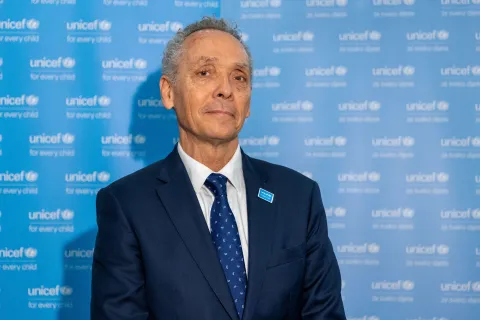
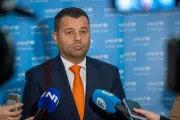
Speaking to participants, UNICEF Representative in BiH Marc Lucet and BiH Minister for Human Rights and Refugees Sevlid Hurtić highlighted the importance of listening to children and young people in decisions that affect them.
“We are aware of challenges – from social exclusion to insufficiently developed support services. But we also know that solutions exist when we act together. This joint action is what connects us today. To the children and young people here I want to say: your voice matters, your presence matters, your ideas are needed. This is your day, and for us a reminder that we must listen more, include more and protect more – not only today, but every day. Children’s rights are not a topic, but a responsibility. They cannot be a matter of goodwill, but a lasting and unquestionable duty of all of us – institutions, communities and individuals,” said Hurtić.
Lucet called on authorities and decision-makers in BiH to work together:
“First, we need a strong coordination structure for children and children’s rights in BiH, and a strong Child Council must urgently be established. Second, investments must continue, especially in early education, which currently only 42 percent of children can access – which is unacceptable. And third, for policies to truly become actions that change the lives of children and families, laws must be adopted that make these changes possible and ensure that every girl and boy can access quality services and family-based care – no matter where they live.”
Congratulating the occasion, Lucet underlined that children’s rights are human rights:
“Today we mark World Children’s Day and remind that all children – girls, boys and adolescents – have the same rights, no matter where they live in Bosnia and Herzegovina. Our joint role as institutions, schools, teachers, and health and social workers is to advocate for the realization of these rights: the right to education, health, identity, safety and development to every child’s full potential.”
The exhibition of children’s artwork, student projects and local initiatives “Communities That Listen / Learn / Care” was opened, giving participants the chance to talk directly with children, youth and students about their ideas and research.
The event concluded with the message that communities which act are those that listen, learn and care – and that only through joint effort can every child in Bosnia and Herzegovina grow up safe, supported and equal.