NUTRITION FRIENDLY KINDERGARTEN
Blue is the color of UNICEF, and in Maglaj we learned how milkshakes become blue

- Bosanski/Hrvatski/Srpski
- English
"Pear, apple, plum, says little Iva, those fruits are sweet, everyone would eat.", children's voices sing, as we enter the working rooms of one of the youngest kindergarten groups of the Public Institution "Vrtić Maglaj". This kindergarten is one of 35 preschool institutions in Bosnia and Herzegovina, which are certified as "Nutrition Friendly Kindergartens", within the program, UNICEF in Bosnia and Herzegovina has been implementing for almost ten years.
This kindergarten was completely reconstructed after the catastrophic floods that hit Bosnia and Herzegovina in 2014. as part of the Reconstruction Program, financed by the European Union. Today, the kindergarten employs two nurses, six teachers, a cook and other administrative staff. Director Kanita Bašić explains how to become a friend of healthy nutrition.

"Even before entering this program, our kindergarten met most of the standards that must be met in order to receive a certificate. We started by holding workshops for staff and children in the kindergarten with the support of UNICEF and the Association of Chefs, improving the menu so that it fully complies with the adopted standards, and our staff underwent additional training with representatives of the Institute of Public Health , and the Ministries of Health and Education and nutritionists," says Director Bašić.
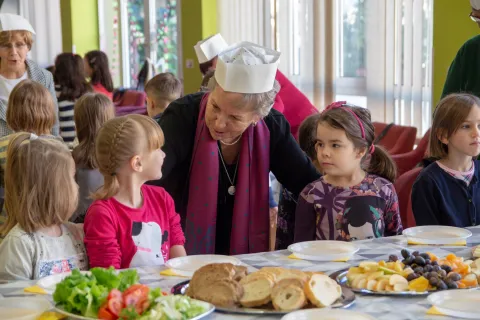
Today, over eighty children in the kindergarten in Maglaj learn from the earliest age through play how to distinguish healthy from unhealthy food. Three-year-old Taira, while putting a paper apple into the mouth of a paper model of a child, tells us that: "The baby doesn't have a stomach ache now.", and Ahmed shows us how the baby, who drinks soda, now has a toothache.
The children also learn about dental health, as well as the importance of hygiene, healthy habits and physical activity.
"Cooperation with parents is extremely important to us, because children of this age mostly adopt behavioral patterns in their homes. That's why we insist that they bring water to kindergarten instead of juice or fruit instead of candy. This is how habits are created, which both parents and children will then more easily implement at home. The parents are really ready to cooperate and the experiences so far have been very positive," the educators are also satisfied.


The kindergarten also has excellent cooperation with the Maglaj Center for Early Childhood Development, whose experts visit the kindergartens annually, and if any deviation from the regular development of children is observed, they are referred to the Health Center and the Center for diagnosis and intervention.
The UNICEF Program "Nutrition-friendly schools and kindergartens" is integrated into the Strategic Plan for the Advancement of Early Growth and Development of Children 2020-2025, and is implemented by the Federal Ministry of Education and Science in cooperation with the Federal Ministries of Health, Labor and Social Welfare, Ministry of Finance, as well as the Institute for Public Health of the Federation of Bosnia and Herzegovina.
In Republika Srpska, the Program is implemented by the Institute for Public Health of Republika Srpska in cooperation with the Ministry of Health and Social Welfare and the Ministry of Education and Culture.
The aim of the program is to establish and expand a network of school and kindergarten communities in which access to children's health is improved and their optimal growth and development is ensured. In order for a kindergarten to receive a certificate, it is necessary to fulfill 26 criteria identified within the five components that make up the framework of the initiative, namely: kindergarten food policy, improvement of knowledge and skills of the kindergarten and school community, development and improvement of work programs with children, provision of community support and strengthening the health service.
Currently, 35 kindergartens participate in the program, and the plan is for 80 communities to establish the institutions of this type through funds from UNICEF and the European Union (EU support for the reform of the health sector in BiH).


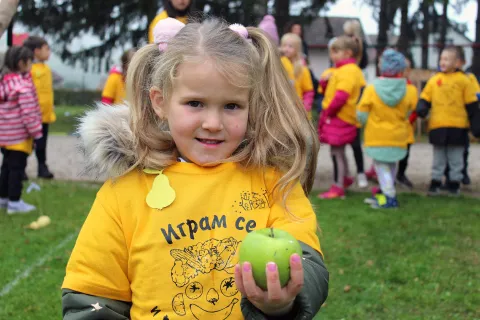
While we were visiting, the middle kindergarten group organized a competition to quickly overcome obstacles, and the older group practiced fine motor skills, which they will soon need at schoo,l by coloring drawn fruits,. We saw a blue milkshake, so together we figured out whether it was made of eggplant or blue banana, until 5 years old Amina explained to us that it was a blueberry.
As the director told us, there is also a plan for the kindergarten to start its own fruit and vegetable production, since they have a large garden. That's why we look forward to the next visit, and maybe making a real blue milkshake together.