Knowledge, Data and the Academic Community for Children’s Rights
A panel on the role of education and data in shaping policies and practices that place children’s well-being and rights at the forefront

- Bosanski/Hrvatski/Srpski
- English
To mark World Children’s Day, the University of Sarajevo’s Center for Interdisciplinary Studies – Prof. Dr. Zdravko Grebo (CIS) hosted a panel discussion and a mini research fair titled “Communities that Learn: Knowledge, Data and the Academic Community for Children’s Rights.” The event focused on the critical role that knowledge, education and data play in shaping stronger policies and practices that put children’s well-being and rights at the forefront.
“This week is an important week for UNICEF and for children around the world, because on the 20th of November we mark World Children’s Day, the day when we collectively celebrate the Convention on the Rights of the Child, adopted more than 30 years ago—one of the most widely signed, adopted and ratified UN conventions. The Convention places the child at the center of development efforts and defines our responsibility to care for the child as a rights holder. That is why I believe there is no better place to mark this than the University of Sarajevo,” said Marc Lucet, UNICEF Representative in BiH, at the opening of the event.
Lucet particularly emphasized the importance of the initiative to develop digital courses on children’s rights:
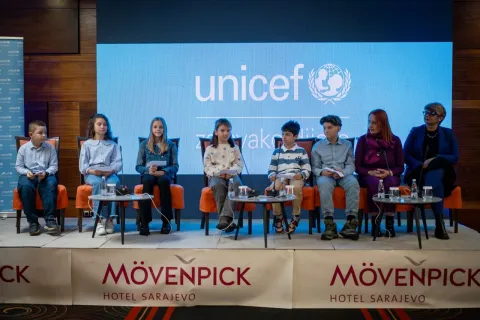
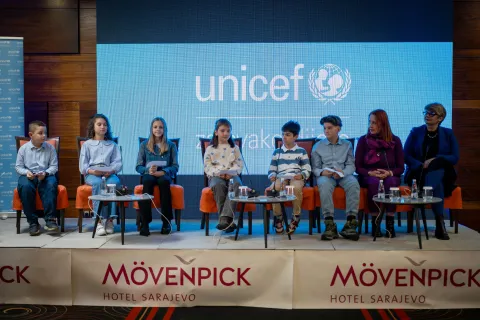
“It is important that today we present digital modules on education about children’s rights, which will be available to everyone. I know that you already have experience with such initiatives, including digital modules on climate change, and I am pleased to see this continuing. I look forward to hearing young and more experienced researchers speak about their cooperation with UNICEF, because there is no good policy without strong evidence produced by the academic community. Partnerships for rights, science, truth and freedom of expression are needed by all of us,” he said, inviting attendees to the central World Children’s Day event, “Communities that Act: Commitment and Joint Action for Every Child,” on 20 November at the Mövenpick Hotel in Sarajevo.
The event gathered professors, students, and representatives of institutions and civil society who discussed the role of the academic community in promoting and protecting children’s rights, the importance of research and quality data, and how education can shape generations that understand and defend children’s rights.
“As we mark World Children’s Day 2025, I want to emphasize that this day is not only a celebration for us, but also a moment to reflect on the role of knowledge and the academic community in shaping better policies for children. In times of uncertainty and polarization, universities must remain courageous and principled, firmly standing on the side of science and verified knowledge. As the oldest and largest higher education institution in BiH, we believe that the academic community must be the driving force of society—the voice of reason, a guardian of principles and a source of knowledge that enables real change. Our duty is to shape generations that understand, defend and advocate for children’s rights, and this is why digital access to knowledge is extremely important,” said Kemal Durić, UNSA Vice-Rector for International Cooperation.


At the mini fair of student research papers, young researchers presented their findings on children’s rights, inclusion, and participation. The pioneering joint initiative to develop digital courses on children’s rights was also presented, intended for the general public, students, educators and decision-makers. The courses, developed jointly by CIS and UNICEF, represent an innovative tool for improving education on children’s rights, and Prof. Dr. Borjana Miković from the Faculty of Political Sciences spoke about the research conducted for the development of the courses:
“Digital experts now need to apply what we have written, and we are all eager to see what these digital courses will look like. These will be the only such courses available in online form in our country, and they concern everyone interested in children’s rights—from professionals working with children, to parents, and to children themselves. The courses will surely contribute to stronger knowledge on children’s rights.”
A special focus during the panel was placed on child participation. The Child Rights Programme Manager at the Global Campus of Human Rights – South East Europe said that “we should not speak about children in the third person”:
“Children’s rights are not only something that exists on paper, but something that must be lived. And in order to know what children think and feel, and what their needs are, it is important that we ask them. This is why we have a child advisory team with hundreds of members from across the region. I am here representing the children who placed their trust in me. We cannot talk about projects and improving the situation of children in the community without asking them what they need.”
The importance of child participation was also emphasized by Prof. Dr. Lejla Kafedžić, Director of the UNSA Student Support Office, who stated that “we need to listen to the child’s voice every day, not only on special occasions,” while Hatidža Šaljić from the Institute for Pre-University Education added that “in practice, we rarely ask children, and it is extremely important to hear their opinion.” Director of the UNSA Center for Human Rights and UNSA representative in the FBiH Council for Children, Dr. Gaj Trifković, said that it is particularly important that the academic community has joined the work of this multisectoral body “because the role of universities is crucial in preparing the professionals who will later work with children.”
Director of the Center for Interdisciplinary Studies (CIS), Rifat Škrijelj, also addressed those present, emphasizing that the University of Sarajevo is a house open to cooperation with UNICEF:
“Under this roof operate three university units that, each in its own way, deal with children’s rights: the Center for Human Rights, the Student Support Office, and the Center for Interdisciplinary Studies, which is also the host of today’s event. I thank UNICEF for the projects we implement together and want to say that our doors remain open for further cooperation.”