The implementation of the new assessment system in the Herzegovina-Neretva Canton encourages parents
“Now that I know that there is a professional team that monitors my son Noah and will be by his side - I feel different”

- Bosanski/Hrvatski/Srpski
- English
The Herzegovina-Neretva Canton has started the practical implementation of assessment and referral of children with disabilities in accordance with the World Health Organization's International Classification of Functioning, Disability and Health (ICF). Members of multi-sectoral professional bodies from Mostar and Čituk coordinate the implementation and work on developing personalised support plans for each child who is currently participating in this process, in which the focus is on empowering the child and family, determining the child's abilities, needs and interests. The first reactions of parents are positive.
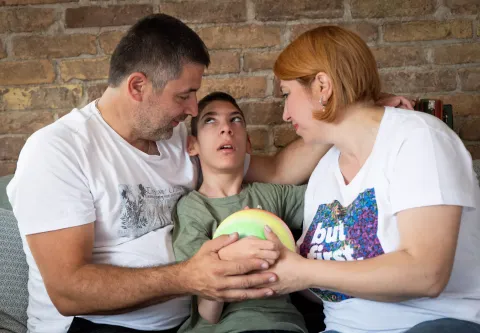
“I am glad that I get support, as the system has finally been set in motion and cares. This is a big step forward. The very fact that I am talking to you today makes it easier for me. I'm glad that through us and Noa, we can also help others," says Martina, one of the mothers, whom we met at a meeting with the professional team during one of the supervision sessions at the "Sveti Josip Radnik" Education and Rehabilitation Centre in Čitluk.
The new assessment system, as the professional body members explains to us, is completely focused on the child and the family, all relevant data is collected about each child and from all actors involved in the child's growth and development: From parents to specialists who work with the child - speech therapist, educational rehabilitator or physical therapist.
“Our priority is to talk to the parents and to observe the child in her/his natural environment, the way the child functions at home, in kindergarten and anywhere s/he is involved. We collect information about the child through specialists who already work with children and all those involved in the child's life. For example, if a child trains something, the trainers also get involved" explains Magdalena Musa, educational rehabilitator and member of the professional body.
“All information is important to us, because surely the child will not behave the same with us if we bring the child to this, for her/him unnatural environment, as s/he behaves at home or with a specialist with whom s/he has been involved for a long time, in kindergarten, in school; how the child functions, what are her/his needs and interests", she adds.
Martina's four-year-old son, Noa, is included in the assessment under the new system:
“The earlier way of assessment, when you bring a child in and the child doesn't show anything because maybe he is just not in the mood that day, that's stressful. Luckily, I had understanding, so I brought him the second and third time. I was very upset by those assessments. You can't determine anything in 10 minutes. For me, it is important to see that Noa is making progress and that we get the best out of him, and he has made progress and that should be seen. I think he can achieve a lot, and that we should work with him," says Martina, adding that she likes this approach precisely because of its comprehensiveness and continuous monitoring:
“I like the whole concept, because when you add up all the results that everyone participates in - that's Noah. To me, this is a fairy tale, now that I know that there is a professional team that monitors Noa and will be by his side – I feel different, because honestly I was most worried about school, and now I believe that with this kind of care, everything will be as it should be", says Martina in a conversation with members of the professional body, and Darko Kobetić, professor rehabilitator, UNICEF BiH consultant and author of "Analysis of policies and practices in the area of assessment and referral of children with disabilities at the FBiH level" who has been working on the introduction of a new assessment system since the beginning:


“Our goal is a humane approach, I'm glad that we have parents who have chosen this approach. We are focused on the child, family, experts and community. I hope that what we will deliver will be useful", he explains through a conversation with Martina, presenting her with further steps in the assessment:
“We will create a personalised support plan, list everything we think the child, you and your environment need, after which we will consult with you again and when we adopt the final plan, it goes to everyone who works with the child. The professional body will monitor everything for a year, after which they will see if anything needs to be changed. The professional body is in charge of finding the best places to support your child", Darko explains, adding that a particularly important segment of everything is working with the complete environment in which the child stays, in order to adapt the environment to the child and to create an enabling atmosphere.
“The comments of the community are very important and can be encouraging, but they can sometimes be problematic too. That's why I think that working with the community is very important, because as a society we have lost our sensibility, and this is passed on to the children as well", says mother Martina, adding that her Noa goes to kindergarten where he is well accepted and has all the understanding of his teachers, and makes more and more friends.
After a detailed discussion with the parents, the members of the professional body further explain, the development of a specially targeted support plan follows, after which they meet with the parents again, evaluate to what extent they agree with the proposed plan and accordingly make possible corrections, they complete it together, and send it on with recommendations. If the child is in kindergarten, that plan will be available to the teachers, and there is everything they need to do with the child, and later the plan is transferred to the schools.
“What we expected from the process was that parents would be satisfied with this method, and our expectations were met in that part. We have positive experiences of parents throughout this process, and perhaps a slight confusion because so far they have not come across this kind of approach to fully involve parents in planning support for their child. For now, everything is going well, the reactions of the parents motivate us to give our best in this", says Dragana Radišić, psychologist and member of the Professional Team of the Education and Rehabilitation Centre "Sveti Josip Radnik" in Čitluk.
Speech therapist Monika Marinčić admits that there was a certain amount of scepticism at the beginning of the entire process:
“At the beginning, we also felt a little confused and afraid of how it would all go, but so far we have had positive experiences from the parents and experts we work with. I think the parents like the most that we cooperate as a multidisciplinary team, we all contribute in a specific way and most importantly we put the child in focus", says Monika, while educational rehabilitator Magdalena Musa says that the process exceeds her expectations too:
“When we started to implement it, we were convinced that this concept was feasible. Of course it is difficult at the beginning, but we are in the process of learning, we are going to start slowly and hopefully in the end it will be as expected of us.”
Social worker Ljubo Ostojić shares the optimism of his colleagues from the professional body:
“The whole process did seem quite unrealistic, but things fall into place with time. At first I wondered how this would work in Bosnia and Herzegovina if it didn't work in some much more developed countries, but it really works very well”.
In 2019, UNICEF BiH supported the creation of the "Analysis of policies and practices in the area of assessment and referral of children with disabilities at the FBiH level", and at the final conference where the Analysis was presented, the Roadmap with recommendations for the implementation of the reform was adopted. It was agreed that the Herzegovina-Neretva and Zenica-Doboj cantons, which established multisectoral working groups and adopted Action Plans for the transformation of the system of assessment and referral of children with disabilities, will be the first to start reforming the assessment system in accordance with the ICF. The new assessment system entailed the establishment of professional bodies at the cantonal level, which, after training, began concrete activities in the field. In the course of this process, Guidelines for establishing a new assessment system and a Manual for the development, monitoring and evaluation of a personalised support plan for the child were created.
"The regulation that was previously in force in this canton, as is unfortunately still the case in other cantons, was adopted on the basis of a predominantly medical approach, which categorizes children in relation to the degree and type of disability, and completely leaves out the component of the assessment of the child's functioning, as well as the assessment of environmental factors that affect the child's development. Also, the planning, monitoring and evaluation of support for the child were not clearly and thoroughly prescribed, as well as the entire segment of support for families as a whole. The new approach we have developed with the support the EU and UNICEF Program for Mitigating the Effects of the COVID-19 Pandemic on the Lives of Children and Families in the Western Balkans and Turkey focuses on the child, but also on the whole family. It is extremely important that this new assessment system is simultaneously followed by the development of services, because the assessment is only the first step of the process. Therefore, UNICEF will continue to provide support to the sectors of education, social and child protection and health, through the further development of inclusive education, early childhood development and a range of social services in the domain of support for children and families," said Selma Kazić, Head of the Social Protection and Inclusion department at UNICEF in BiH.