Child allowance is not an expense, but a long-term investment
A new model of child allowance covering a larger number of children could be introduced as early as 2026, announced at the Conference on Social Protection Reform in FBiH

- Bosanski/Hrvatski/Srpski
- English
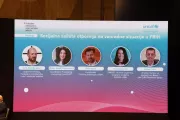
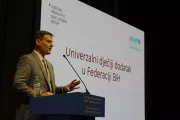
Timely investments in children, the adoption of reform laws, and the strengthening of social services can turn the vision of a just society into laws, laws into practice, and practice into a dignified life for all citizens and children. This was the unified message from the conference "Reforming the Social Protection System in FBiH: A Fairer, More Resilient, and More Efficient System for All," held in Sarajevo and organized by the Federal Ministry of Labor and Social Policy and UNICEF BiH.
"This is an important moment for the future of social protection, and significant reforms are underway. In this way, the Federation is making a strategic and long-term investment in its greatest asset — its people and its children. With partners such as the EU and the World Bank, UNICEF is proud to support the authorities in working on these three key priorities: a universal child allowance, social protection institutions, and emergency-resilient social protection," said Marc Lucet, UNICEF Representative in BiH at the Conference, emphasizing that investment in these areas is an investment in human capital that will be crucial for the future of BiH.
"A universal or, in this case, an expanded child allowance is not an expense but the smartest investment in reducing child poverty, building human capital, and creating equal opportunities for every child. This is more than social support — it is a powerful tool to reduce child poverty in FBiH and narrow the gap of inequality."
Deputy Head of the EU Delegation to BiH, Adebayo Babajide, stressed that social protection is one of the foundations of an inclusive, just, and prosperous society, and its importance in the context of BiH's EU accession:
"Through social protection, we ensure that no one is left behind and that all citizens have the opportunity to live a dignified life, regardless of their circumstances. One of the most important aspects of reform is cross-sector cooperation. The interconnectedness of social services, housing, social insurance, education, and employment policies requires a holistic approach that includes risk assessment and protection. As BiH progresses toward the EU, it is crucial to ensure that social insurance systems are sustainable and provide adequate benefits."
"Social protection is not the last item on the list of priorities — it is the first line of defense in a healthy state. Our goal is to expand the current child allowance, which reaches only 20% of children, to at least 50% of children in FBiH. This would be a major step in slowing demographic decline, strengthening families, and building a more resilient society. We must focus on the idea not of ‘how much it costs to support families,’ but of ‘how much it costs to abandon them,’” said Federal Minister of Labor and Social Policy Adnan Delić at the Conference.
The Conference offered an overview of key reform processes that will lead the Federation of BiH toward a more modern and inclusive system of social and child protection, with a focus on three reform laws: the Law on Social Services, the Law on the Institute for Social Protection, and the Law on Professional Activities in Social and Child Protection.


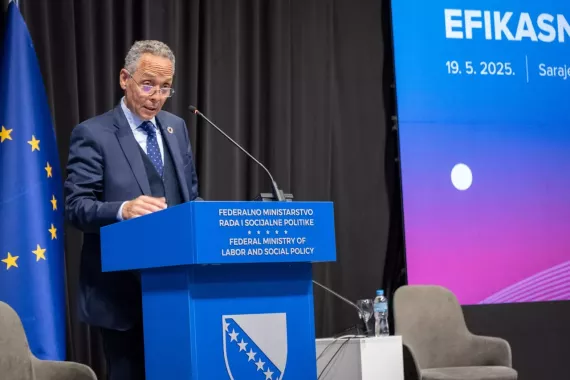


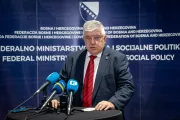


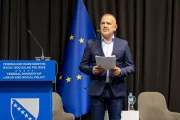
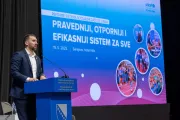

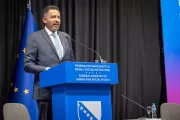
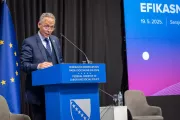
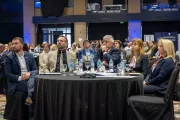
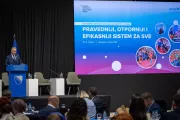

"We have low birth rates, the working-age population is emigrating, and the pension system is overburdened. People are our most important resource, and if we do not pay attention to our children, I fear we may lose the future. These reforms are not political, economic, or any other type of issue — they are a matter of the state’s survival," emphasized Minister Delić during one of the panels, where Dragan Mioković, Speaker of the FBiH House of Representatives, also underlined the importance of the reforms:
"Everything we do today, we do for our children and grandchildren. I believe that along with the economy and security, social protection is the third pillar of successful policymaking. A universal child allowance, or a quasi-universal model with significantly wider coverage, is something revolutionary if implemented as presented today,” said Mioković, announcing that all of this should soon become a reality:
"A universal child allowance is an extremely important topic that we must discuss and support, given the demographic situation in our society. It represents a major step forward not only in the policies of this government but overall. As the legislative authority, we are ready to pave the way for amendments to the Law on Material Support to Families with Children so that by 2026 we can introduce a new model of child allowance that will cover a much larger number of children in the Federation."
The working part of the Conference was divided into three blocks covering legislative reforms, the universal/expanded child allowance, and strengthening the system’s resilience to crises. Feasibility studies were presented for the introduction of a universal child allowance in FBiH and for providing cash assistance in emergencies through the social protection system in FBiH. Experiences from the 2024 floods highlighted the importance of a unified, institutionally supported social sector response during emergencies.
"With a bit of effort, energy, and political will, a major step can be taken toward introducing a universal child allowance,” said Muamer Halilbašić, Director of the Economic Institute Sarajevo, during the presentation of the feasibility study. Mirnes Telalović, President of the FBiH Association of Social Workers, focused especially on those for whom the reforms are intended:
"When we talk about reform, the essence of social protection is not an administrative or technical issue — it is a matter of responsibility, dignity, and justice for the most vulnerable social groups."
The Law on the Methodology for Creating Social Maps in FBiH was also discussed, which would enable the creation of a digital social map — a tool that would consolidate data on citizens’ socio-economic status and allow faster, more transparent, and fairer allocation of budget funds.
Miroslav Jurešić, Assistant Minister for Social Protection and Child and Family Protection, emphasized the importance of bringing services closer to their users:
The goal of reforms is also to bring balance to the child protection sector. What we must strive for is to return social services to the community where they belong and to provide those services locally."


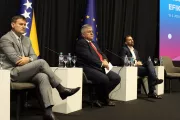



There was also discussion on social protection in the context of increasing risks from emergencies in FBiH, with lessons learned from the floods and preparations for future crises. Experience in FBiH, through a study on cash assistance options in crises, clearly shows that the most feasible model is expanding the existing system of material support for socially vulnerable categories.
"Poverty and inequality make our families more vulnerable to these threats. The rate of increase in child poverty during disasters can reach up to 20%. We know that every second child in the Federation of BiH lives on the poverty line, and every fourth child is below it. Simultaneously, one in five children in FBiH lives in a flood-prone area. That’s why social protection must become a strong shield that protects children and their families — offering security, dignity, and quick help when they need it most. Social protection in emergencies is not a luxury or an expense — it is a strategic investment in the resilience of society, the safety of children, and the sustainability of our communities,” said Irina Kulenović from UNICEF BiH’s social policy program.
Analyses show that reserving 5–10% of the total social protection budget for emergencies would allow the system to react quickly and provide additional financial support to the most vulnerable people already identified in social protection registries and databases. This ensures rapid and efficient protection with minimal additional cost and no need for parallel mechanisms during crises.
"Emergency aid cannot be subject to improvisation — funds must be pre-allocated in budgets, with clear activation mechanisms. This will ensure that our systems are ready and that children and families are not left waiting due to bureaucratic delays," said Senad Tutić, Director of the Center for Social Work Bihać and member of the Bihać DRR Platform, referring to Bihać’s integration of innovative emergency cash support into the local budget and system.
"We must also not forget the important role of civil protection as a partner in identifying those affected and coordinating interventions — only through synergy across sectors can we achieve optimal results,” added Maida Mekic Skrobanovic, Coordinator of the Project and Development Team of the Federal Civil Protection Administration.
The Conference brought together over 200 participants, including representatives of the legislative and executive branches, cantonal ministries, social work centers, civil protection, academia, embassies, international organizations, the European Union, the World Bank, UN agencies, and civil society organizations.