Minutes that save lives: Inside Bhutan’s neonatal care
How pre-term babies are nursed into healthy children

Thimphu: Parsuram Ghimiray, 33, reclines on a hospital bed with two tiny lives pressed against his chest. When he tires, his wife, Dika Maya Dhakal, 31, takes over. Between them lie their twins, born a little early and weighing just 700 grams and 1,100 grams. Time is measured not in days, but in hours of skin-to-skin contact.
Parsuram and Dika Maya are among a dozen parents providing kangaroo mother care (KMC) at the Jetsun Pema Wangchuck Mother and Child Hospital in Thimphu. Until the babies gain 2,000 grams, which can take up to three months, the parents will take turns holding them close for at least eight hours a day. It is simple and basic, yet lifesaving.
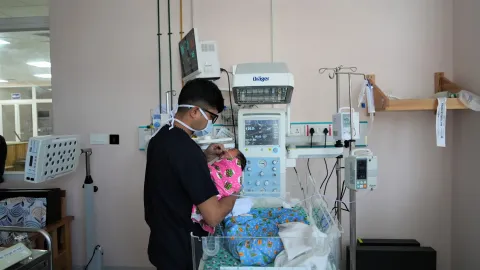
“Here, skin-to-skin contact is treatment,” says Dr Dinesh Pradhan, Bhutan’s only serving neonatologist in charge of the NICU. “For babies this small, every degree of temperature, every breath, matters. Every minute counts.” The NICU cares for the smallest and sickest. Babies weighing less than two kilogrammes, mostly preterm, arrive here daily. They are placed in incubators, tube-fed, and closely monitored by a team of 25 nurses working in three shifts.

On average, around 500 babies are admitted each year, with 70 to 80 per cent born preterm. Some remain for weeks. Others stay for as long as three months. The unit was set up in 2011, and over the past 12 years, Dr Dinesh has watched neonatal care mature. “In terms of coverage, we have done well,” he says. “Now the focus is quality. How well a country is doing is reflected in how well it cares for its newborns and mothers.”
That focus has paid off. In 2017, mortality among babies born before 28 weeks was around 70 per cent. By 2024, it had dropped to 40 per cent. Bhutan’s neonatal mortality rate now stands at 6.9 per 1,000 live births, close to European levels. “Every baby is precious,” Dr Dinesh adds, “especially because our fertility rate is low.”
Behind these numbers are long shifts and dedicated hands. Kelzang Namgyal, 35, a staff nurse for 13 years spent 12 of them in newborn care. “The biggest challenge is human resources,” he says. “Preterm births are increasing, cases are more complex, and equipment keeps evolving. A nurse does a six-hour morning shift and a 12-hour night shift. It takes a toll.”
Clinical nurse Sonam Tshomo, with 15 years of experience, echoes this. “We receive in-house training on equipment, but we are short-staffed,” she says. “Still, we do our best because these babies depend on us.”

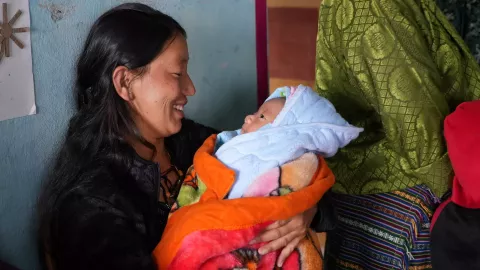
Nurses also support mothers beyond medical care. They teach them how to express breast milk and provide counselling when anxiety overwhelms joy. “Many parents are depressed,” says Dr Dinesh. “We remind them their babies will become big and healthy.”
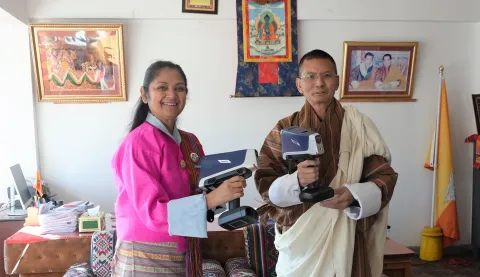
UNICEF’s support runs through every layer of this care. Working with the government, partners and through the support of donors, UNICEF has strengthened maternal and neonatal health services across the country by providing simple but life-saving equipment.
The mattresses keep tiny babies warm and stable in their first few hours immediately after birth. T-piece resuscitators help health workers support a newborn’s breathing when the baby struggles to take its first breaths. Continuous Positive Airway Pressure (CPAP) machines deliver a steady flow of air to keep fragile lungs open, reducing the effort needed to breathe.
Neonatal transport exothermic mattresses provide warmth during ambulance or helicopter transfers, protecting babies from dangerous drops in body temperature. Together, these tools have transformed the fragile “golden hour” after birth, when the right care can mean the difference between life and death.
“Earlier, referrals were a major challenge because we did not have T-pieces,” Dr Dinesh says. “Now, they have made a huge difference. We cannot put numbers to the impact of UNICEF’s support, but it has definitely changed outcomes.”
Training has been just as critical. Since 2023, neonatal basic and advanced life support training reached more than 500 nurses in advanced courses and over 1,000 in basic courses nationwide. Small and sick newborn care training, breastfeeding support, and six-month critical care nursing courses have strengthened skills at the bedside. Half of the nurses in Thimphu’s newborn ICU are now trained in critical care.

Only three hospitals in Bhutan – the National Referral hospital in Thimphu, and Regional Referral Hospitals in Gelephu, and Mongar – have newborn ICUs. Thimphu’s is the only one run by a neonatologist. The Ministry of Health and UNICEF’s strategy has been to reduce disparities, ensure equitable access, and prevent overburdening the capital by strengthening priority hospitals, where most births and newborn deaths occur.
For families like Dika Maya and Parsuram, these systems feel personal. When their babies are discharged, follow-up will continue for two years. Twice a week, Dr Dinesh runs an outpatient clinic for NICU graduates. Some parents return with cakes and smiles to celebrate their children’s birthdays with the staff.
Dr Dinesh has seen many such returns. “Seeing babies discharged from the NICU and growing up into healthy children,” he says, “is the most satisfying part of this work.”