Youth sensitised to become climate champions
Joint Press Release

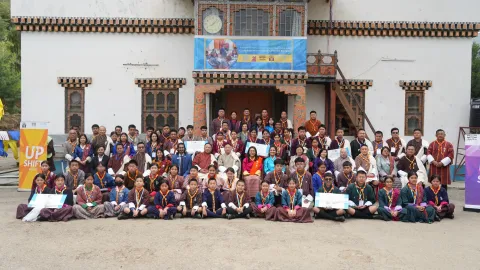
More than 50 young people from across Bhutan participated in a sensitisation programme today to deepen their understanding climate champions in Bhutan’s climate policy, particularly in relation to the outcomes of COP30 and Bhutan’s child sensitive Nationally Determined Contributions (NDC) 3.0.
It emphasised practical avenues for youth participation in climate action at both the community level and through formal policy‑making platforms. It served as a follow-up to the national presentation of the Youth Consultation Report held on 31 July 2025, where the Ministry of Energy and Natural Resources (MoENR) committed to integrating youth recommendations into the NDC 3.0 and explored mechanisms to formalise youth engagement in climate policy.
Assistant Environment Officer at MoENR, Lekzang Jayoed Dorji, highlighted that Bhutan’s core commitment at COP30 was to maintain its carbon‑neutral status, with NDC 3.0 strategically aligned to ensure that as national GDP grows, emissions continue to decline.
She emphasised that youth play a key role in delivering NDC 3.0 by researching climate impacts, leading community awareness, contributing to policy discussions, and promoting climate‑friendly daily habits. "Young people can also serve as global ambassadors for climate action, advocate within their communities, and engage with relevant organisations to develop practical climate solutions as future leaders," she said.
She noted that Bhutan faces significant mitigation challenges, an estimated 53,865.6 Gg of CO₂ emissions requiring USD 13.68 billion for mitigation and USD 13.9 billion for adaptation across seven priority sectors. To strengthen access to climate finance, 59 indicators reflecting Bhutan’s mountain ecosystem have been adopted. She also shared key departmental priorities, including a three‑year work programme (2026–2028) to implement the Enhanced Transparency Framework, preparations for the second Global Stocktake to safeguard the “mountain agenda,” advancing National Adaptation Plan implementation, and developing a Loss and Damage knowledge product with UNDP.
During the event, youth group representatives presented and discussed the impacts of climate change and adaptation, waste management, and the meaningful participation of youth in grassroots, national and global policy processes. Young advocates shared climate action projects, such as Climate LAW and Waste Management Initiatives, that they had led in their communities. They also provided updates from YOUNGO and the Local Conference of Youth (LCOY), demonstrating how youth in Bhutan continue to contribute to climate dialogue.
Kuenga Palmo, a youth volunteer from Thimphu Youth Centre, said, “while climate change is a massive challenge, it is not beyond us, if decision-makers and youth work together to build a resilient future.”
The youth‑led initiatives showcased during the programme align closely with Bhutan’s NDC 3.0 priorities: Climate LAW supports governance, capacity‑building and climate education; waste management initiatives advance mitigation and circular economy approaches in the waste sector; and active participation in YOUNGO and the Local Conference of Youth strengthens youth involvement in international and national climate processes.
The participants reaffirmed their personal commitments to sustainability by choosing public transport or walking instead of using private cars, planting trees, conducting cleaning campaigns, segregating waste and ensuring proper waste management.
Chencho Dorji,19, pledged to advocate within communities for forest fire prevention and discourage the disposal of cigarette butts and rubbish in the forests. Sharing her reflection, participant Deki Yangzom,20, said, “Today’s session was inspiring. Seeing youth form organisations for climate action made me proud and showed the inclusive participation we’ve long needed.”
Another participant, Jigme Sonam Thinley, 19, noted that “insightful session on climate change, COP30 and youth involvement, showing our voices matter as key stakeholders.” Participants said that as Bhutan has begun taking important steps toward climate change mitigation, they emphasised the need to take bigger strides, ones that centre inclusivity and empower not only the youth but also women, children, elders and persons with disabilities to contribute meaningfully to climate action.
Jigme Tenzin, 22, representative of project CLAW (Climate Law for Awareness and Wisdom), a youth-led initiative by JSWLAW, highlighted their data‑driven dual strategy for climate justice, engaging youth inclusively and creating an open‑air ‘Climate Resilience Classroom.’
The sensitisation session echoed the spirit of the recent United Nations Environment Assembly (UNEA‑7), where Bhutan co‑sponsored the resolution on Enhancing the Meaningful Participation of Youth in Environmental Processes and on Environmental Education. The resolution aims to strengthen youth participation in environmental decision‑making and support the Youth Environment Assembly under UNEA. The programme also complements MoENR’s broader efforts to operationalise NDC 3.0 across sectors.
The event was jointly organised by the Programme and Youth Coordination Division under the Department of Education Programmes of the Ministry of Education and Skills Development (MoESD), the Department of Environment and Climate Change of the Ministry of Energy and Natural Resources (MoENR), and UNICEF. It builds on a series of nationwide youth climate consultations conducted in 2025, which engaged more than 155 young people and contributed to the social sector components of Bhutan’s NDC 3.0. The NDC outlines Bhutan’s pathway to remain carbon neutral through 2035, integrating emission projections, mitigation commitments and an inclusive social sector strategy to ensure an equitable transition.
By fostering intergenerational dialogue between youth, government agencies and development partners, the programme reaffirmed Bhutan’s commitment to placing young people at the centre of climate resilience and sustainable development.
###
Download photos here
Note to Editors
The success of this program is attributed to strong collaboration with the Programme and Youth Coordination Division, MoESD, the Department of Environment and Climate Change, MoENR, UNICEF and the youth groups. The 50 youth are from the following seven youth groups:
- Social Justice Initiative, JSWLAW.
- YPEER Bhutan.
- Changjiji Youth Centre Volunteers.
- Thimphu Youth Centre Volunteers.
- Paro Youth Centre Volunteers.
- Local Conference of Youth (LCOY).
- Bhutan Youth Summit.
About the Programme and Youth Coordination Division, MoESD
The Programme and Youth Coordination Division under the Department of Education Programmes of the Ministry of Education and Skills Development caters to the educational and recreational needs of youth and continues to design and deliver youth-friendly services, facilities and programmes through the establishment and operation of Youth Centers (YCs) in the country. Moreover, the Division also designs and implements innovative and relevant programmes for youth.
About the Department of Environment and Climate Change, MoENR
The Department of Environment and Climate Change (DECC) under the Ministry of Energy and Natural Resources (MoENR), which incorporates the National Environment Commission (NEC), is Bhutan's premier body for environmental protection and conservation. Guided by the Gross National Happiness (GNH) philosophy, its mission is to ensure sustained, enlightened development through relevant policies, programs, and legislation. The NEC's mandate includes developing environmental policies, mainstreaming environment into national development, promoting awareness, enforcing Environmental Impact Assessments (EIAs), and coordinating cross-sectoral issues to safeguard the environment for all generations.
Media contacts
About UNICEF
UNICEF promotes the rights and wellbeing of every child, in everything we do. Together with our partners, we work in 190 countries and territories to translate that commitment into practical action, focusing special effort on reaching the most vulnerable and excluded children, to the benefit of all children, everywhere.
For more information about UNICEF and its work for children, visit www.unicef.org.