Young innovators drive digital solutions at hackathon
The initiative equips 963 youth with digital and entrepreneurial skills
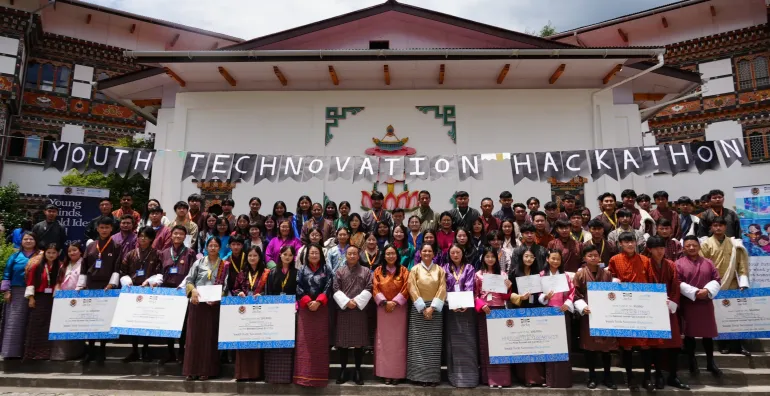
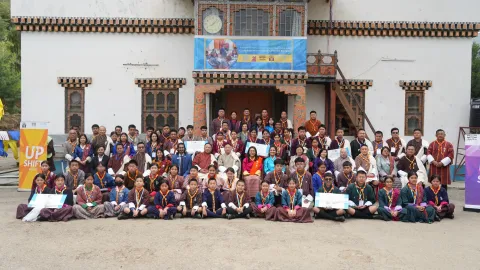
Thimphu, 18 June – Nearly 100 young people, including 45 female students, came together at Bhutan’s first Youth Tech-Novation Hackathon to present innovative digital solutions addressing real-life challenges and needs faced by youth, education, youth centres and the communities.
Organised by the Programme and Youth Coordination Division, Department of Education Programmes, Ministry of Education and Skills Development (MoESD) in partnership with UNICEF, the hackathon marked the culmination of the Youth Tech-Novation: Empowering Youth through Digital Skills, an initiative designed to equip young people with digital, innovation and entrepreneurial skills for a rapidly evolving economy. The programme has engaged 963 young people across 13 youth centres, schools, and three tertiary institutions since May this year.
The three-day hackathon provided an intensive, hands-on platform for participants to refine ideas, test prototypes, and present solutions. A total of 21 teams showcased innovations ranging from digital learning companions and education guidance platforms to job-matching systems and tools to help young people access accommodation and local opportunities. These solutions reflected not only technical skills but also a strong understanding of the challenges faced by the youth in Bhutan.
The challenge saw team FAIR Code from the College of Science and Technology win the level three category with Peerlytics. It is a collaborative writing platform with artificial intelligence-assisted grading and contribution tracking for lecturers and students. In the level two category, team EON from CST won first place with their innovation, EDUMOS. It is an offline-based learning platform designed to provide accessible education without requiring internet connectivity. In the open category, team JINA won first place with their idea, JINA, a paid survey data collection platform developed to address limited data availability in Bhutan.
Structured as a progressive learning pathway, the programme supported young people to move from foundational digital skills to advanced innovation and real-world application. Participants developed competencies in areas including coding, artificial intelligence (AI), user interface and user experience design, data analysis, and digital entrepreneurship. At its highest level, the youth participants worked in teams to design and prototype technology-enabled solutions that respond to challenges in education, youth development and communities.
“Technology alone does not create change,” said the Minister of Education and Skills Development, Yeezang D. Thapa. “It is people, especially young people with creativity, vision and determination, who transform technology into practical and impactful solutions.”
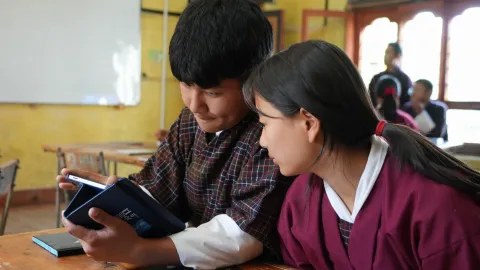
For many participants, the hackathon was their first opportunity to translate ideas into a digital product and present them in a professional setting. Through mentorship, teamwork and learning by doing, young people gained confidence and strengthened their ability to solve problems collaboratively.
For example, members of the Edu Entrance team from Jigme Namgyal Engineering College shared that they built this idea from their experience preparing for entrance exams, where study materials and guidance were difficult to access. “Even without strong technical backgrounds, we learned coding together, supported by mentors, and gained confidence through teamwork and practice.”
UNICEF Representative to Bhutan, Rushnan Murtaza, said Bhutan’s national plans are investing in digital skills, education transformation, and creating opportunities for young people in a changing economy. “That is why UNICEF invests in platforms like hackathons, innovation labs, and programmes like UPSHIFT and Tech-novation to give young people the space to learn by doing, to turn ideas into solutions and to become creators, not just users.”
Beyond competition, the hackathon emphasised collaboration, creativity, and innovation as part of the learning process. It created space for youth to take ownership of ideas and explore pathways to employment, entrepreneurship and further development of their solutions.
Building on this momentum, partners will continue to support young innovators through mentorship, networks and opportunities to refine and scale their ideas, helping connect youth-led innovation to real opportunities in education, technology and community development.
Media contacts
About UNICEF
UNICEF promotes the rights and wellbeing of every child, in everything we do. Together with our partners, we work in 190 countries and territories to translate that commitment into practical action, focusing special effort on reaching the most vulnerable and excluded children, to the benefit of all children, everywhere.
For more information about UNICEF and its work for children, visit www.unicef.org.