Digitalisation of education initiative achieves campus wide internet connectivity transforming learning for 6,000 students and 400 teachers
The MoESD, European Union and UNICEF initiative is enhancing learning through reliable internet connectivity, digital content, and teacher training.
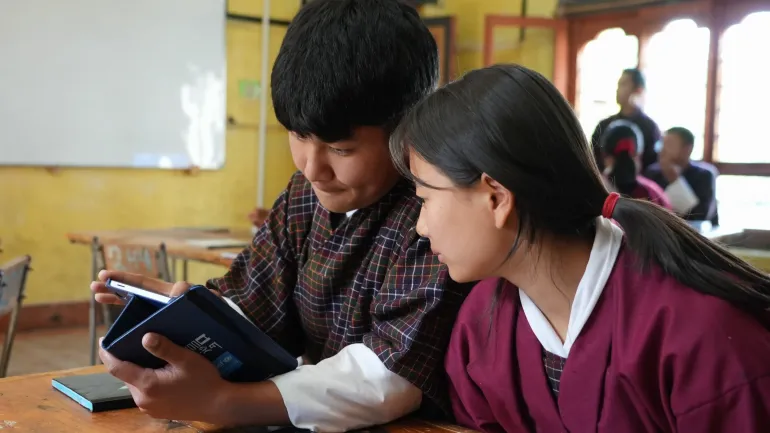
Thimphu, 20 May 2026 – Marking a significant milestone for digital transformation in education, 10 pilot schools across Bhutan have successfully deployed campus wide internet connectivity, improving learning and teaching for over 6,000 students and 400 teachers.
Funded by the EU with €1 million, the initiative is implemented by the Ministry of Education and Skills Development (MoESD) in partnership with UNICEF Bhutan to bridge the digital divide and future-proof the classroom experience.
This achievement marks a turning point and breaks barriers that once confined internet connection to ICT labs and limited access of students to creative exploration, and blended learning.
Moving forward, the initiative aims to transform classroom learning and advance skills development. By combining reliable connectivity, interactive digital content and intensive teacher training, while embedding cybersecurity awareness, the project aims to establish a safe, modern learning environment. Together, the MoESD, the EU, and UNICEF are strengthening these pillars to ensure Bhutanese youth are fully prepared to lead in a digital-first global economy.
The Digital Lopen programme developed within the initiative has resulted in training 24 EdTech ambassadors, teacher district leads and 21 teachers from all 20 districts and four municipalities on Digital Literacy Standards for Teacher. The trained teachers will further cascade the Digital Lopen training to 600 teachers across Bhutan, helping scale digital literacy and pedagogy support to the school level.
To ensure schools manage and sustain their new connectivity with local expertise, 12 ICT laboratory assistants, 22 teachers from pilot schools and eight district ICT officials from GovTech Agency have been trained in computer networking and hardware maintenance.
The initiative is also investing in the future of learning by developing digital content for Science and Mathematics . Aligned with the national curriculum, work has begun to design interactive and engaging experiences for students of Science, Technology, Engineering, and Mathematics (STEM) subjects for Grades nine and 10. These resources will support innovative teaching practices, encourage curiosity, and help children build the skills they need to thrive in a digital world.
Minister of Education and Skills Development, Yeezang De Thapa said, “Through the support of the European Union and UNICEF, we are not only improving internet access in schools but also strengthening Bhutan’s digital education ecosystem through the Education Technology Framework, which provides the national standards and direction for a safe, equitable, and effective integration of technology in teaching and learning.”
The minister said that investments in connectivity, teacher capacity building, and digital content development are helping create more engaging and future-ready learning environments for children and teachers across the country. “This initiative reflects our shared commitment to ensure that children and young people across Bhutan have access to quality learning opportunities and the digital skills needed to thrive in a digital world.”
These digitalisation initiative are implemented based on the standards of the Education Technology Framework launched in July 2025.
Ambassador of the European Union to India and Bhutan, Hervé Delphin said, “Two years ago, when we launched this initiative with the Ministry of Education and UNICEF, our vision was to connect every child in Bhutan to the digital world. Today, with campus-wide connectivity live across pilot schools, over 6,000 students and 400 teachers are experiencing a new era of learning and skilling. The EU is proud that our investment is delivering real results, and we remain committed to putting human capital at the heart of the EU-Bhutan partnership to create lasting opportunities for the youth.”
In the next phase, the initiative will expand teacher training nationwide through the Digital Lopen programme. Digital STEM content for Grades 9 and 10 will be rolled out through the National Learning Management System, giving schools a central platform to access interactive resources. Connectivity models tested in pilot schools will be scaled up, ensuring reliable internet reaches classrooms across Bhutan.
UNICEF Bhutan Representative Rushan Murtaza said UNICEF is proud to be a partner of the digitalisation initiative, the impacts of which will go beyond schools. “It is building the foundations of a digital education system that empowers teachers, and prepares students to thrive in a technology-driven world,” Rushan Murtaza said.
The three-year digitalisation programme complements existing initiatives of the Royal Government of Bhutan, towards creating an enabling environment for the digital transformation of basic, secondary and technical and vocational training education in the country. The initiative specifically:
- Strengthens systems for an enriched and high-quality digital learning experience with improved digital governance and policy environment towards inclusive quality education and skills for children.
- Enhances capacity of stakeholders, teachers, parents and students in digital skills, cybersecurity and online safety and digital content development.
- Tests and implements suitable and feasible connectivity models for digitalisation.
###
Download photos here
About the European Union (EU):
The EU, which consists of 27 countries, has the world's second-largest economy and its third-largest population, after China and India. Though, the countries that make up the EU (its 'Member States') are all committed to the same basic values: peace, democracy, the rule of law, and respect for human rights. By creating a which has been adopted by 20 Member States, the EU has given a significant boost to trade and employment.
Comprising 27 Member States, the European Union represents the world's second-largest economy and third-largest population. While richly diverse, the Union is anchored in shared foundational values: peace, democracy, the rule of law, and respect for human rights. Through the establishment of a frontier-free single market and a single currency (the euro), adopted by 21 Member States, the EU has given a significant boost to trade and employment.
EU-Bhutan relations: The European Union-Bhutan cooperation started with a development project in 1982, focusing on renewable natural resources. In 1985, diplomatic relations between the Royal Government of Bhutan and EU were established. The EU's current support for Bhutan under the 2021-2027 Multiannual Indicative Programme, focuses on three priority areas i.e. Climate Change and Green Growth, Good Governance for inclusive development; and Digital Transition in the education and public service delivery sectors. These areas have been allocated an amount of €48 million for the period 2021-2027. In addition to this, funds have been allocated to projects in support of sustainable consumption and production (€1.3 million), civil societies and their engagement with the Parliament (€3.4 million), and support to agrifood sector (€ 1.3 Million).
Media contacts
About UNICEF
UNICEF promotes the rights and wellbeing of every child, in everything we do. Together with our partners, we work in 190 countries and territories to translate that commitment into practical action, focusing special effort on reaching the most vulnerable and excluded children, to the benefit of all children, everywhere.
For more information about UNICEF and its work for children, visit www.unicef.org.