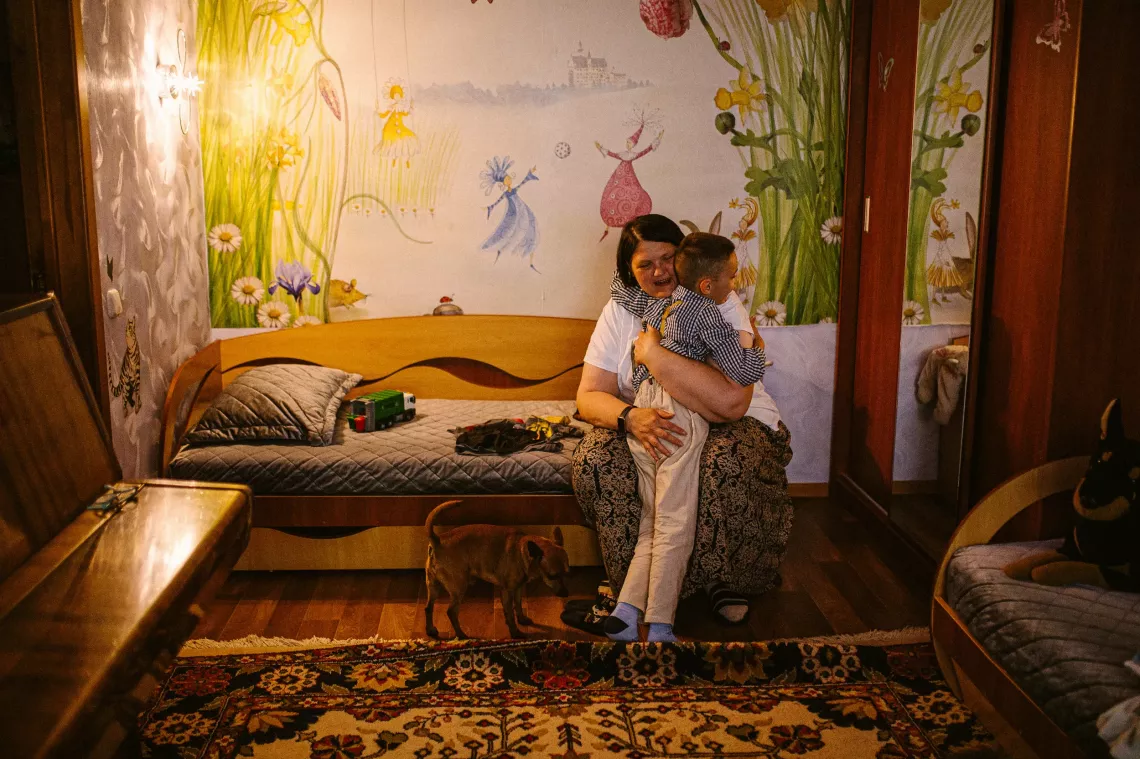
Give me a hug too, Mum!
How the Family for Every Child programme helps children to find a family

- русский
- English
"Special school, psychoneurological residential facility", these two words could have become Gleb's fate. When he was seven years old, he studied at a special school for children with special developmental needs, and after graduating from the school, his path was to a psychoneurological residential facility. But he got his mum Oksana. For six months of life in the family and intensive work Gleb's diagnosis of mental retardation was removed. And at the same time - they completely changed his fate.
"I agreed to this interview to tell the story of Gleb. To let people know that in such institutions there are children who can still be helped and brought to a normal life," says Oksana Demko, Gleb's mum.
Today, thousands of boys and girls live in care facilities in Belarus. UNICEF works with partners to ensure that every child lives in a family. For this purpose, the programme "Family for every child" has been created. The project supports the idea of deinstitutionalisation – the creation of conditions so that children live in families rather than in orphanages.
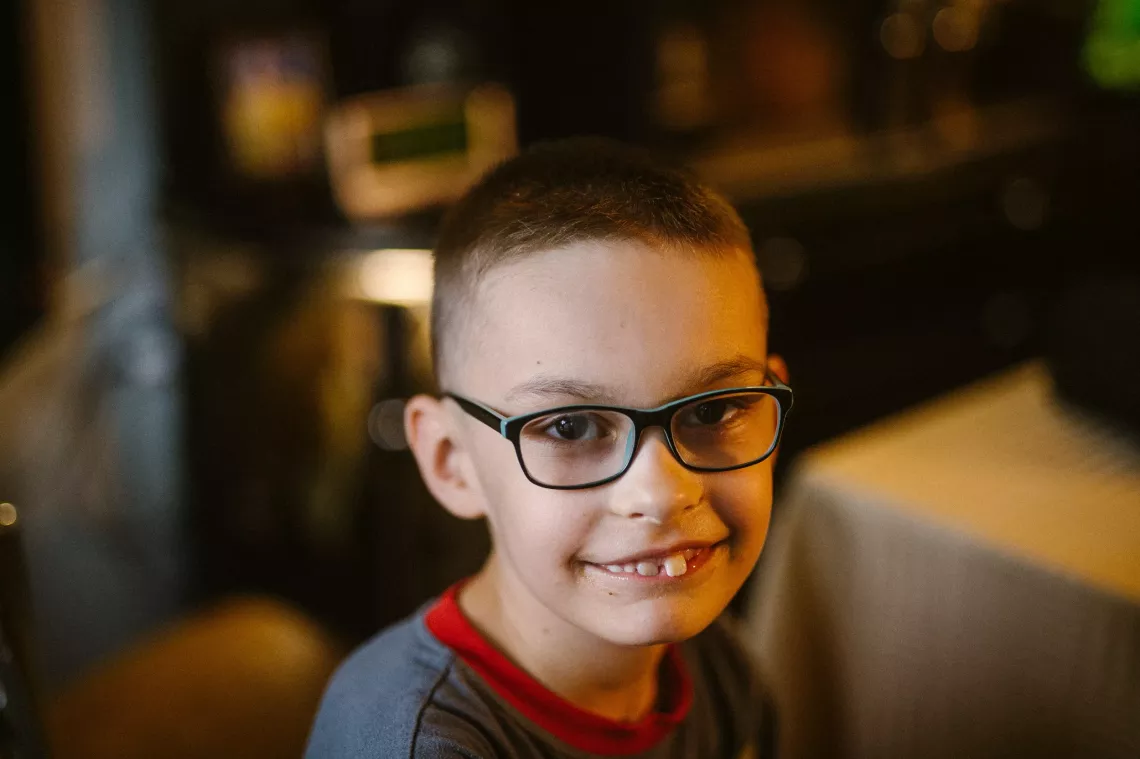
"He was cross-eyed, with glasses. He was mine", Oksana finds out about Gleb and his diagnosis.
"Mom, can I sit with you?"
"Sure! Sit wherever you want!"
"You sit here, mum, and I'll sit there. OK, mum?"
Gleb says "mom" as often as possible. It's as if he can't get enough of the word or believe that it is for him. That now, at the age of seven, he finally has the right to say "mum". Because there is a mum.
And mum Oksana is in her usual bustle: she sets the table, answers the children's questions, makes sure that the children wash their hands and don't touch the cat, and tells the story of her and Gleb.
"The first time I saw Gleb in the database was when I just decided to adopt a child. At that time, Gleb was in the Vitebsk Child Care Home. He was cross-eyed, with glasses. And he captured my heart. While I was collecting documents and preparing, he disappeared from this database. So I started looking for him. I found him in Begoml (Begoml Special Boarding School - editorial note). He was mine."
But Gleb was diagnosed with mental retardation. And Oksana had four more adopted children. And although the heart made a choice, the mind was in no hurry to agree.
"There was no such thing: that's it, I'll take him, and come what may. I can take him, but then what? It's a serious step."
The programme ‘’Family for Every Child‘’ started in the Gomel Region four years ago, and in 2022 started working in the Vitebsk Region, where Gleb and his mother Oksana live. The programme pays special attention to children with disabilities and young children.

"Whether I can handle it or not": Oksana doubts whether to get closer to Gleb or not
"This is my room! This is my bed, and this is Kirill's bed. And in this wardrobe Kirill and I sometimes get in and hide from mum! She thought we'd run away into the street! "Come on, children, come home!" she said. And we jumped out and said, "Hi!" And she said, "Where have you been?", Gleb excitedly tells about his adventures with his brother Kirill.
"Gleb follows Kirill, repeats everything after him. And Kirill is a good role model. It's a great luck that it turned out this way: two boys, the same age. The girls are also very helpful, they take care of Gleb," mom Oksana comments.
Oksana was 18 when she decided that she would adopt a child. At the age of 31, she went to the maternity hospital for the newborn Vasilisa. By the age of 52, she already had four adopted children: Vasilisa (now 20), Masha (17), Varya (12), Kirill (8). All this time Oksana worked full-time as an economist. Her mum helped her to raise her children, but three years ago she died.
"If I met my man and got married, I would probably have not only adopted, but also blood children. But I always knew that I would adopt a child. I just didn't think there would be so many children. But there came a moment when my mother and I realised: we have the energy for one more."
So in general, adoption was not a novelty for Oksana. But everything about adopting Gleb was new. His diseases and his age were disconcerting, as previously all the children in the family came healthy and from the cradle. It was unclear whether the children would accept Gleb. And how the whole story would affect them in general. And whether Oksana would cope with such a load.
"I had to understand whether I can handle it or not."
But after the first meeting there was hope.
"He came out like this: in flip-flops and without glasses. He was very ashamed to wear glasses. But it was obvious that he was interested in everything. And when it's interesting, you can teach it."
Soon Gleb came to visit them at their home for a week to get acquainted.
The specialists told Oksana in detail what difficulties awaited her if she decided to adopt Gleb. No one described rosy prospects But she could count on support. Usually departments supervise only their own area of issues: health care, education, social protection. But often the issues arise at the intersection of different areas. And this makes it difficult to get help.
The programme ‘’Family for Every Child‘’ aims to ensure that families receive assistance in a comprehensive and prompt manner. The project team consists of more than 20 specialists from the education, health care and social protection systems. It includes doctors, psychologists, social pedagogues and other experts. They are gathered in an interdepartmental group and work together.

"That's it, he's ours": Gleb moves in with his new family
"Look how the hoover does it," Gleb plugs the robot hoover into the socket, presses the button and waits mesmerised.
"Gleb, let's not do this right now, " mom asks.
"Can I open the microwave!?" Gleb has heard a distinctive squeak from the kitchen and is already rushing there to show us the microwave skills.
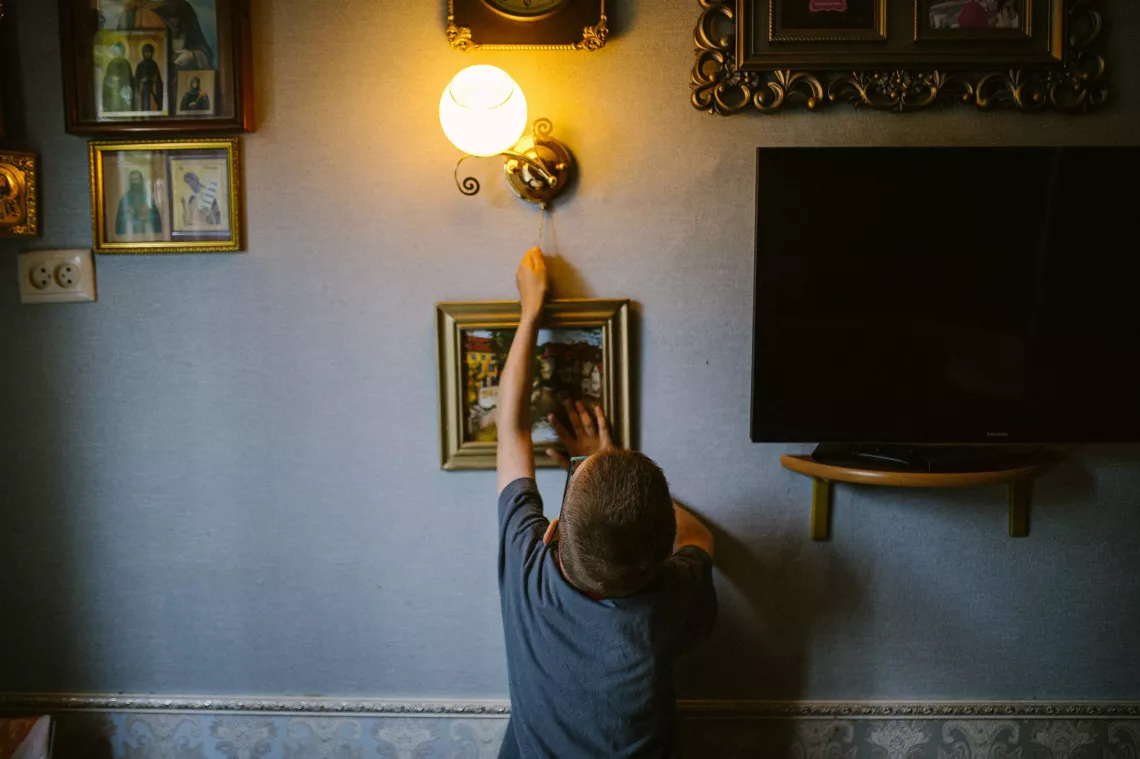
For the last six months, Gleb's life has been full of discoveries and challenges. Watching how the light turns on and water boils, hoovering the flat, using the lift, memorising car brands, poems and letters, trying different foods, watching different cartoons.
"He absorbs everything and it's like he's going through all the stages he hasn't gone through. There was bedtime rocking There was a period of "I'll do it myself, I'm the first" if someone else opened the door first, such a tantrum would start! I even went to a psychologist, and she helped me to resolve it."
Oksana constantly reads articles about psychology for children, children with special developmental needs, and watches videos on these topics. She also knows that at any moment she can turn to a psychologist or other specialists for help. They are present in the family's life as an invisible background, and this gives a sense of support and stability.
And stability is needed now. Gleb still has a lot of work to do to adapt to his new life.
"The hospital was quarantined, and Gleb was there alone for several days. He ate a lot of sweets, which we gave him: difficulties with self-control. He took a boy's power-bank without asking and broke it: his understanding of the own-others concept is not fully formed. But it is minor. He will learn everything, he just needs time," mum is sure in her son.
By feelings they became mother and son by the end of that first week of acquaintance. Oksana then felt, "I can do it." The defectologist confirmed, "You can do it." And Gleb said, "Mom." But Oksana was still worried about what her other children would say.
"He came in: that's it, he's ours," Masha, one of Gleb's elder sisters, shrugs her shoulders.
Soon Gleb moved in with them, and Oksana took custody of him. The experts recommended taking this step first. So the child lives in a family, but taking care of him is a job for the parents. At the first stage the specialists support the child and see what is going on in the family, whether the parents are coping.
Each family that is supervised by the project ‘’Family for Every Child‘’ has a case manager. This person is in touch with the family, identifies its needs, and then specialists provide the necessary support. Trusting relations between families and specialists is one of the main tasks of the project, and special attention is paid to it. Parents should call immediately if they have a question or need help. Parents and carers of children with disabilities receive training on caring for such boys and girls, building the necessary knowledge and skills.
‘"We've been re-diagnosed‘’: Gleb gets rid of his main problems and becomes a normal child
"Gleb, what will you be when you grow up?"
"I told you already! A minibus driver!"
"And what kind of car will you have?"
"I will have a Volkswagen Passat."
"Why?"
"It's a cool car. It's very powerful and fast."
While Gleb is making plans for the future, mum is solving problems in the present. For the last six months she's been working on the boy's health step by step.
First of all, the battle with mental retardation was taken up. Gleb every day studied with a defectologist in kindergarten, at additional classes, at home. He began to take medication, underwent a course of massage. Constant communication in their large family also had its effect. The second task was to deal with his eyesight. He wore glasses without taking them off, we glued occluders (a special patch to treat strabismus - editor's note), and had an operation.
"Recently the diagnosis of mental retardation has been removed. There is no more strabismus, both eyes see perfectly," mom reports the results.
But the main result for Gleb is that he has a family. Recently Oksana was allowed to adopt Gleb.
The specialists of the programme ‘’Family for Every Child‘’ are regularly trained to better see which forms of child placement suit the family better, to work more coherently, to determine more effectively what kind of help the family needs.
"There are still children who can be helped": there are many children like Gleb
"Gleb, where did you live before?"
"In Begoml. And in an orphanage."
"And how did you like it there?"
The always smiling boy suddenly answers in an adult voice,
" ...I feel much better with my family."
Mum Oksana enters the room a second later. Gleb brightens up again, climbs into her lap, and we continue the conversation.
"We still have a lot of issues. With coordination, with spatial thinking, we need to do physical therapy, continue to work with the intellectual abilities, with the eyes, with the teeth. We will solve everything gradually. In the meantime, the effect for six months is very good," mom rejoices, hugging Gleb to herself.
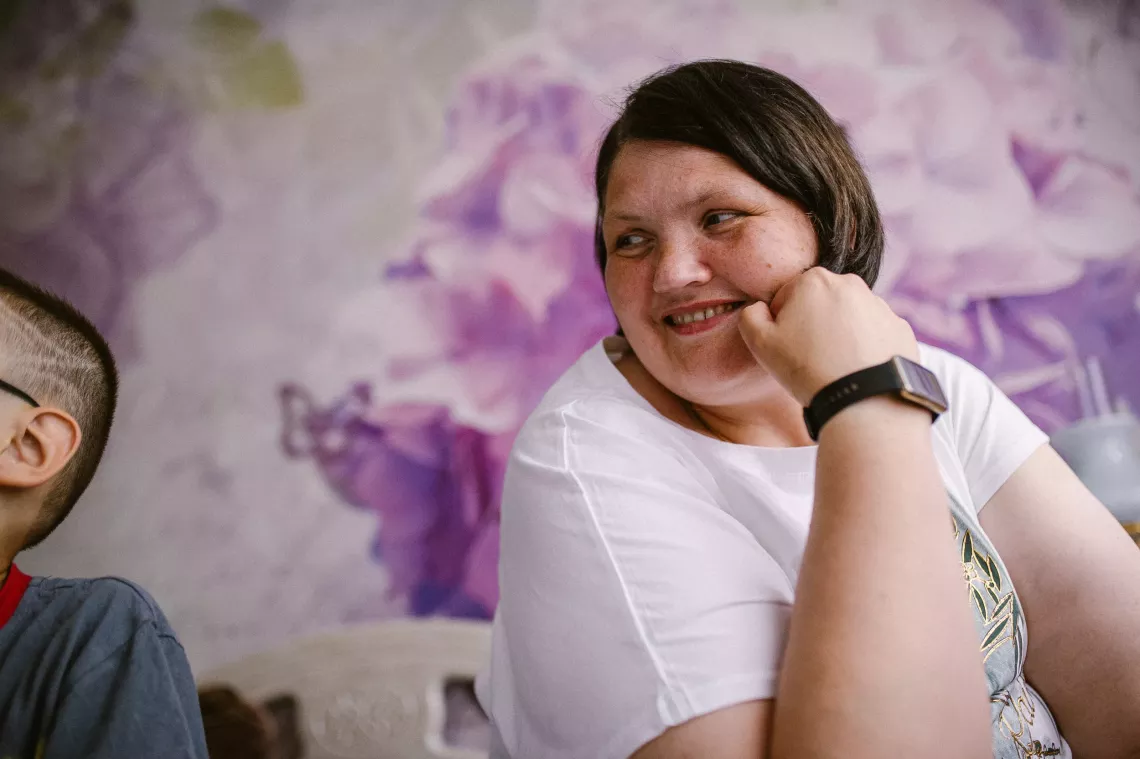
Slowly, the whole family gathers into the room. The boys take turns climbing into their mother's arms, the girls just sit next to each other, two dogs and a cat scurry back and forth.
"People don't understand: it's not the children who are lucky, it's me who is lucky. God entrusted them to me to bring them up. They are my family, I love them, and they love me!"
And she adds later,
"I agreed to this interview to tell the story of Gleb. So that people know that there are still children in such institutions who can be helped, taken away from there and brought to a normal life. What kind of future awaited Gleb? Only six months of work - and what wonderful results! And we are all so happy that he is with us."
Gleb suddenly stands up and wraps his arms around her neck, hugging her tightly.
"Give me a hug too, Mum!"
Every day of childhood spent without warm embraces, caring hands and loving eyes of mum and dad creates a delay in the development of a child for one month. In Vitebsk Region there are more than 2,200 orphans in residential institutions, including children with disabilities. The programme "Family for Every Child" helps these children. You can support the work of this project by making a donation on the website. And also by sending an SMS with any text to the number 2244 for MTS subscribers and to the number 888 for A1 subscribers.