Amid the Mud of Chaos, Life-saving Supplies Reach the Doorstep
As Runa’s life was upended by floods, UNICEF mobilized emergency supplies that protected her children’s health and dignity, while strengthening water services to withstand future climate shocks.

- বাংলা
- English
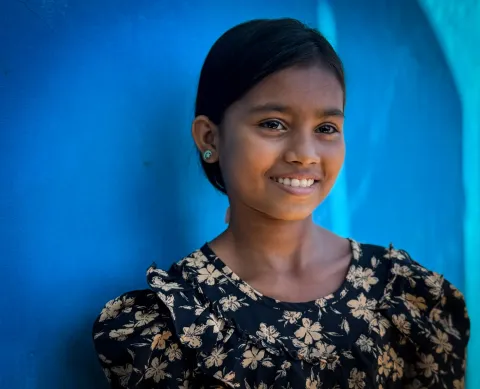
FENI, Bangladesh– Israt reaches for her mother Runa’s hand passing down the UNICEF blue pitcher filled with fresh drinking water. At five years old, Israt is a little taller than the raised platform of the tubewell near her house. With the support of UNICEF, the tubewell was constructed at a one-meter height to prevent submersion during floods and water contamination.

Last August, when the worst floods in three decades lashed through eastern Bangladesh, with Feni district at the epicenter, Runa’s village was not ready.
“Even my grandparents didn’t experience such floods,” shares Runa as she remembers how the water came up to her chin. “My in-laws cried because they could see everything ruined by the floodwaters before their eyes.”

‘I thought I wouldn´t survive’
For Runa and her community, a flood of such intensity, such devastation, was unlike anything they had ever experienced. Runa remembers it all – the fear, the hunger, the soggy chaos. The rain fell relentlessly for days, turning fields of tended crops into wastelands. Families huddled in overcrowded shelters, packed so tightly that there was barely room to lie down. Her father-in-law, a cancer patient, became sicker and passed away three months after the floods.
“There was nothing to eat. Forget about the animals, we human beings were trying to get food,” says Runa. “I thought I wouldn´t survive with my two children and that I would never return [from the shelter].”
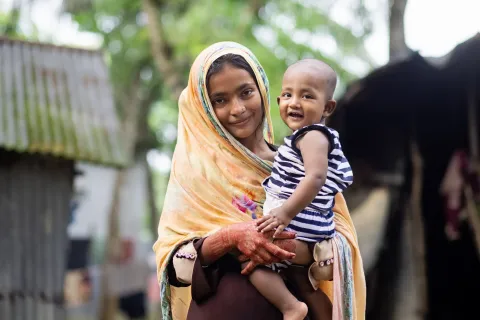
In her early 20s, Runa is the mother of two girls: Israt and Nusrat. Israt is quiet and watchful, sometimes adopting an adult-like wrinkle between her brows that will quickly melt away when she feels comfortable.

Her younger sister, one-year-old Nusrat, is still too small to follow Runa and Israt to fetch water. So she stays at home, nestled in the loving arms of her grandmother, and charming others in the village with her round cheeks and bright, pearl-like eyes.

When the floodwaters came, both girls fell ill - coughs, colds, rashes on their skin. Their village, like so many others, was overwhelmed. Water tore through homes, schools, and entire communities, disrupting the lives of more than two million children across the region.
In Runa’s village, both of the community’s tubewells - shared by 200 people - were destroyed, as was her family’s latrine. These shallow tubewells were already vulnerable to contamination from nearby pit latrines and arsenic in the soil. The flood made things worse, submerging the wells and turning already unsafe water into a serious health hazard.
In these conditions, diarrhoea, cholera, and skin diseases found the perfect environment to thrive.
The first line of defense
UNICEF staff were on the ground since day one to support the government to assess the situation and deliver urgent support. Water purification tablets, jerry-cans, and WASH (water, sanitation and hygiene) kits filled with other essential items were distributed to families in need. The WASH kit - designed for a family of five - is a vital, lifesaving part of UNICEF’s emergency response, helping to meet the basic needs of children and their families during crises like this.


“[In the kit] there were two pairs of sandals, diapers, soap, jug, mug, potty, nail cutter, towel and some clothes. All the items were really, really helpful,” remembers Runa.
Her house was filled with mud and sand, so she would use the sandals to walk around, the soap and laundry detergent for washing hands and clothes, the diapers for Nusrat, and the potty for Israt.


“With pre-positioned life-saving supplies at strategic Government-owned locations throughout the country, UNICEF was able to deliver WASH emergency kits within 72 hours since the disaster onset to support the Government to help children survive and ensure the dignity of the most vulnerable, especially women and girls,” emphasizes Saleha Khatun, WASH Officer.

Resilience after relief
As the floodwaters receded, UNICEF, in partnership with the Department of Public Health Engineering, began the critical task of recovery. In hard-hit areas like Feni, Noakhali, Cumilla, Lakshmipur, and Khagrachagri, efforts focused on disinfecting water points, repairing and elevating damaged latrines, restoring piped water networks, and constructing new tubewells with elevated platforms to guard against future flooding.
“The newly installed [tubewell] brings more quality water. It is closer to me, so I prefer to go to that one. It is a good decision to build it at a higher level so that it won’t get flooded by floodwater,” shares Runa.
Unlike older shallow wells, the new tubewell near Runa’s home was drilled deeper to tap into safer, uncontaminated water. She now uses it daily for cooking and drinking without fear of water pollution. With partners, UNICEF has applied the same approach to constructing other climate-resilient tubewells in the flood-affected area, planned to ensure long-term access to safe water for vulnerable families.
“Our response isn’t just about immediate recovery. It’s about helping communities become more resilient to future disasters,” adds Khatun.
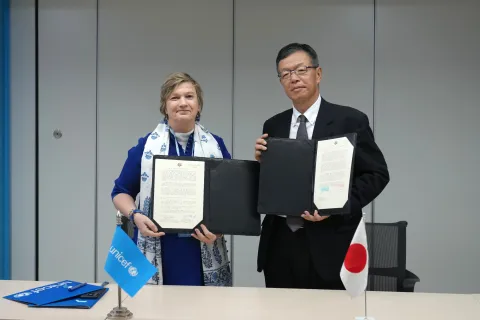
UNICEF wishes to express sincere gratitude to the Central Emergency Response Fund, the Government of Japan, and donors to the Global Humanitarian Thematic Fund of UNICEF for their continued support and immense contribution to the emergency response operations in Bangladesh.