While flood waters subside in western Afghanistan, the devastating impact lingers
Flash floods claimed hundreds of lives and destroyed thousands of homes, and UNICEF is concerned that such extreme weather events could become the norm.

Nine-year-old Farzan is wearing his cousin’s clothes. He lost all his belongings when floods swept his home away in Chaghcharan district, part of Afghanistan’s western Ghor province.
“We live at my uncle’s house now, with my parents, four brothers and two sisters.”
It has been nine days since the floods devastated his village. Farzan is scared it might rain again.
“Everyone was running around shouting and there was so much water everywhere,” he recalls.
Over 400 homes were destroyed in Ghor province alone, leaving Farzan and hundreds of other children with no home, no clothes.
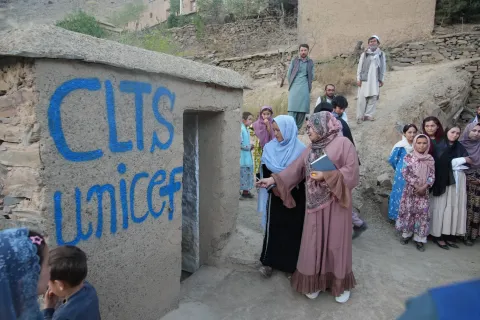
Since the flood, Farzan attends a new a child-friendly space in his village, established by UNICEF with support from the Government of Spain and USAID’s Bureau for Humanitarian Assistance (BHA). Activities and trained facilitators help children like Farzan cope with the stress, loss of home and property, and for some, the loss of loved ones. Counselors at the child-friendly space speak with children and mothers about their fears and concerns for the future in group and individual sessions.

There is also time for fun and games at the child-friendly space. Farzan enjoys playing volleyball with his friends, welcoming the opportunity to take his mind off the uncertainty of the next few weeks and months.
UNICEF also provided blankets, children’s clothes and hygiene supplies to families affected by the floods, including buckets, jerry cans, soap and water purification tablets. A mobile health and nutrition team, supported by the Asian Development Bank, remains on site to vaccinate children, screen and treat for malnutrition, and provide regular check-ups for pregnant women and children.

In 13-year-old Mustapha’s village, 25 water wells were damaged by the floods.
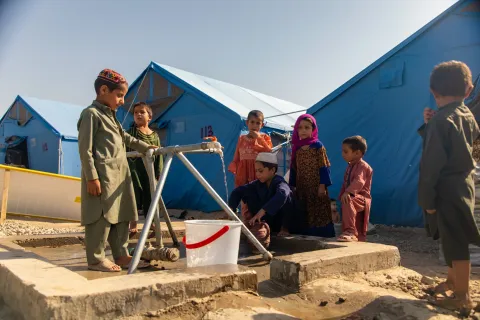
With support from the Swedish International Development Cooperation Agency (SIDA), UNICEF is trucking safe water to over 30,000 people across affected villages in Ghor province. In addition to providing 15 litres of safe water per person per day, the water truck fills up a 5,000-litre water bladder, giving children and families an uninterrupted supply.
While some affected families are now staying with relatives, some are not as lucky. Many families now live in tents after their family compound was washed away.
As families look ahead with uncertainty, UNICEF provides cash assistance, offering flexibility and dignity for families to meet their urgent, basic needs.

Unfortunately, floods are only increasing in frequency in Afghanistan. The country is the seventh most climate-vulnerable country in the world, and ranks 15th of 163 nations on UNICEF's Children's Climate Risk Index. This means that not only are climate and environmental shocks and stresses predominant across the country, but children here are particularly vulnerable to their effects compared with elsewhere in the world. However, although children in Afghanistan are particularly vulnerable to the effects of climate change, their country is among the least responsible for creating the problem. In contrast, the 10 highest emitting countries of CO2 collectively account for nearly 70 per cent of global emissions.
UNICEF is calling on the international community to redouble efforts and investments to support communities to alleviate and adapt to the impact of climate change on children, urges all humanitarian actors to prepare for more rapid and large-scale humanitarian responses, while concentrating on building communities’ resilience to adapt to climate shocks.