“Where do we go?”
Carrying all they own, families returning from Iran to Afghanistan face an uncertain future

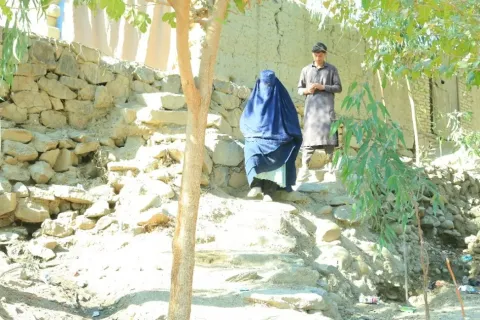
“Where do we go?” was the most common phrase I heard when I visited the Islam-Qala border near Herat in the West of Afghanistan. This is where around 20,000 people are arriving from Iran, every day, forced to return to their country of origin, Afghanistan, a place that is now foreign to them. Carrying everything they own, they arrive at the dusty, hot, and windy border, tired, disorientated, and anxious, with no destination and little idea of where to go.

In recent months the numbers of families, women and children, returning through the border has grown significantly, with over 250,000 people arriving in June alone, and at least a quarter are children including approximately 5,000 children who are unaccompanied or separated from their families.
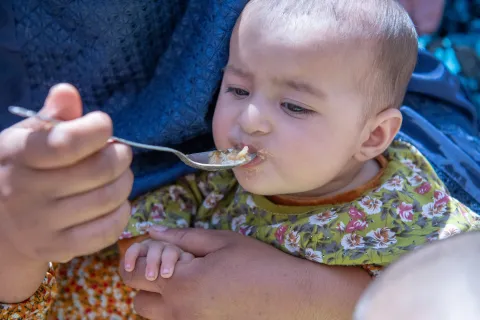
Afghanistan returnees from Pakistan and Iran have been increasing annually, but this year, in June, a huge spike in the numbers of people from Iran have put unprecedented pressure on the reception center at the border and the communities they return to. UNICEF is part of an inter-agency border consortium to support families, where we provide women and children with immunization and nutrition services, water and sanitation provisions, child friendly spaces for play and some respite, and safe places for unaccompanied and separated children.
Yet the needs are growing daily, and we urgently need to ramp up our response at the reception center in Islam Qala. An inter-agency consortium between OCHA, IOM, UNHCR, WFP, WHO, and UNICEF are coordinating with local stakeholders and partners to ensure the immediate needs of returnees are met. But much more is needed.

With the increase in the number of returns, UNICEF is scaling up our response, increasing essential access to safe drinking water (drilling an additional borehole, while in the meantime providing clean water through water trucking), expanding the health and nutrition services as well as expanding child friendly spaces and the screening for family tracing and reunification capacity.

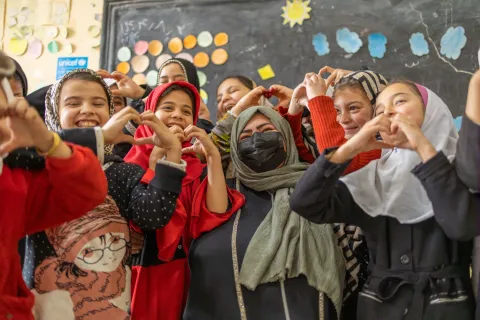
With Sanjay Wijesekera, UNICEF Regional Director for South Asia, I saw firsthand the immediate needs there, meeting women and children who all have questions, concerns, and demands for where to go, and what will happen to them. In a UNICEF Child-Friendly Space we met with bright and educated young children, with girl’s hopeful to continue going to school, only a few aware of the current situation facing girl’s education in Afghanistan. It is hard to imagine the changes that they face, to their education, to their lives, so different from how they lived in Iran.
To respond to the urgent needs of returnees from both Iran and Pakistan, humanitarian partners and UNICEF are appealing for $64.4 million to scale up the response across key sectors such as protection, food assistance, health, WASH, shelter, non-food items, and support to livelihoods.
Their journey only just begins at the border as they make their way back to uncertain locations and uncertain futures in a country which is already struggling to meet the humanitarian needs of people in Afghanistan. UNICEF will do everything we can to support them in their journey and as they begin to rebuild their lives in Afghanistan. But we call on the international community to support us, to support them, to support every child.