Short but perilous: Children’s smuggling journey across Afghanistan’s border
Hiding under moving trucks, children risk their lives smuggling goods – and themselves – across the Torkham border between Afghanistan and Pakistan
NANGARHAR, AFGHANISTAN – At Afghanistan’s eastern border with Torkham, Pakistan, a small town bustles with trade, business and people looking for opportunity. Colorful cargo trucks, decorated with floral and geometric patterns in blue, green and gold sit parked at the border crossing before slowly rumbling from one country to the next. The trucks carry a variety of goods, and sometimes, some unexpected stowaways.

Every day, dozens of children – some as young as 8 or 9 years old – risk their lives smuggling sacks of goods across the border, hiding under the trucks to avoid detection by the authorities. They carry cigarettes, handmade goods, and fruits, aiming to sell them in Afghanistan and help support their families.
These sacks of goods, known in Afghanistan as gandey, are usually just pieces of plastic or tarpaulin, fashioned into a backpack with ropes as shoulder straps. Many of the gandey are the same size as the children themselves, heavy and cumbersome.

Salman, 11, recalls the misery of his past as he displays a photo of his younger brother on his uncle’s phone.
“This is Haidar,” he says. “He was 9 years old. He carried gandey under moving trucks.”
“I remember one day when Haidar waved goodbye to me cheerfully, saying ‘bye bye’ as he hid under a truck with his gandey.”
Five minutes later, Haidar fell under a moving vehicle and was crushed by the wheels.
“I do not want to cross the border again,” says Salman. “I do not want to follow in my brother’s footsteps.”
Unable to speak further about his brother’s death, he went inside his tent and cried.

There are thousands of children like Haidar who endanger their lives like this to try and help their families. Smuggling these goods earns $2.00 - $4.00 for each gandey.
“According to a survey we conducted in March last year, more than 2,500 children are engaging in this hazardous child labour at the Torkham border,” says Aziz Noor, UNICEF Child Protection Officer in Nangarhar Province.

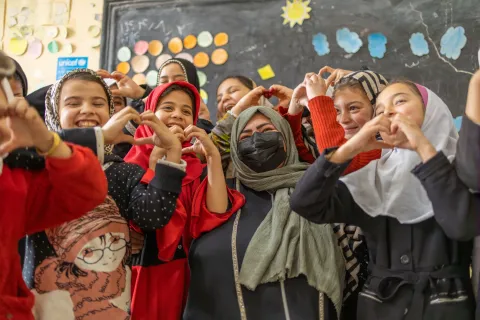
With funding support from the European Union, UNICEF established a child-friendly space at the Torkham border, a safe place where children come to learn and play. The space was designed as a deterrent from smuggling, offering activities like Pashto lessons, singing, and sports like cricket and jumping rope.
UNICEF also supports social workers, who help determine the best interests of the child and link them to the services they need the most, such as mental health and psychosocial support.

Although he still struggles with the tragic loss of his brother, Salman stopped making perilous trips across the border and spends his days playing cricket at the child-friendly space instead.
“I love cricket,” says Salman, swinging his bat. “I play it with my friends who also come here.”

Children like Shaheda have experienced more danger and fear than most 9-year-olds should. At her age, she should spend her days playing and learning, unconcerned with earning an income.
Each day she crosses the border, she loses a day in the classroom, important social interactions with her friends, and she is at risk of violence or abuse.

“Our social workers at the child-friendly space encourage children not to attempt risky journeys across the border again. It’s a space where Shaheda and her friends can enjoy the simple joys of childhood.”
“UNICEF also works closely with community elders and parents to bring children off the streets and into the closest education centres," continues Saghar.

“We had no other option. We had nothing to eat.”
Sadia used to smuggle gandey across the border, but she stopped when her father Zargol was employed by UNICEF's implementing partner, HARO, as a caretaker of the child-friendly space.
“When I got this job, I stopped sending Sadia on such risky journeys,” he says.
Recognizing the dangers of smuggling and appreciating the joy and safety of the child-friendly space, Zargol now advocates with other parents in his village not to encourage their children into labour. He spreads the word about how Sadia is thriving at the centre and uses his salary to buy food and stationery for her.
In addition to this child-friendly space at the Torkham border, with funding from the European Union, UNICEF supports other border centres around Afghanistan. These centres help thousands of children reunite with their families, speak to counsellors and social workers, and re-enroll in school or find opportunities for vocational training.