Clean water and school supplies
How UNICEF and The World Bank are helping children in Afghanistan stay in school

In Afghanistan, children continue to face numerous barriers to education. While education bans and economic hardships are often highlighted, equally critical is the lack of safe water and sanitation facilities in schools. One-third of schools in Afghanistan lack safe drinking water, half have inadequate sanitation, and more than 60 per cent do not provide separate toilets for girls. These are factors that significantly contribute to absenteeism and school dropout rates, particularly among girls.
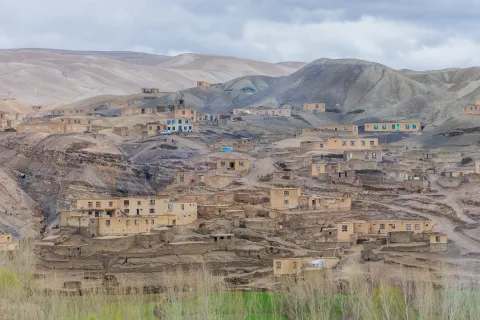
In Pul-e-Alam district of Logar province, eastern Afghanistan, these challenges are starkly visible. Saeed Rehman, a teacher at the Malik Sheer Ahmed school, recalls how children were often absent from classes because the school didn’t have toilets, “When I joined this school, children either had to go to agricultural lands nearby to relieve themselves or they were away helping families with fetching water from the streams for their toilets at home. Many often suffered from diarrhoea and other water-borne diseases,” he says.
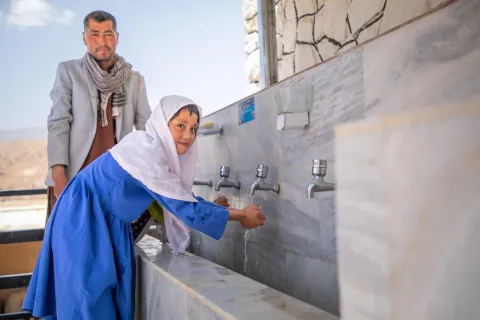
In response, UNICEF and The World Bank are helping to address these gaps by improving access to water, sanitation, and hygiene (WASH) in schools. Nine schools in Logar have already benefited from new facilities, including wells providing safe drinking water, modern latrines, dedicated menstrual hygiene management rooms, handwashing stations with soap, and garbage collection points. These improvements directly impact more than 2,300 children - nearly 70 per cent of them girls - and 47 teachers; encouraging them to keep coming to the school and even attracting more to enrol.
Six-year-old Malika, at Malik Sheer Ahmed school, shares her newfound comfort: “I feel safe using the toilets inside the school. They are clean and nice. We have one at home too, but it is simple and not like the one at school. I like that we also have a place to wash our hands with soap inside the toilet. Sometimes it is extremely hot outside, so we come indoors here to wash our hands.”
For first-grader Sola, the impact reaches beyond the classroom:

“I told my father about the soap at school, so he brought soap for us at home as well. Now I can wash my hands at school and at home. I like handwashing. It makes my hands clean.”
A simple chain of healthy behaviours, learned at school and now protecting Sola, her siblings and family at home from preventable water-borne diseases. The World Bank partnership is bringing more than just improved water and sanitation facilities to schools. With their generous support, UNICEF is also providing children with school bags, notebooks and learning materials for the first time in Logar province. Teachers are also receiving teaching tools and teaching aids.

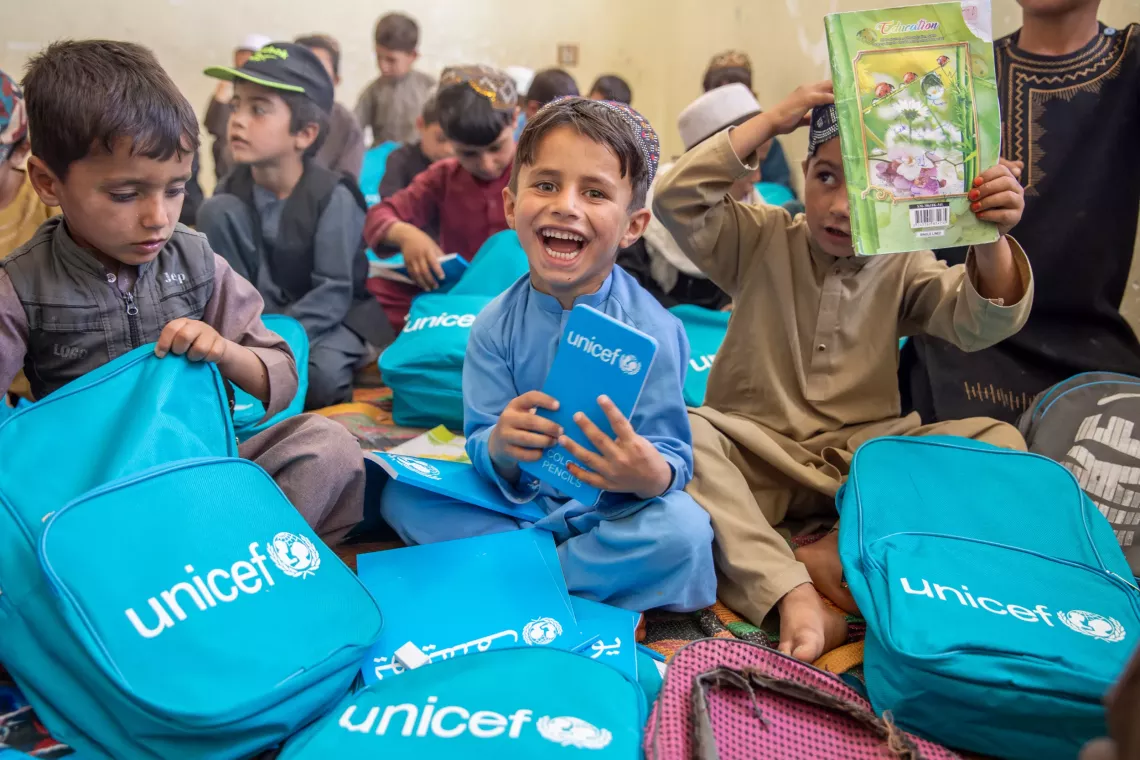
Six-year-old Sana, at Hajiano Keli School in Pul-e-Alam, expressed excitement at receiving her very first school bag: “I have never had a school bag before. This is the first time I have one, and I like it. It has notebooks that I can write in, and colourful pencils. I am excited to show it to my mother.”
Teachers also benefit from training and new teaching aids. Ahmadullah, a 32-year-old teacher, highlights the transformation saying “with no teaching materials and visual aids, we would make shapes in the air with our fingers, encouraging children to imagine letters and shapes. Now, with the materials we received, there is a stark improvement in learning and class participation. Children can see and remember what they are taught.”

Ahmadullah further reflects, “Until now, some children would come to school holding a loose notebook with torn pages, others with broken pencils or nothing at all. Despite little to no resources, we continue, as it is important for them to be here and learn. Now, not only do they have school bags and necessary learning materials, but the teaching materials also make our classrooms and learning more interesting too. These school bags alone have brought great excitement to children at our school.”
With additional funding from the World Bank under the Education Emergency Response for Afghanistan, UNICEF is reaching 15,000 schools across all 34 provinces with essential teaching and learning materials. As teachers receive training on how to use these tools effectively, 1.5 million children are receiving school bags, notebooks, and stationery to support their education – many for the first time.
Thanks to the World Bank’s generous support, UNICEF’s holistic approach ensures children in primary education across Afghanistan can learn, grow, and thrive in safe, dignified conditions.