Cash for the early moments
Supporting families in Afghanistan to improve diets and health care in the first 1,000 days of their child’s life

"Some days we can’t find even a single potato to eat." – Barato, mother of six
“Some days we can’t find even a single potato to eat,” says Barato, a mother of six children. Her youngest is just eight months old.
She lives in the ultra-remote Daychopan district, part of southern Zabul province in Afghanistan. Her village is a six-hour drive from the provincial centre on a dirt road through other isolated communities.
Barato was born here and has never stepped a foot outside of Daychopan district. The farthest she has been is the hospital in a nearby village, where two of her children were born. The other four were born at home.
“It’s expensive for us to go to the hospital but when my children get sick; we try to find a way,” explains Barato.
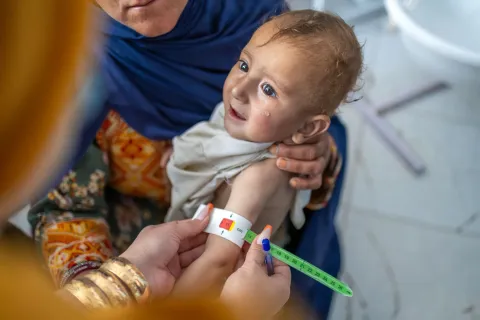
Three of her children have suffered from malnutrition in the past year. It’s not surprising given their situation.


Dry prospects for children and mothers
Across Afghanistan, most children do not eat the variety or quantity of foods they need to grow healthy. Mothers are also malnourished, leading to a harmful cycle of malnutrition. The stunting rate in Zabul province is at a staggering 61 per cent according to the 2022-23 Afghanistan Multiple Indicator Cluster Survey. This is far above the equally concerning national average of 45 per cent. Coverage of antenatal and vaccination services are also low in Zabul, at 12.5 and 3.6 per cent respectively.
The first 1,000 days of life, between a woman’s pregnancy and her child’s second birthday, set the tone for a child’s growth and development well into adulthood. These early days determine whether the child will survive, their ability to grow, learn and prosper in future. Children therefore need the right food, stimulation and care during this critical window.
But in Barato’s village, the crop fields are visibly dry. Drought has not spared this southern province. Her husband explains that they used to harvest tonnes of wheat but now they can only get a few kilogrammes. Food prices on the local market are prohibitively high, matching the high cost of transporting goods into this remote district.

A cushion in the early moments
A mother’s nutrition is closely linked to their child’s nutrition. During pregnancy, the quality and quantity of her meals affect the unborn child’s development. After delivery, a nutritious diet enables the mother to produce breastmilk, a critical source of nutrients for babies.
With support from the Asian Development Bank and other partners, UNICEF is delivering cash assistance to 66,000 households where women are within this 1,000-day window: Those with children under 2 years, and those with pregnant or breastfeeding women.
Families like Barato’s receive US$ 20.00 cash per month, paid out in a US$ 60.00 lump sum every quarter.
The 66,000 eligible families are from Zabul, Kunar, Samangan and Badghis provinces, where the global acute malnutrition rate – a combination of moderate and severe acute malnutrition – is more than 10 per cent, according to surveillance data. For 18 months, these families will receive cash assistance to buy food and other basic needs including paying for hospital visits.

Across Afghanistan, women’s movement and activities are restricted. When in public gatherings, men and women are required to be in separate spaces. The cash distribution schedule in Daychopan district has different slots for women in the morning and for men in the afternoon.
Barato was occupied with household chores in the morning, so she goes to the distribution site in the afternoon. The officers make arrangements for her and two other women to receive their cash away from the main booths where the men have queued up for their afternoon slot.
"I will buy potatoes, beans and fruits for my family. And if I eat enough, I will be able to breastfeed my baby Asif," says Barato.