UK provides £8 million to tackle rising child malnutrition in Afghanistan
Funding will support UNICEF, FAO and WFP to scale life-saving nutrition services and strengthen access to nutritious foods for young children.

Dari Version: here
Pashto Version: here
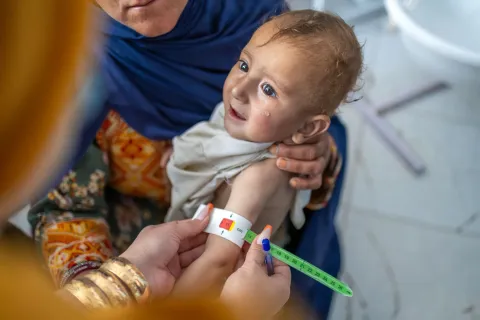
KABUL, Afghanistan, 21 January 2026 – With child malnutrition on the rise in Afghanistan, the United Kingdom has provided £8 million to United Nations Children’s Fund (UNICEF), the Food and Agriculture organization of the United Nations (FAO) and the World Food Programme (WFP) to prevent and treat malnutrition among the country’s most vulnerable children and mothers.
The welcome support comes as the latest Integrated Food Security Phase Classification (IPC) report reveals nearly 3.7 million children under five are projected to suffer from acute malnutrition in 2026. These include 942,000 children with severe acute malnutrition and 700,000 at high risk of moderate acute malnutrition. In addition, around 1.2 million pregnant and breastfeeding women are expected to face acute malnutrition during the same period.
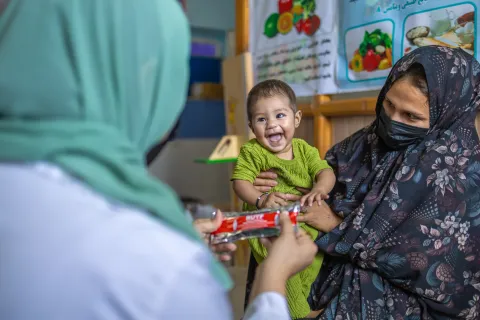
The UK’s contribution will support the First Foods Initiative Afghanistan implemented by UNICEF, FAO and WFP, and aims to reduce child food poverty and malnutrition by improving access to diverse, safe, and affordable first foods for children aged 6–23 months.
The initiative will support young children together with pregnant and breastfeeding women, through a multisectoral approach across food, health, WASH, social protection, and skills development. The initiative is expected to directly benefit more than 150,000 children under two and reach over 640,000 of caregivers and other community members.
UNICEF will support the affordability of nutritious food, strengthen community-based counselling on best feeding practices, and promote a locally developed complementary feeding recipe book. UNICEF will also empower youth through skills development programmes contributing to innovative local solutions supporting first foods and will promote WASH services and practices to ensure safe preparation of baby complementary foods at home.
Given the significant share of imported baby foods in the market, UNICEF will also work with partners and the private sector to regulate the production and importation of baby foods to protect young children from harmful products, while supporting local home-based solutions, and use of micronutrient powders for home food fortification.
“Too many children in Afghanistan are being pushed into malnutrition, nearly 80 per cent of them under the age of two - the critical stage when children need nutritious complementary foods, alongside breastfeeding, to grow and develop,” said Dr. Tajudeen Oyewale, UNICEF’s Representative in Afghanistan. “Thanks to the UK’s support to the First Foods Initiative, UNICEF and partners will be able to ensure multiple systems are better equipped to improve the complementary foods for young children and mothers.”
WFP will focus on strengthening local food systems. WFP will support women-led microenterprises in food processing and connect them to the market strengthening livelihoods. The introduction of energy-efficient cold storage facilities will help reduce post-harvest losses and support for irrigation will boost agricultural productivity. Through business skills development, WFP will empower households to establish small enterprises. WFP will also conduct value chain assessments and contribute to joint monitoring and evidence generation to build resilience and improve diets.
“In Afghanistan, WFP not only delivers lifesaving nutrition products but also works closely with communities to strengthen local food systems that support better diets,” said John Aylieff, WFP’s Country Director in Afghanistan. “With support from the UK, WFP will continue to expand longer-term programmes that tackle child malnutrition and help build a resilient, empowered generation.”
“Good nutrition starts with the food families can grow, raise and afford every day,” said Richard Trenchard, FAO Representative in Afghanistan. “When households are supported to produce simple, nutritious foods such as eggs, milk and vegetables close to home, and to protect that food after harvest, everyone in the family — especially young children and mothers — is more likely to get the proteins and vitamins they need for healthy growth. Thanks to the continued commitment of the United Kingdom’s to food security and nutrition in Afghanistan, this coordinated work helps turn shared goals into practical, meaningful solutions for families.”
Through the initiative, FAO will provide nutrition-sensitive household production packages, including homestead gardening, backyard poultry and livestock protection to safeguard access to protein-based foods, including eggs and milk. FAO will also strengthen safer household and community food processing and conservation, with training to reduce post-harvest losses and contamination risks, alongside veterinary services and preventive livestock vaccination campaigns to protect animal health and sustain food availability.
This UK contribution aligns priorities set out in the UN Joint and Strategic Call to Action on Nutrition in Afghanistan (2025–2030), led by UNICEF, FAO, WFP, WHO and UNFPA, which calls for coordinated, multisectoral action to prevent, detect and treat child wasting and other forms of malnutrition by strengthening health and nutrition, food and agriculture, WASH, education and social protection systems.
For more information:
UNICEF Afghanistan: Daniel Timme, [email protected]
WFP Afghanistan: Isheeta Sumra, [email protected]
FAO Afghanistan: Giulia Elsayed, [email protected]
Media contacts
About UNICEF
UNICEF works in some of the world’s toughest places, to reach the world’s most disadvantaged children. Across 190 countries and territories, we work for every child, everywhere, to build a better world for everyone.
UNICEF has been in Afghanistan for over 70 years. For more information about UNICEF and its work for children in Afghanistan, visit https://www.unicef.org/afghanistan/ or follow us on X, Facebook, Instagram or subscribe to our YouTube channel.