The Afghan women who refuse to give up
Female health workers continue providing care amid rising challenges in the aftermath of the earthquake

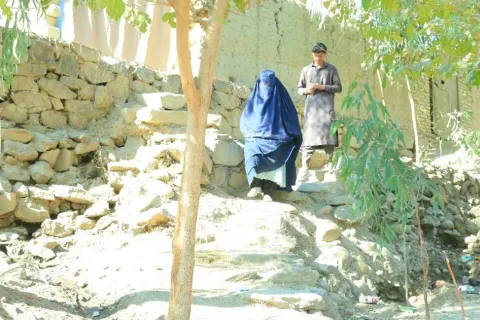
In Afghanistan's mountainous northeast, Kunar’s villages cling to steep hillsides, their mud and stone homes tucked into the rugged landscape. Narrow dirt roads snake through cliffs and valleys, where families live closely amid terraced fields, fruit trees, and sharp, rising peaks.
Over one month ago, a powerful earthquake struck this region, followed by relentless aftershocks. The worst damage hit Kunar and Nangarhar provinces, where entire valleys were reduced to rubble. Nearly 2,000 people were killed and more than 3,600 injured—over half of them women and children.
As women and children bore the brunt of the earthquake’s toll, it was also women—health workers like Basmina, Brishna, Khadija, and Adela—who stood at the frontlines of the response.


Despite the personal risks, Basmina was determined to reach the Ghaziabad Basic Health Centre and serve as a nutrition counsellor, carrying her breastfeeding son with her. Her two older children stayed behind. Her father-in-law encouraged her, saying this was the time to stand with her people and serve. Two days after the earthquake, with roads blocked, she walked more than three hours in the rain. Her feet were injured along the way, and her child, exposed to the cold, soon fell ill.
When her team arrived at the Basic Health Centre, they saw that it was partially destroyed. Cracks ran through the walls, and the team couldn’t risk staying inside. They set up a temporary health facility using tents outdoors, but the rain returned shortly after. Her first night was difficult and everyone, including the mahrams (male guardians) accompanying the team, had to sleep outside in the rain.
By morning, the team began seeing patients, but the challenges grew. There were too many injured, too few supplies and constant aftershocks. The rain didn’t let up. Later, other teams arrived and started rotating in weekly, easing the pressure. She was heartbroken to see families with no food in the first days. When food finally arrived, people were overjoyed.

She didn’t hesitate when asked to join the clinic at Khas Kunar camp—these were her people, and they needed her, and she knew they needed help. Brishna Habibi, a midwife from Sarkano district in Kunar, was at home when the earthquake struck. Her area was spared the worst, and her family remained safe.
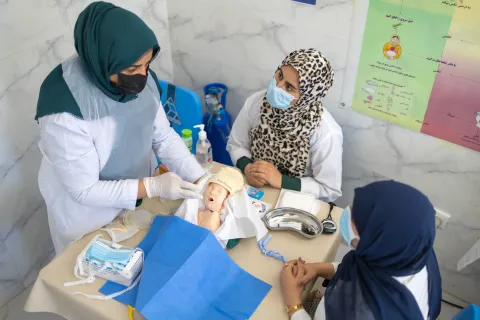
At the camp clinic, she and her colleagues provide care for both pregnant and non-pregnant women, including antenatal and postnatal services. Children are screened for malnutrition and receive routine vaccinations. For many displaced families with no access to regular health services, this clinic is their only option.
One case she recalls is a two-month-old baby whose mother and relatives died in the earthquake. Rescued from the rubble with leg injuries, he was treated by emergency teams and later brought to the clinic, where she and her team dressed his wounds and vaccinated him.
She noted that many patients were struggling with depression, overwhelmed by the loss of their homes. While medical, nutrition, and other services were provided early by humanitarian teams, the emotional toll grew as aftershocks continue. In response, UNICEF and partners are providing mental health and psychosocial support to help families cope.

Khadija’s children, Ajwa and Najma, were terrified during the earthquake. As the ground shook, she carried one child while her husband carried the other as they fled. Even now, the smallest aftershock leaves the girls shaken.
Despite her family’s own losses, with her in-laws’ home partly destroyed and their village wiped out, Khadija, a midwife, began her emergency assignment just days later. Her family never discouraged her.
“This suffering isn’t just ours,” her in-laws told her. “We must serve our people.”
She began her emergency rotation at the Zeri Baba camp in Nurgal district, where she worked from Saturday to Thursday. The camp was newly set up, and families were still in shock. The heat was intense. There was no water, no tents, not even a tree for shade. People were desperate, for shelter, clothing and a single bite of bread. Many had lost everything in the blink of an eye.
Aftershocks continued throughout the week. Every tremor sent people into panic. Patients came with low blood pressure from the heat, and many remained in psychological shock. By the time Khadija left that camp, basic services like water, tents, food, and medical care had begun to arrive.
When the earthquake struck, Adela, a vaccinator, was in Nangarhar for training. Her family was safe. But by the time she was sent to Chawkay district in Kunar to support families affected by the earthquake, aftershocks were still ongoing, making it hard to sleep or feel at ease.
In her second week, she was assigned to Ghaziabad Basic Health Center in Nurgal. There, she saw children without clothing, families who had lost everything and people sheltering wherever they could.
“This is why I chose to be here,” she said. “To serve those most affected by the earthquake.”

Most children in the Ghaziabad clinic catchment area had likely received their routine vaccinations, but many had lost their immunization cards. To be safe, the team vaccinated all children under 10 with polio and measles doses, following their supervisor’s advice.
When her team left the village, residents were sad to see them go, but deeply grateful for the care they had provided. “Their gratitude motivated me to continue my work,” she said.


All four women—Basmina, Brishna, Khadija and Adela—are delivering vital support in the heart of the earthquake-affected areas, working with UNICEF’s partners to deliver life‑saving health and nutrition services to displaced families.
UNICEF is delivering these services with funding from the World Bank, the Asian Development Bank and EU humanitarian Aid, in Khas Kunar and nearby districts and provinces impacted by the earthquake. While the team continues to provide essential services from a temporary tent structure, preparations are underway to establish a hardwall facility that will soon serve as a fully operational clinic.