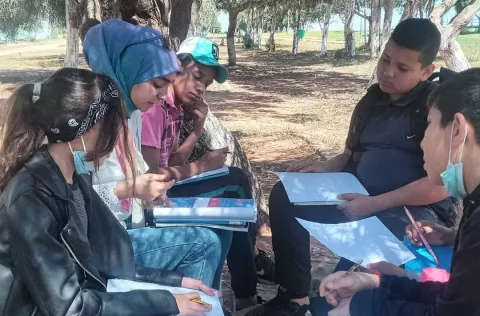
Tool: Running an adolescent feedback session
Tool to help obtain formal feedback from adolescents regarding their facilitators

Use the tool below to help you to obtain formal feedback from adolescents regarding their facilitators.
Consider
Adolescents’ feedback can help facilitators to improve their skills, and to identify areas where facilitators may need additional support or training.
Be aware of the sensitivities involved!
- Support an open, constructive dialogue between adolescents and facilitators.
- Make sure that adolescents and facilitators understand how the feedback will be used to improve their work together.
- Make sure that facilitators value and respect adolescents’ opinions.
Plan the basics
Select a time and place for a structured feedback discussion with adolescents and facilitators. This can take place during or outside sessions, in an activity space, or in another familiar setting where everyone feels safe.
Decide on the best way for adolescents to share their feedback, taking into account their age, maturity and emotional wellbeing. Younger adolescents (ages 10-14), those coping with difficult experiences, and newer participants may be more comfortable with a very short consultation using simple questions. Others may be ready for a longer, more reflective discussion.
Before Meet with facilitators individually or in a group to:
- Discuss what type of feedback from adolescents would be helpful and in which areas;
- Develop a list of questions to ask adolescents; (Refer to the Great facilitator checklist tool for guidance).
- Agree on how adolescents’ feedback will be used;
- Clarify the consequences if facilitators receive strong or weak feedback (for example, whether they can expect additional training or support).
During
Clarify the purpose of the feedback discussion. Make sure adolescents understand how their opinions and feedback will be used.
Review facilitators’ roles with adolescents. (the Great facilitator checklist tool can be
adapted for this purpose).
Start with the positive. Begin discussions by asking adolescents to outline facilitators’
strengths, and to describe positive experiences from their sessions. For example, ask
adolescents to:
- Identify facilitators’ top three strengths, and provide examples;
- Complete the following sentences: A time our facilitator did something very helpful for me was… or I like it when my facilitator…
Focus on opportunities, not problems.
For example, ask adolescents to complete the following sentences:
- Something our facilitator does not know about me (or about our group) that I wish he/she knew is….
- I would like it if our facilitator would do … (more often).
Move on if highly sensitive issues are raised. If one or more adolescents express a very negative opinion of a facilitator, and/or if they suggest that a facilitator has violated their Code of Conduct, don’t continue the discussions with a large group present. Move on to another topic and follow up after the session with the parties concerned. Take appropriate action immediately (and confidentially), if a serious problem is suspected.
Discuss next steps for improving work together. For example, complete the following sentences:
Facilitators: In our next sessions I will …
- continue to ….
- do … more often
- start (doing) …
Programme Coordinators: To help facilitators do their best work I will...
- continue to …
- do … more often
- start (doing) …
Adolescents: To help our facilitator support us, I will …
- continue to ….
- Do … more often
- start (doing) …
Conclude with a clear agreement about the steps that will be taken to support facilitators in their work with adolescents.
End on a positive note. If appropriate (based on what was discussed), take a moment to acknowledge and applaud the facilitator(s) and the adolescents. Use this as an opportunity to celebrate the group’s efforts and achievements.
After
Follow up with facilitators to make sure that they understand adolescents’ feedback and to agree on how to move forward. Check in with them regularly to see whether they have implemented any agreed upon changes and provide support where necessary.
Highlights
Use the tool to help you to obtain formal feedback from adolescents regarding their facilitators.