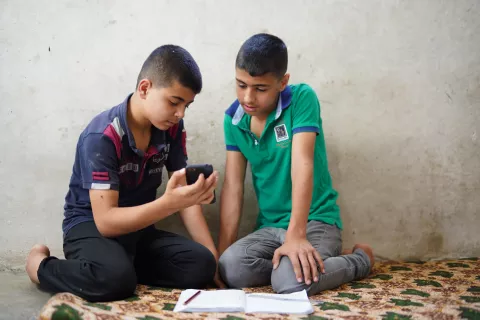
Self-guided activity: Relationship map
Explore your relationships with a few important people in your life by drawing a “relationship map” of your connections with them

What is the purpose of this activity?
Who are the most important people in your life? How do they influence who you are, and how you feel?
In this activity, you will explore your relationships with a few important people in your life by drawing a “relationship map” of your connections with them.
What will you need?
- A place where you can sit comfortably and draw or write, and a table or flat surface to draw or write against.
- A piece of paper, and pen or pencil.
Step by step
Start by sitting somewhere where you are comfortable and have a clean, flat surface to draw against.
Have your paper and pen or pencil ready.
- In the middle of your paper, draw a small picture of yourself.
If you prefer, you can draw a symbol that represents you.
Leave space around your picture for more writing and drawing. - Close your eyes. Think of six very important people in your life.
They could be people you spend time with every day, or people you do not see often, but who feel important to you. You may think of some people who feel helpful to you, and others with whom you have difficult relationships.
Do not write their names down yet - just remember the six people you have thought of. - Start by thinking of one of those six people.
Imagine a symbol/drawing that represents them. It might represent something they do for you, something they enjoy, how you feel about them, or how they make you feel about yourself. - Draw the symbol of that person somewhere on your paper.
You may choose anywhere on your paper to draw it, but you can try to place it in a location that feel right. For example, if you admire the person a lot, you can draw them close to or above your head.
Note: You can write the person’s name if you wish but try to present them through drawing first. - Draw symbols for the other five important people you thought of.
Draw them wherever you wish, choosing locations on your paper that represent your relationship to them. - If you wish, add lines or additional drawings to illustrate more about your relationships with the six people. You can also draw lines to show how they are connected or thicker lines to the ones that you feel a strong connection to.
Create more
- Keep adding to your Relationship map. You could add symbols to represent more people who are important to you or add lines or other drawings to show and express more about your relationships with them.
- Write a letter to one of the important people in your life. Tell them what you learned about your relationship with them by drawing your relationship map.
- Create a new map, drawing, poem or essay about the people in your life.
Share
Online:
- Send a photo of your relationship map and anything else you created to the chat group.
- Look for more messages from [WhatsApp address] to see what other adolescents have created. Participate in a discussion!
Everyone (online and offline):
- Keep your map somewhere where you can look at it every day. For example, you might hang it on your wall.
- If you want, share your map with other people in your household. Put the map somewhere they will be able to see it and explain it to them. Invite them to tell you what they learn about your relationships or ask you questions. Do not feel that you must share your map with others if you don’t wish to.
- Ask if others want to participate in the activity and share their maps.
Notice how your relationships are similar and different!
Highlights
Who are the most important people in your life? How do they influence who you are, and how you feel?
In this activity, you will explore your relationships with a few important people in your life by drawing a “relationship map” of your connections with them.