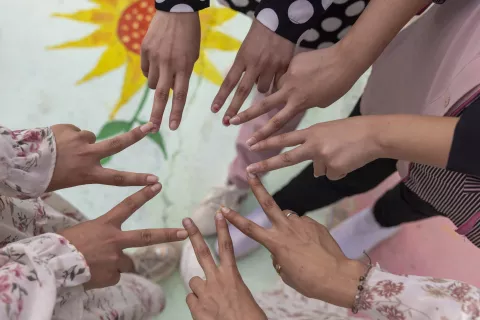
Activity: Ourselves on the inside and outside
Knowing ourselves: Adolescents introduce themselves and learn more about each other by drawing self-portraits

Activity overview
Energy level: 2/5
Literacy level: 1/5
Complexity level: 2/5
Time: 30 minutes
Purpose: Adolescents get to know each other by introducing themselves and drawing a self-portrait.
Objectives
Adolescents will be able to:
- Express their identity through drawing.
- Communicate with others and build trust.
Competency domains
- Creativity and innovation
- Identity and self-esteem
- Communication and expression
Works well for
Adolescent circles that are starting a new cycle or welcoming many new members; adolescents of any age.
Phase
Knowing ourselves
Before
Setting group rules in advance with the adolescents will help them to review each other’s drawings in a respectful and supportive manner.
After
In the next step, adolescents can look at each other’s work and share their thoughts using the Gallery walk tool.
Adolescents can finish their drawings and/or work on new drafts of their drawings in future sessions.
Preparation
None needed.

Activity steps
Step 1
Warm up: Ask adolescents to sit somewhere where they are comfortable and have some space around them. Give each of them a piece of paper, and make sure they have a pen, pencil or crayon.
Step 2
Facilitator says: “Close your eyes for a minute and try to think of six different words that describe you. Don’t say them out loud, just think about them.”
Step 3
Give a few minutes to think quietly.
Step 4
Facilitator says: “Now you are going to introduce (or reintroduce) yourselves to each other without actually using those words. Start by drawing a very big circle on your piece of paper. (Demonstrate this by drawing a circle on a piece of paper.) This circle represents you - your mind, your face, yourself.”
Step 5
Facilitator says: “Remember the six words you thought of earlier to describe yourself. Maybe some of these words describe what you are like on the inside, and some describe what you are like on the outside. Now draw yourselves and remember:
- You can use the space inside the circle to show what you are like on the inside, and what you are like on the outside.
- If you want to make your drawing look like a face (using the circle you drew) you can do that, but feel free to take another approach.
- Try to draw, not write with words. Don’t worry if you don’t know how to draw well!”
Step 6
Give the adolescents at least 20 minutes to work on their drawings. Observe their progress and encourage them.
Step 7
Challenge: Ask the adolescents to look at each other’s drawings.
Step 8
Facilitator says: “Try to find one person who is similar to you in some way, and one person who is different from you in some way.”
Step 9
Divide the adolescents into groups of two. Ask them to look at and discuss each other’s drawings.
Step 10
Explain: Each adolescent will introduce their partner. They will do this by showing their drawing to the group. Make sure you discuss your similarities and differences.
Step 11
Sharing and Take away:
Discuss: What are some of the characteristics that everyone in the circle shares? What are some things that are different?
Do and don't
Do
- Encourage adolescents to use their group rules, and to share feedback about each other’s work by being respectful and positive.
- Encourage adolescents to have fun as they draw, and not to worry about being good or bad at drawing.
- Make your own drawing, if you think it will encourage adolescents to see you try something challenging.
- Give adolescents a chance to keep their drawings, and/or post them somewhere where others can see them (including inside the activity space, if it is indoors).
Don't
- Criticize or correct the adolescents’ drawings (including the circle they draw at the beginning), or push them to draw in a certain way.
Adaptation
If there are adolescents who are blind or visually impaired: Those adolescents, or all of the adolescents in the circle, can create collages (with shapes they can feel) or poems to describe themselves. Consider letting all of the adolescents explore each other’s collages or sculptures with their eyes closed or with blindfolds on, to create similar experiences.
Environment
Indoor or outdoor space
Supplies
- Paper (at least one piece for each adolescent).
- Pens, pencils or crayons (at least one for each adolescent).
Improvise
Adolescents can use a collage, sculpture, sound, music, dance, movement or poetry to introduce themselves.
Adolescents can draw pictures of people they admire. Adolescents can identify and represent their strengths in their drawings.
Continue
In a future session, ask the adolescents to draw another picture of themselves, so that they can see how they’ve changed and grown.
Create a group portrait that shows the similarities and differences between all the adolescents in the circle.
Ask the adolescents to draw pictures of characteristics they hope to have at some point in the future. Encourage them to refer to these ideas when they set goals for themselves or their circles.
Highlights
Adolescents get to know each other by introducing themselves and drawing a self-portrait. Works well for: adolescent circles that are starting a new cycle or welcoming many new members; adolescents of any age.