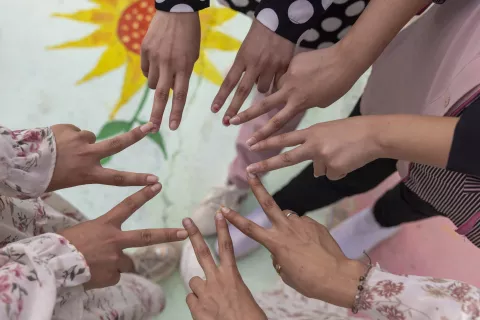
Activity: Communicating without words
Connecting: Role-play non-verbal communication

Activity overview
Energy level: 4/5
Literacy level: 1/5
Complexity level: 2/5
Time: 20 minutes
Purpose: Learn and understand the meaning of non-verbal communication; Practice expressing emotions using only non-verbal communication through role play.
Objectives
Adolescents will be able to:
- Understand how ideas or emotions can be communicated through nonverbal communication.
- Use nonverbal communication to communicate some of their own ideas and emotions.
Competency domains
- Communication and expression
Works well for
Adolescents who know what a role play is.
Phase
Connecting
Before
Use the Role play tool.
After
Adolescents can discuss how they use non-verbal communication. They may be communicating without knowing it.
Preparation
None needed
Activity steps
Step 1
Explain: There are different types of communication other than talking.
Step 2
Facilitator says: “Crossing my arms in-front of me might mean something to you. Rolling my eyes might mean something to you. These are examples of non-verbal communication.”
Step 3
Facilitator says: “What other types of non-verbal communication can you think of?”
Step 4
Call on volunteers to demonstrate some examples of things that can be communicated through gestures or body language. Ask the other adolescents to explain in words what the gestures or body language is communicating. Some examples include:
- Placing hands on hips
- Placing hands over mouth
- Turning your back to someone
- Scratching your head
- Smiling
- Frowning
Step 5
Explain: Participants will get into smalls groups and create a short, two-to-five-minute role play.
Step 6
Explain: Each group will roll the emotion cube (where only members of the small group can see it). Each group will then work together to create a story about the emotion they rolled. They will start by imagining a character who is experiencing this emotion. Imagine who he or she is and why he or she is feeling that emotion. Now imagine a person in his/her life who is experiencing a different emotion (it can be whatever you want). What happens when they interact?
Step 7
Explain: The role play should tell a story using the character created and only non-verbal communication (no speaking!).
Step 8
Give time for small groups to practice and prepare their role plays.
Step 9
Sharing and Take away: Ask groups to perform their role plays for the group. The audience watching the role play should try to guess what happened. What emotions were the characters experiencing? What did they communicate to each other?
Step 10
Discussion: After the groups have presented their role plays, ask participants:
- Do you always notice when you are communicating non-verbally.
- Do you think others always notice when they are communicating nonverbally?
- How can being aware of both our verbal and non-verbal communication help us?

Do and don't
Do
- Let participants decide how they will organize their role play.
Don't
- Correct participants or get angry if they use verbal communication as well as nonverbal during their role play.
Adaptation
Environment
Indoor or outdoor space.
Supplies
Improvise
Adolescents can choose specific scenarios to role play. One group can role-play only verbal communication questions and one group can roleplay only non-verbal communication responses. This can be a game.
Continue
Encourage participants to be aware of both their verbal and non-verbal communication. Participants can also observe others and tell them what nonverbal communication they see.
Highlights
Learn and understand the meaning of non-verbal communication; Practice expressing emotions using only non-verbal communication through role play. Works well for adolescents who know what a role play is.