

Zambia launches the ‘End Learning Poverty for All in Africa’ campaign led by the Ministry of Education, the African Union and UNICEF
The campaign is an Africa-wide initiative aimed at mobilizing resources, expertise, and political will to address the learning crisis, by strengthening foundational literacy and numeracy provision on the continent.
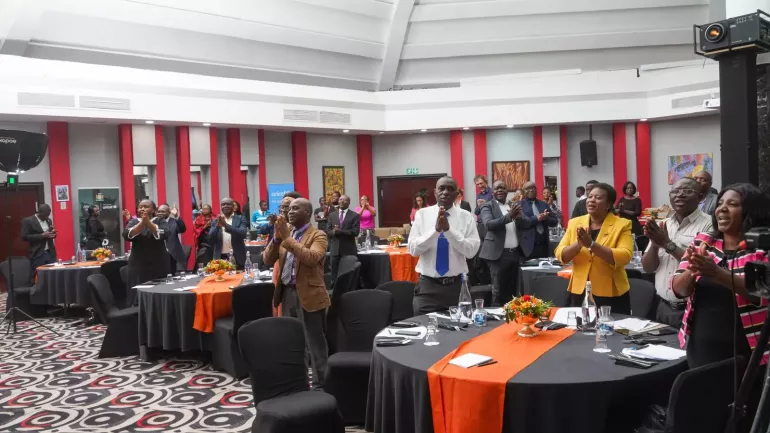
LUSAKA, Zambia, 3 April 2025 --- The Ministry of Education with support from UNICEF and the African Union has today launched the End Learning Poverty for All in Africa campaign in Zambia, a continent-wide initiative aimed at addressing the foundational learning crisis affecting millions of children across Africa and within Zambia’s borders.
"For Zambia, the launch of the end learning poverty signifies the importance we place as a country on foundational learning, and our commitment to recovering and accelerating learning. This new campaign we are launching is aimed at spotlighting deficits in literacy and spurring action to ensure that all children acquire literacy, numeracy and social and emotional skills,” highlighted the Minister of Education, Hon. Douglas Syakalima, MP, speaking at the launch on behalf of the President of the Republic of Zambia, Mr. Hakainde Hichilema.
Foundational learning is described as basic literacy, numeracy, and transferable skills, that are the building blocks for a life of learning. Without foundational learning, students often fail to thrive later in school or when they join the workforce, leading to intergenerational transmission of poverty and vulnerability. Across Africa, the state of foundational learning is alarming. Approximately 90 per cent of children in this region are unable to read and understand a simple text, or undertake simple mathematical tasks, by the age of 10. This has been exacerbated by prolonged school closures and limited access to remote learning during the COVID-19 pandemic and, in the case of Zambia, post-pandemic public health emergencies such as the 2023/2024 cholera outbreak and the 2024/2025 drought. The lack of foundational literacy and numeracy skills not only hampers individual growth but also poses a significant threat to the continent's socio-economic development.
The End Learning Poverty for All in Africa campaign is a critical step towards achieving Sustainable Development Goal 4. By focusing on foundational learning, we can unlock the potential of Africa's children and contribute to the continent's long-term development," explained the African Union Director for Education, Science, Technology and Innovation, Professor Saidou Madougou.
In Zambia, the situation mirrors the broader regional challenges. The Southern and Eastern Africa Consortium for Monitoring Education Quality results indicate that students in Grade 6 largely operate at level 2 in both reading and numeracy. Though registered in Grade 6, these students are functionally in Grade 3 based on their reading and numeracy level. In addition, national assessment surveys at Grade 5 also indicate a similar trend in learning achievements, with mean performance scores of 34.9 per cent in English and 36.9 per cent in Mathematics. Teacher shortages, high student-to-teacher ratios, and inadequate educational resources further compound the problem.
"The foundational learning crisis in Zambia requires urgent and sustained action. Through collaborative efforts, we can ensure that every child can acquire essential literacy and numeracy skills, setting them on a path to a brighter future,” said UNICEF Zambia Deputy Representative, Programmes, Dr. Nejmudin Bilal. “Programmes like ‘Catch-Up’ employ an approach that ensures that each child receives tailored instruction to help them catch up with their peers. Through this remedial learning initiative, we can ensure that primary school students are given a chance at improving their foundational literacy and numeracy skills.”
The Catch-Up programme employs innovative, learner-centered teaching methods which have shown promise in improving learning outcomes. The programme uses the “Teaching at the Right Level” methodology to group learners based on their understanding rather than their age. The programme has shown significant results in enhancing the quality of education particularly in the skills of reading, writing and counting.
“ADEA commends the Government of Zambia's leadership and vision in prioritizing foundational learning and launching this ambitious campaign in collaboration with UNICEF and the African Union. The commitment to foundational learning is further cemented by the Zambian Republican President, who is a champion of foundational learning and emphasizes the importance of increased investments and evidence-based interventions to improve learning outcomes at the foundational level. The launch embodies the spirit of collaboration and collective action essential to eradicating learning poverty,” said the Executive Secretary, Association for the Development of Education in Africa (ADEA), Albert Nsengiyumva.
The End Learning Poverty campaign aims to eliminate learning poverty in Africa. It targets parents and caregivers, as well as decision-makers, to raise awareness and drive action towards improving foundational learning. Under the theme, ‘Read, Write, Count. Foundations4Life’, the campaign will use mass and digital media to engage and mobilize stakeholders across the country.
To realise the goals of the End Learning Poverty campaign, UNICEF and the African Union are calling on the Government to:
- Invest more and better in quality education, focusing on foundational learning, as returns on investments in schooling are higher when focused on quality foundational learning.
- Ensure that every child has access to quality, accountable teachers by providing them with the training, resources, and support needed to deliver quality education. This includes ongoing professional development, access to teaching materials, and a supportive work environment.
- Accelerate the scaling up of workable models for the implementation of Foundational Literacy and Numeracy initiatives in schools. Programmes such as Teaching at the Right Level (TaRL), which in Zambia is known as the Catch-up programme, have shown significant success in improving foundational literacy and numeracy skills. They must be scaled up to reach every child in Zambia. Investment in the generation, collation, and use of quality assessment data on foundational learning is equally important.
End learning poverty, in alignment with recent calls for the elimination of learning poverty by 2035, and a decade of accelerated action for education, called for at the inaugural Continental Education Conference, in 2024, and endorsed at the recent African Union Summit.
###
Notes to editors:
NEW: Subscribe to UNICEF’s global media updates on WhatsApp.
Media contacts
About UNICEF
UNICEF promotes the rights and wellbeing of every child, in everything we do. Together with our partners, we work in 190 countries and territories to translate that commitment into practical action, focusing special effort on reaching the most vulnerable and excluded children, to the benefit of all children, everywhere.
For more information about UNICEF and its work for children in Zambia, visit www.unicef.org/zambia.
Follow UNICEF Zambia on Twitter, Facebook and Instagram


