UNICEF and partners launch First Foods Africa, an ambitious initiative to end child food poverty and malnutrition
Cotonou, Benin, 29 September 2025: In partnership with the African Union, the Government of Benin, other governments in Africa, regional organizations and private sector actors, UNICEF has launched First Foods Africa. This innovative continent-wide initiative aims to combat food poverty and malnutrition among children.
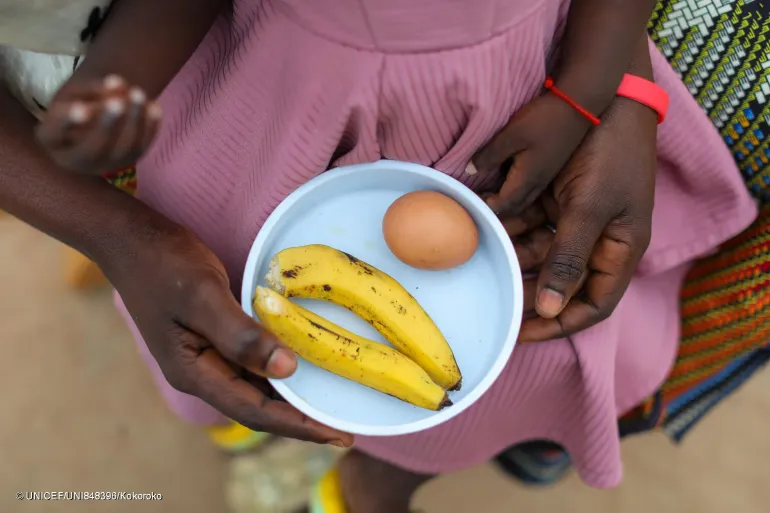
Globally, 181 million children under the age of five live in severe food poverty, which means that they consume no more than two of the eight defined food groups, an inadequate intake for their physical growth and cognitive development. Nearly a third of these children, or 59 million, live in sub-Saharan Africa. Deprived of the essential nutrients necessary for their survival, growth and development, they experience persistently high rates of stunting and wasting across the continent. First Foods Africa was designed to change this reality. By investing in local producers, promoting responsive public policies, and stimulating collaboration among multiple stakeholders, the initiative aims to make safe, nutritious, affordable, and sustainable first foods available to every child, in all contexts in Africa.
"This is a transformative moment for the children of Africa," said Omar Abdi, UNICEF Deputy Executive Director. "With the support of political leaders, the private sector and local communities, First Foods Africa will lay the foundation for strengthened human capital, sustained economic growth and long-term resilience on the continent."
Improving the quality of children's first foods, food environments and feeding practices requires innovative approaches at scale. Recent UNICEF-supported surveys of packaged food products for young children in Africa have revealed that the vast majority of these products are imported, grain-based and high in sugar and additives.
The initiative is based on an integrated three-pronged strategy:
- Encourage the local production of high-quality, nutritious, safe, affordable and sustainable children's food and supplements.
- Shaping policy environments to improve food standards and regulations and ensure access to nutritious food for the most vulnerable children.
- Stimulate adequate consumption to increase demand and make nutritious, locally produced food the accessible and desirable choice for those who care for children.
"The African Union Commission welcomes the launch of the First Foods Initiative, a transformative step towards eradicating child malnutrition and building resilient food systems across our continent. We are committed to working in partnership with UNICEF and Member States to scale up these efforts, so that no child on the continent is left behind," said Professor Julio Rakotonirina, Director of Health and Humanitarian Affairs at the African Union Commission.
The Initiative is anchored in the African Union's Agenda 2063, the Malabo Declaration on Nutrition, through the Framework of the Comprehensive Africa Agriculture Development Programme, as well as the African Regional Nutrition Strategy (2015-2025), which collectively highlight the central role of child nutrition in human capital development and socio-economic transformation of the continent.
First Foods Africa is a transformative initiative. It aims to redefine how countries address child food poverty and malnutrition, going beyond traditional models of aid, adopting market-based approaches to attract capital investment to local businesses, and transforming food systems.
Multimedia material available here :FFA Press Materials
Media contacts
About UNICEF
UNICEF promotes the rights and well-being of every child, in everything we do. Together with our partners, we work in 190 countries and territories to translate that commitment into practical action, focusing special effort on reaching the most vulnerable and excluded children, to the benefit of all children, everywhere.
For more information about UNICEF and its work for children in West and Central Africa, visit https://www.unicef.org/wca.
Follow UNICEF West and Central Africa on Twitter, Facebook, Instagram et Youtube