High-level delegation visits Chad as President Déby is named champion for routine immunization and polio eradication
- English
- Français
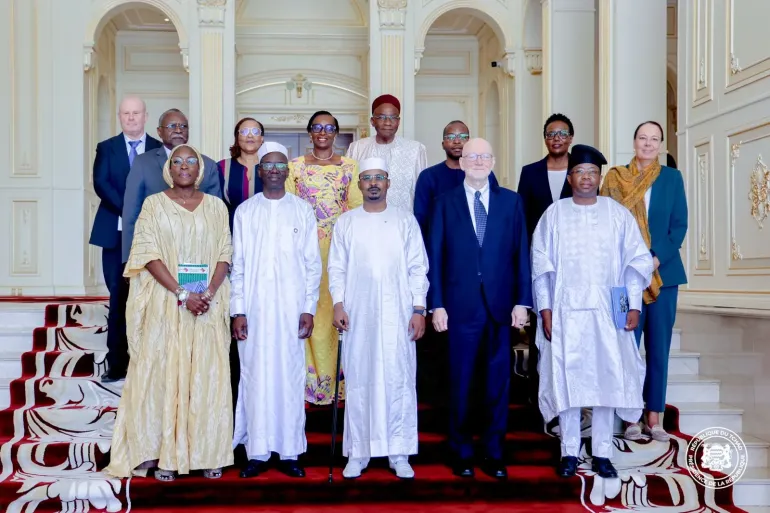
N’DJAMENA, 31 August 2026 – A high-level delegation of global polio and immunization partners was received today by H.E. President Mahamat Idriss Déby Itno, President of the Republic of Chad, to advance political commitment and regional cooperation for polio eradication and stronger immunization in Chad and across the Lake Chad Basin. The visit also provided an opportunity to review progress and reinforce collaboration towards achieving a polio-free future.
The visit was marked by the recognition of President Déby as Champion for Immunization and Polio Eradication, recognizing Chad’s important role in driving collective action across and withing the countries in the Lake Chad Basin region.
In this role, President Déby will help to keep polio eradication and routine immunization high on the national and regional agenda, promote stronger cooperation among countries and advocate for sustained action to reach every child, including those living in border areas and among mobile, displaced and underserved communities.
The delegation included Dr Chris Elias, President of the Global Development Division at the Gates Foundation; Dr Zouera Youssoufou, Managing Director and CEO of the Aliko Dangote Foundation; Dr Mohamed Yakub Janabi, WHO Regional Director for Africa; and Gilles Fagninou, UNICEF Regional Director for West and Central Africa, alongside senior representatives of the Global Polio Eradication Initiative (GPEI), Rotary International, Gavi, the Vaccine Alliance, the United Nations Population Fund (UNFPA) and the United States Centers for Disease Control and Prevention (US CDC).
The Lake Chad Basin remains a priority for polio eradication efforts, with population movements, insecurity and access constraints continuing to make it difficult to consistently reach every child. Chad’s position at the heart of the region gives it a critical role in advancing stronger cross-border cooperation and ensuring that children on the move are reached with vaccines. The visit also reinforced the importance of linking polio eradication efforts with stronger routine immunization to better protect zero-dose and under-immunized children.
The delegation also held discussions with the Minister of Public Health and Prevention, Dr Abdelmadjid Abderahim, and the Minister of Finance, Budget, Economy, Planning and International Cooperation, Mr. Tahir Hamid Nguilin, and participated in a high-level review of polio and routine immunization with government representatives and partners.
The discussions emphasized the importance of maintaining polio eradication and immunization as political priorities, backed by sustained financing and human resources, stronger accountability, and coordinated regional action.
Global polio and immunization partners will continue to support Chad and countries across the Lake Chad Basin in translating political commitment into sustained action and accelerating progress towards reaching every child with life-saving vaccines.
About the Global Polio Eradication Initiative
The Global Polio Eradication Initiative is a public-private partnership led by national governments with six partners – the World Health Organization (WHO), Rotary International, the US Centers for Disease Control and Prevention (CDC), the United Nations Children’s Fund (UNICEF), Gates Foundation and Gavi, the Vaccine Alliance. Its goal is to eradicate polio worldwide. For more information on the global effort to end polio, visit polioeradication.org.
Media focal points:
- Gavi: Laura Shevlin, Gavi, [email protected]
- UNICEF: Anne-Isabelle Leclercq Balde, UNICEF Chad, [email protected]
- WHO: Jonas Naissem, OMS Chad, [email protected]
Media contacts
About UNICEF
UNICEF promotes the rights and well-being of every child, in everything we do. Together with our partners, we work in 190 countries and territories to translate that commitment into practical action, focusing special effort on reaching the most vulnerable and excluded children, to the benefit of all children, everywhere.
For more information about UNICEF and its work for children in West and Central Africa, visit https://www.unicef.org/wca.
Follow UNICEF West and Central Africa on Twitter, Facebook, Instagram et Youtube