Story of Dang Thuy Linh
Fighting for the rights means walking the talk
- English
- Tiếng Việt
My name is Linh, Dang Thuy Linh. I am a woman with physical disability. I was born and raised in Ha Noi, the capital city of Viet Nam. As the story goes, I was born into the aftermaths of the wartime.
Since birth, there were a lot of hearsays about my disability. Some said that I could have been a victim of the Agent Orange sprayed in the American-Viet Nam war’s combating zones since my father was a military serviceman for two years in Quang Tri –an area heavily barraged with bombs and chemicals.
Others attributed my physical difference to my mother giving birth rather late in her life. Some even ventured to believe that my defects were brought to life from the karma of my past life. Whenever asked about it, my answer remains the same: “I was born with a disability. That’s all to it.” In fact, no disability can define me. I want to define the person I am by what I do –I am an advocate for people with disabilities.
I remember when I was in kindergarten, my friends and I learned to count fingers. All of them said they had 10 fingers, but I said I had 6. They asked: Why does your left hand have one finger? I said: Because not everyone is alike.
My parents were right when they managed to bring me up in an inclusive environment where I was always among friends without disabilities. This made me think, “I am different from my friends, but that doesn’t mean I can’t do what they can. I can do things in my own way – and that way is different from theirs.”
Having been in an inclusive education system, I can see both opportunities and barriers it brings to personal development for girls with disabilities. With this experience, I desire to work towards removing the barriers to ensure chances for people with disabilities to fully and equally participate in our society.
At the end of high school, I was at the crossroads when I had to decide the major I would pursue in college.
“I plan to choose Law,” I was overenthusiastic.
Most of the responses I received were countering: “You should be practical. Choose something less challenging that would help you earn a stable living.” “Many people without disabilities are still unemployed, let alone you with disability!”
Self-doubt led me to the decision to apply for both my desired major and the safe choice that I had been told of – something that could have been suitable for a person with disability. In the end, when the heart called – I chose to follow my dream.
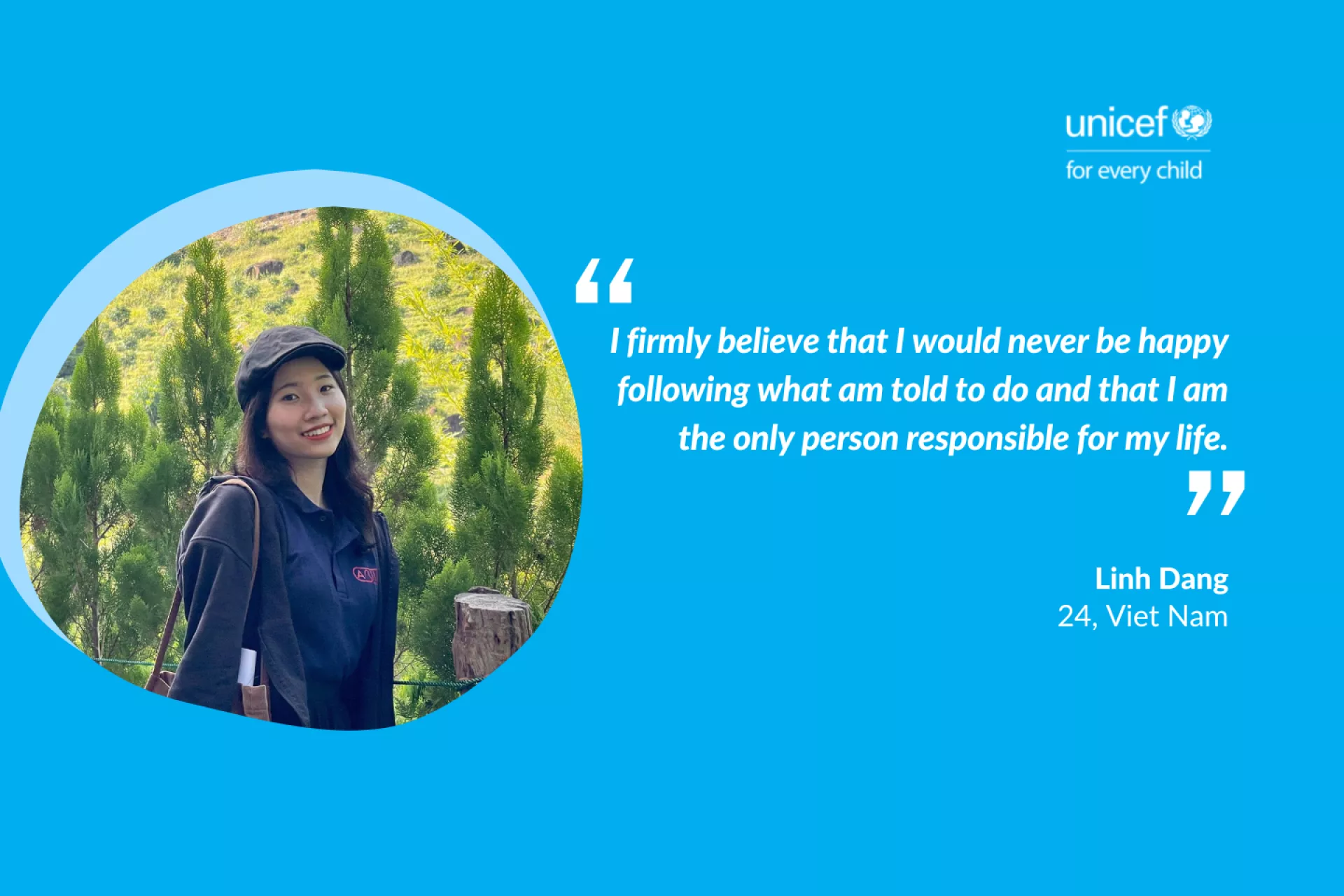
The reason was simple. I was not confident that I would find a job upon graduation, but I held a strong belief that I would never be happy doing what I was told to do – which seemed to happen always. I am and will be the only person responsible for my life.
More importantly, the experience has driven me towards another passion in the attempt to remove barriers that keep children with disabilities from realizing their dreams. And here I am today working to advocate for equality and inclusion of those children although the roads leading to this place have not always been rosy and there have been many huddles that I had to surpass.
Being a young disability activist in Viet Nam, I see myself as an Agent of Change, who bears a huge responsibility to represent the voices and movements of people with disabilities in the quest to claim our rights as well as contributing to an inclusive society. I focus on disability rights research and activism. Research provides me a better understanding of facts and situations and gives me in-depth insights to issues impacting our disabilities community.
Working as a Disability Coordinator at the Blue Dragon Children’s Foundation in Hanoi, I am able to apply my knowledge and practices on children and youth with disabilities coming from the most disadvantaged circumstances including those having been trafficked and sexually abused and provide legal assistance to them.
Those are also children who have never been to school, children living on the streets and ethnic minority children. My small part in changing their lives has been rewarding as I find happiness going to work everyday.
I have also become a better version of myself through work and advocacy. When working with a group of hearing-impaired children and learning sign language, I realized that my physical barrier of having only a complete set of fingers did not prevent me from communicating with them. Barriers and limitations don’t stop us when we look at them from a different mindset. – ENDS
My research projects aim to generate new knowledge of people with disabilities especially of girls and youth groups to enhance the participation and empowerment of adolescents and youth with disabilities in activism.
My initial exposure to disability rights was as a research assistant for the “Transforming Disability Knowledge, Research and Activism” project. I was dedicated to this project as I believe fostering the participation of girls and women with disabilities through empowerment to generate sustainable changes is imperative.
Over the last five years, I developed a new research interest in how an interdisciplinary approach to disability rights can foster collective engagement and activism. Intersectionality is crucial for framing the politics of inclusion because it helps to tease out axes of social inequality based on the individuals’ experiences with disability, class, race, gender, sexuality, ethnicity, and nationality and also to enhance the production and mobilization of inclusion in relation to disability activism through the voices of people with disabilities because “Nothing about Us is without Us.”