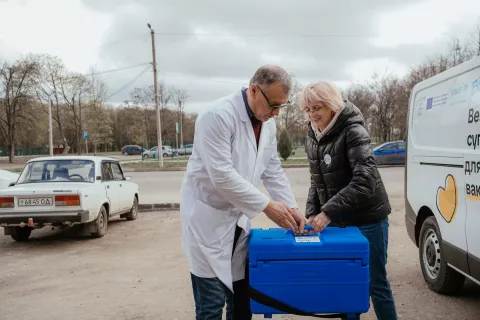
Vaccination clinic helps safeguard health of Roma families
A human-centred approach to health care delivery has helped to build trust and boost vaccination coverage among the Roma population.

- Українська
- English
Twenty-six-year-old Kateryna and her children live in Mukachevo, in Ukraine’s south-western Zakarpattia region. Here, in one of the largest Roma communities in Europe – home to around 10,000 people – lives are being transformed by a local outpatient clinic.

As well as providing easy access to medical care and the opportunity to register with family doctors, the clinic offers life-saving access to vaccination – 85 per cent of residents are now protected from diseases such as diphtheria and tetanus. Kateryna often takes her children for check-ups and all six are fully vaccinated.

“Many Roma are afraid of vaccination. They think their children will develop health problems after getting vaccinated. But I’m not afraid. I know that vaccines protect against many diseases. I tell everyone to bring their children here and get them vaccinated too.”
Kateryna is among those who participated in a UNICEF project promoting immunization within the Roma community. Family doctor Nataliia Loja says that the adoption of this people-centred approach to health care in the city has played a significant role in achieving high vaccination rates among the Roma population.
“In 2023, I took part in a training in Lviv where I learned a lot about the people-centred approach,” says the doctor. “The core of this approach is recognizing that every person has different needs and circumstances. So situations must be addressed with that understanding in mind".
"The UNICEF training helped me apply these skills in practice, especially during the implementation of a mini-grant to promote vaccination among the Roma population in the Mukachevo community."

Nataliia explains that Roma people may seek medical care infrequently due to a lack of trust and a language barrier, since many of them do not speak Ukrainian. Medical professionals in Mukachevo were determined to understand how to build stronger connections with the community and earn their trust.
As a first step, through the UNICEF project, medical professionals conducted a survey made up entirely of open-ended questions. This allowed respondents to share their views, express fears, indicate preferences for location and timing of vaccination, and talk about their past experiences with immunization.


The survey was carried out at the outpatient clinic, in the Roma school, at the market and in the church. These locations allowed the team to reach the largest number of people who, due to a lack of identification documents, are unable to register with a family doctor. Around 170 people were surveyed in total, and this sample size proved sufficient to develop an effective action plan.
Responses revealed that Roma living in rural areas – such as the village of Pavshyno, which is also part of Mukachevo – were found to be more open to engaging with doctors and more willing to agree to vaccination than those living in the city.
The survey also found that Roma families fear vaccinating due to fears and myths. Therefore, another important task for the medical staff was to dispel these myths and provide accurate information about immunization.

In total, during the spring and summer of 2024, health care workers in the Mukachevo area succeeded in vaccinating over 400 people, which led to an approximate 1.5 per cent increase in vaccination coverage among the adult and child Roma population in the community. Vaccinations were administered both at the outpatient clinic and during mobile team outreach visits. A local priest was helpful in encouraging undocumented parishioners to receive their vaccinations after Sunday mass.
“In Roma families, the decision to vaccinate children is usually made by the father, so it was important for us to involve both parents in the project,” says doctor Nataliia Loja. “Overall, the project showed us that if the people-centred approach is applied properly and the Roma community is given clear information about the importance of vaccination, they respond with genuine interest and active engagement,” adds Dr. Loja.
In 2024, with the support of the Government of Canada, UNICEF organized a series of training sessions for health workers and civil society representatives, focusing on human-centered design to improve vaccine uptake. Following this capacity-building phase, 15 teams worked across Ukraine to design, implement, and assess participatory, gender-responsive initiatives within their communities. This process ensured that the projects were grounded in community needs and preferences.