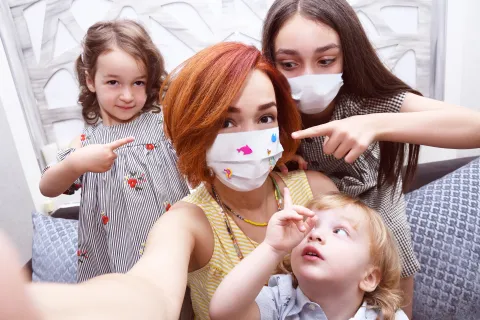
А mother with three children on the autism spectrum embraces a parenting club
Being a parent of three autistic children during wartime requires additional adjustments, as the stress of war combined with disrupted services impacts everyday life.

- Українська
- English
Oksana and her husband from Sumy are raising three children on the autism spectrum, including 11-year-old twin daughters, Alisa and Margaryta, and their 10-year-old son, Artem. Each day brings new challenges, as constant shelling impacts the children’s well-being, sense of safety and learning.
With her children now adolescents, Oksana realised she needed an emotional anchor to nurture her own wellbeing so she could best support her children.


“Taking care of my children isn’t difficult for me. But taking care of myself, that’s something I wasn’t used to,” Oksana says.
The game changed for her when she joined a parenting club, organised under the UNICEF programme “Hug for You”, implemented by the partner NGO “CPD Confidence” in Sumy and Kharkiv regions with the financial support of the German Government.
“For me, the parenting club became a second family—a place where I’m understood even without saying a word,” Oksana says. “Relatives and friends aren’t always able to help. Honestly, finding this kind of professional support in the club and being able to care for my mental health feels like a true blessing.”


At the parenting club, she attended weekly meetings, completed the positive parenting programme, and—most importantly—discovered a circle of support she had longed for.

“We’re the buttons that hold everything together,” said Maryna Kislitsyna, a club moderator and psychologist, during one of the sessions.
Oksana remembers this phrase that resonated for her and the group. When the parenting club meetings ended, the women continued gathering every week on their own to sustain the mutual support they had built together. It’s no coincidence that among themselves, the club members jokingly refer to the abbreviation PC (Parenting Club) as 'pretty cool'.
Oksana dedicates a lot of her time to self-education.
When she first learned of her children’s developmental challenges she thought she accepted the fact. Over time, she realised that acceptance evolves, taking on different forms and meanings.
“I sat there thinking: do I truly accept my children as they are? Not ruminating on what will happen after kindergarten, after school. Now I know that life after kindergarten, after school goes on—there is always hope.”


Oksana’s family knows all too well what it means to face challenges that demand strength and resilience. At the end of December 2021, they lost their home in a fire. Two months later, the full-scale war erupted.
“I spoke about it with the psychologist, and it helped. I don’t know how I would have coped without this space for parents,” she adds.
Oksana says that her husband is a great source of support. It’s a joint effort with both parents holding the family together.
It’s also bolstered by the empowering community who support each other and nurture Oksana’s true courage and resilience. The parenting clubs are not just about gaining knowledge on positive parenting skills but about hope and understanding, a friendly shoulder and thoughtful guidance from psychologists.
“You can be yourself, vulnerable, imperfect. You can take off the mask of the ‘strong mum’. After all, it’s a lifelong journey and to be able to walk alongside your children on this path, you need to care not only for their wellbeing, but also for your own,” Oksana says.