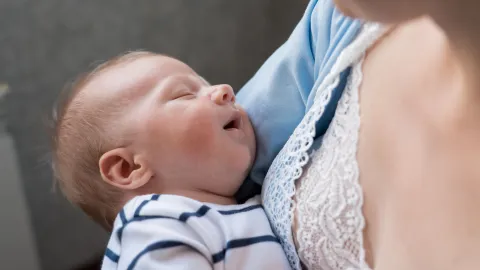
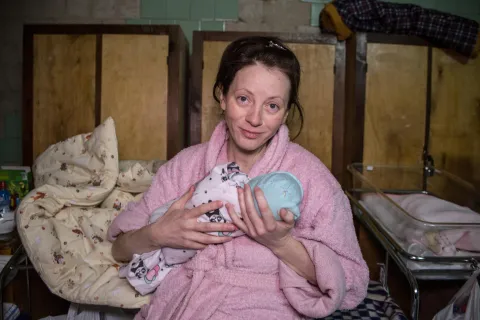
Three in four newborns are breastfed within the first hour, yet only 43 per cent are exclusively breastfed by six months
Joint press release by the Ministry of Health of Ukraine, UNICEF and WHO
- Українська
- English
KYIV, 3 August 2026 — New data from the 2025–2026 Multiple Indicator Cluster Survey (MICS) shows that 74% of newborns in Ukraine were breastfed within the first hour after birth, an important step that supports both maternal and infant health. However, only 43 per cent of infants aged 0–5 months receive only breast milk, as recommended by the World Health Organization (WHO) and UNICEF.
These findings come at a time when families in Ukraine are raising young children for a fifth year under the extraordinary pressures of full-scale war.
Breast milk is one of the most reliable ways to protect the health of infants, especially during emergencies. It is free. It requires no boiled or filtered water, no sterilised bottles and no access to a pharmacy. It is always safe and ready, even when there is no electricity or clean water.
As Ukraine marks World Breastfeeding Week from 1-7 August, the Ministry of Health of Ukraine, UNICEF and WHO are calling for greater support for families with young children to enable breastfeeding, and the dissemination of evidence-based information on breastfeeding.
“The foundations of a child's health are laid in the very first moments of life. That is why breastfeeding support is not merely about a baby's nutrition, it is also an essential part of child health policies. Even during a full-scale war, we need to ensure the best possible conditions for every child. This means not only providing high-quality health care but also helping parents make decisions that support their child's long-term health. Our task is to ensure that every family receives the evidence-based information, professional assistance, and support they need to breastfeed successfully,” Viktor Lyashko, Minister of Health of Ukraine.
WHO and UNICEF recommend exclusive breastfeeding for newborns from birth to 6 months, where they are fed only breast milk and nothing else. Breast milk contains all the nutrients that an infant needs for healthy growth and development, and to protect them from diseases. They don’t need water, tea, juices, formula milk or breast milk substitutes, or any other liquids or foods during the first six months.
"Breastfeeding helps give children the best start in life. Enabling breastfeeding protects the right of every child to good health. Every mother must have access to a supportive environment to breastfeed exclusively for the first six months and beyond," said Anne-Claire Dufay, UNICEF Representative to Ukraine.
“Breastfeeding is the natural foundation for healthy growth and child development. Children who are breastfed have lower risks of overweight, obesity, and type 2 diabetes later in life, while mothers have reduced risks of breast and ovarian cancers, as well as lower risk of noncommunicable diseases like obesity, diabetes, and cardiovascular diseases. Breastfeeding has mental health advantages for mothers and helps to lower stress, reduce the risk of postpartum depression, and strengthen the emotional bond between mother and baby. It is also one of the most important investments in population health. WHO and partners will continue to support efforts to protect, promote, and support breastfeeding”, said Dr. Jarno Habicht, WHO Representative in Ukraine.
After 6 months of age, an infant must continue to be breastfed while nutritious complementary foods are introduced to their diet. However, the MICS survey also shows that healthy feeding practices after six months need further attention. Among children aged 6–23 months, 56 per cent already consume sugary drinks, and 21 per cent already eat unhealthy foods.
The Ministry of Health, UNICEF and WHO recommend:
- Starting breastfeeding within the first hour after birth.
- Feeding babies only breast milk during the first six months, without giving water, teas, juices, formula milk or breastmilk substitutes, or other foods and liquids.
- Introducing nutritious complementary foods from six months, while continuing breastfeeding up to two years of age or beyond.
- Seeking support from healthcare professionals or trained breastfeeding counsellors if challenges arise.
- Fathers, family members and employers supporting mothers so that they can breastfeed, by helping with household tasks, ensuring rest and emotional support, time off from work, and creating a safe and comfortable environment for breastfeeding.
Parents can find more information on breastfeeding and infant and young child feeding through:
- the resources of the Ministry of Health of Ukraine;
- the Path of Parenting platforms.
Note to editors: The 2025-2026 Multiple Indicator Cluster Survey, the largest household survey in Ukraine in 14 years, presents new data on the situation of children and families. The findings can be accessed on the State Statistics Service of Ukraine website: https://stat.gov.ua/en/publications/MICS
Media contacts
About UNICEF
UNICEF works in some of the world’s toughest places, to reach the world’s most disadvantaged children. Across 190 countries and territories, we work for every child, everywhere, to build a better world for everyone. For more information about UNICEF and its work for children, visit www.unicef.org
Follow UNICEF Ukraine on Facebook, Instagram , Twitter та TikTok.