“Working in a COVID-19 treatment centre without protective gear was scary”
Health workers in Masaka Regional referral Hospital share their experiences.

On Monday, 19 October 2021, people from Masaka District in central Uganda and the surroundings areas braved a heavy downpour to access health services at the Masaka Regional Referral Hospital.
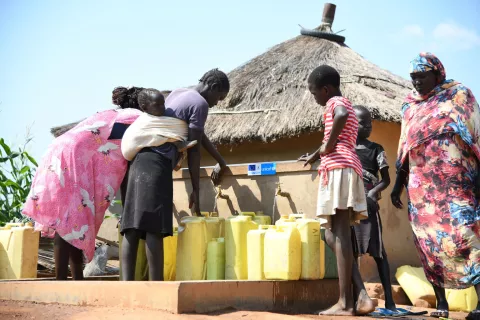
At the entrance just a few metres from the main gate, a water stand with several taps awaits all those entering. It is the first point where everyone washes their hands with soap and water. At a nearby tent, a group of young medical trainees checks the temperature of all those that have washed their hands before proceeding to the different clinics housed at the regional referral hospital.
At the hospital, several health services are offered including vaccination against coronavirus disease (COVID-19), immunization of children, antenatal care, maternal health, among others. In the different clinics, all the health workers and medical interns are wearing masks as they attend to the patients. The masks are given to them by the hospital every morning.
With thanks to funding from the UK Government – UKaid and the US Bureau of Population, Refugees and Migration, UNICEF procured and distributed nearly 7,000 personal protective equipment for health workers at Masaka Regional Referral Hospital to keep them safe from COVID-19. The PPEs include gumboots, glovers, aprons and surgical masks.

“All of us were scared. We didn’t know what to do, how to manage ourselves. It is was very scary to work on patients especially those that have tested positive without protective gear. But now I feel safe to come and support the vaccination exercise,” explains Maria Namirembe, an Enrolled Nurse. Namirembe works in the hospital’s private wing and volunteers to support the vaccination exercise whenever she is off duty or less engaged at the private wing.
At the peak of the pandemic during the first and second lockdown, the hospital attended to many COVID-19 patients warranting the need to heighten the safety of the health workers.

Harriet Kyamulabi, a Nursing Officer who is also supporting the vaccination drive and was part of the team that worked in the COVID-19 treatment centre says, “It wasn’t easy for us to work in the centre without protection. We were fearing to handle patients that tested positive. The first wave was very scary. Everyone that tested positive was admitted and the numbers were high. We didn’t know what to do.”
Kyamulabi further reveals that when they received the PPEs, Ministry of Health, UNICEF and other partners trained them on how to use and handle the PPEs, how to wear and keep them clean, infection prevention and control among others. Namirembe also noted that the trainings were very beneficial and re-energized them to deliver the much-needed services at that time.
The trainings were also funded by the UK Government – UKaid and the US Bureau of Population, Refugees and Migration. During the trainings, the health workers were also encouraged to regularly get tested to ensure easy detection of the virus and undertaking of treatment as early as possible.
Kyamulabi says that she feels safe now that she is vaccinated against COVID-19 and is provided with PPEs while at the hospital.
37 health workers suffered from COVID-19 while the hospital lost two staff – one health worker and one accountant to the virus. The Hospital Director Dr. Nathan Onyachi explained that the two could have contracted the virus from the community and not necessarily the hospital because they never interacted with COVID-19 patients in the course of delivering their duties.
Sr. Juliet Kintu, the In-Charge Maternal Child Health is grateful to UNICEF for the support extended to the hospital before, during and after the peak of COVID-19.
The Hospital Principal Administrator Edward Kabuye says that the government provided PPEs for the health workers in addition to other partners. “We got PPEs from government which were inadequate and when more partners like UNICEF and others came on board, we supplemented what we had received from the government. Complaints of lack of PPEs reduced. Our emphasis was to give those health workers working in the COVID-19 treatment centres. You can’t have demoted health workers and as a manager you sit comfortably,” he further explained.
Dr. Onyachi appreciates the support of UNICEF noting that it was very difficult for the hospital to ask health workers to risk their lives to work on COVID-19 positive patients without PPEs.
“PPEs weren’t enough, but we had quite a lot. Wearing masks inside the hospital is encouraged for everyone including the support staff. Challenge is enforcing it outside the hospital setting,” he observes.
Masaka Regional Referral Hospital serves a population of about 3 million people from nine districts of Masaka, Kalungu, Kalangala, Sembabule, Lyatonde, Rakai, Kyotera, Lwengo, Bukomansimbi and one city – Masaka. Daily, the hospital’s various clinics are visited by 1,500-2,000 people.
The hospital has over 300 staff including the support team.