Seeing COVID-19 patients die was depressing
Fort Portal Regional Referral Hospital Assistant Head COVID-19 Treatment Unit narrates how some patients died due to limited oxygen

The months of June and July 2021 are still vivid in Dr. Francis Natuhwera’s mind. It was when the demand for oxygen for Coronavirus Disease (COVID-19) patients was very high. Some patients died due to lack of oxygen as the hospital worked around the clock to have oxygen cylinders refilled from either Mbarara Regional Referral Hospital or Mubende Hospital.
“It was a depressing moment because we would register one death per day."
"There was a day six COVID-19 patients died. We suffered from depression because the death rate was so high,” explains Natuhwere, the hospital’s Assistant Head of the COVID-19 Treatment Unit (CTU). 108 COVID-19 patients died during the peak of COVID-19.

The situation at Fort Portal Regional Referral and other regional referral hospitals is better, thanks to the United States Bureau of Population, Refugees and Migration who through UNICEF supported the procurement of oxygen and refilling of oxygen cylinders to save lives of not only COVID-19 patients but other critical patients like preterm and term babies; expectant mothers and others admitted in critical condition.
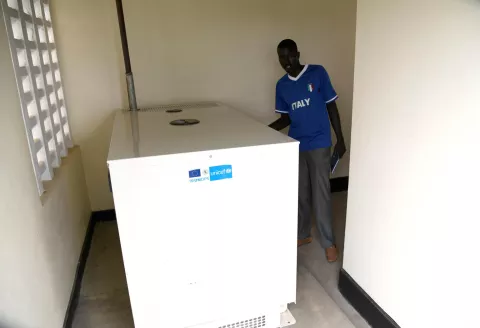
Whereas the hospital has an operational oxygen plant, it couldn’t sustain the demand. The plant produces oxygen for 38 cylinders in a day yet the demand at that time was 60 cylinders per day. Noting that oxygen is utilized in other hospital units.
The hospital’s COVID-19 Treatment Unit had 16 patients on 23 November 2021 with only five of them using oxygen. The National Medical Stores provides about 60-70 filled oxygen cylinders to the hospital twice a month.
“The admissions and death rate significantly reduced. We thank the government, partners like UNICEF, politicians and well-wishers who have contributed to ensuring that we have more oxygen provided and personal protective equipment (PPEs). The situation is much better, and our current admissions do not go beyond 20,” Natuhwere explains. He also says that utilization of the PPEs was high as at one moment, the CTU would have 20 health workers working on patients, adding that the PPEs were critical to keeping the health workers safe.
Asked the longest time a COVID-19 patient was admitted at the unit, Natuhwere reveals that a 97-year-old spent 2 ½ months in the unit but unfortunately three weeks after he was discharged, he passed on.
“COVID-19 causes a lot of damage not only to the lungs but the entire system in the body even after you have recovered,” he adds.
Apart from contributing to oxygen supply at regional referral hospitals, US BRPM funds were used by UNICEF to procure an assortment of PPES – coveralls, masks, aprons, and gloves, to all regional referral hospitals and national hospitals. These include: Fort Portal, Arua, Kayunga, Masaka, Mbarara, Kabale, Soroti, Moroto, Mbale, Jinja, Gulu, Lira, Hoima, Kiruddu, Mulago and Nambole COVID-19 Treatment Centre.
US BPRM through UNICEF also funded the provision of a set of handwashing facilities (foot operated handwashing stand, 60 litre mini water tank and bucket), liquid soap, sanitizers to the regional referral hospitals for infection prevention and control.

Outside the Fort Portal Regional Referral Hospital CTU, the hospital is practicing strong infection control and prevention where the health workers working in the unit disinfect their gumboots, wash their gloves and later hands thoroughly with chlorine, remove the disposal aprons, masks, gloves and other re-usable protective wear like gaggles. Two handwashing facilities are stationed in this area to support this process which lasts for about 10 minutes per individual. All this is done to protect the health workers who are working tirelessly in the CTU from contracting COVID-19.
Still with US BRPM funding, regional referral hospitals were provided with hospital decongestion items such as benches, conference tables, plastic chairs, and emergency tents, all procured by UNICEF.
At Kiruddu Hospital in Kampala, transport service hire for the movement of health workers during lockdown was implemented by UNICEF using funds from US BRPM.