Oxygen flows again at Soroti Hospital
UNICEF Installs first ever Oxygen Plant-in-a Box to save critical COVID-19 patients and babies with breathing difficulties

The activity at the COVID-19 treatment unit in Soroti Regional Referral Hospital remains calm. A few health workers move about preparing medicines while others clean the surrounding environment. Some roll out empty oxygen cylinders outside the unit for refill. Others dressed in full Personal Protective Equipment (PPE), from head to toe, attend to the five admitted patients battling the COVID-19. All the patients are on oxygen support, critical for their stability. Additional full oxygen cylinders are lined up at the triage area in case a patient needs a quick refill. The doctors are optimistic that they will pull through – the medications are available and so is the oxygen. But we are told, the situation right now cannot compare to the crisis the unit handled a few months ago.
The Genesis
“The story of oxygen begun in March 2020 when the COVID-19 pandemic, an illness whose treatment centred around oxygen was declared,” recalled Dr. John Wilson Etolu, Head of the COVID-19 Treatment Care Unit of the Eastern Region. He further narrates that at the start, the COVID-19 pandemic in Uganda was manageable with majority of the cases stable and very few severe ones until July 2021 when the first death was registered. “This is when the country’s oxygen requirements shot up.”
At the Soroti Regional Referral Hospital, the oxygen plant that pumped oxygen twice a week was run day and night to address the increasing demand. Even then, the oxygen requirements could not be matched by the production capacity of the plant.
The second wave hits with limited oxygen supply
Sadly, as the hospital maneuvered through those difficult times, the second wave hit the nation, not sparing the Eastern region where the hospital is located. COVID-19 cases and admissions at the facility spiked – with an average of about 200 on the ward and majority requiring the much-needed oxygen.
“Our average daily hospital oxygen requirements for the COVID-19 unit and other critical units like the Neonatal Intensive Care Unit (NICU) and operating theatre, at the time were about 120 cylinders, yet the plant was only able to pump 20 to 30 cylinders per day. The deficit was so big, and the demand was high.”
Sourcing oxygen from neighbouring hospitals and later from faraway Kampala didn’t seem like a workable solution given that the hospital lacked sufficient cylinders to support urgent refills. The already bad situation was made worse when the oxygen plant broke down a few months into the crisis.
“We didn’t have oxygen pumped at the hospital at all! We relied entirely on refills from Kampala, with support from Ministry of Health and other partners including UNICEF which was very slow.”
With this dire situation, several patients in the COVID-19 treatment centre and other critical units like the NICU didn’t make it.
“We could have lost about 40 to 50 patients only because we lacked oxygen,” Dr. Etolu sadly recollects.
UNICEF installs plant, oxygen flows again
Pondering on those horrible days that he and his staff endured, Dr. Etolu shares that over the past five or four months, the most used word at Soroti Regional Referral Hospital was ‘oxygen’. Health workers would not complete a conversation without using the word oxygen. Whenever a call for an ambulance came through, the first question would be – ‘what is his/her oxygen concertation level? Is he/she on oxygen? Does the ambulance have oxygen?. “Everything was centred around the word oxygen.”
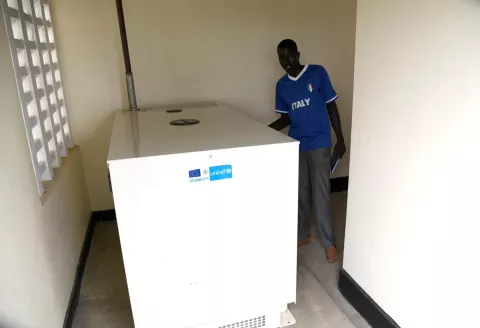
Thankfully these bad days have since been put behind them. Today, the hospital boasts of a new oxygen plant installed by UNICEF with funding from the US Bureau of Population, Refugee and Migration to cater to the oxygen needs of the regional health facility. The fully functional plant, the first of its kind in the world pumps a maximum of 50 small and 60 large cylinders a day.


The hissing and buzzing sounds at the plant are nonstop, as the clean air needed so badly by patients with breathing difficulties is pumped into the cylinders. Several cylinders are already full and awaiting deployment to the various wards. With the new cylinders supplied with the plant, the hospital now has about 400 cylinders from only 100 in June 2021.
“We believe that the plant will serve the hospital, region and neighbouring sub-regions.”
To fully optimize the use of the new oxygen plant as well as ensure continuous flow of oxygen to critical areas of the hospital, UNICEF will support piping of oxygen from the main plant to the Neonatal Intensive Care Unit (NICU), operating theatre, and maternity ward, for a start. This will also minimize the use and demand of cylinders.
Thankfully, according to UNICEF’s Supply Manager, Jon Blasco, the plant comes with majority of the equipment required for the piping, so this will be completed soon.
With the new COVID-19 wave brought by the Omicron variant, Dr. Etolu confirms that a spike in COVID-19 cases is anticipated early 2022 after the economy is fully open. However, he is optimistic that the facility is currently equipped to take on the challenge, should another wave hit the nation or his region.
“With the new plant, the oxygen needs of the hospital and patients are covered,” Dr. Etolu concluded.
The hospital currently has sufficient oxygen, not only for the COVID-19 treatment unit but also other wards like the NICU where 16 small and sick babies whose breathing was ably supported by the oxygen pumped from the new plant.