Keeping children out of hazardous gold mines in Busia
Marion’s story

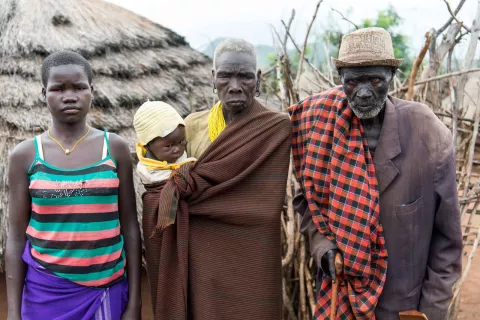
16-year-old Monica Achom goes about her house chores calmly at her parents’ home in Amagoro village in Tiira, somewhere in Uganda’s eastern district of Busia. But as she does the laundry, helps out in the kitchen and babysits her little sister, Sarah, Marion has one dream – to go back to school.
“I stopped going to school because my parents did not have enough money for my fees,” says Marion, who dropped out of Senior Three. Apart from the usual lessons in class, Marion says she missed being part of the school choir and the Scripture Union club where she had been part of the leadership. “I enjoyed singing and training my friends in the choir,”
Her father, Philip Lwande, confirms that it has been quite difficult to ably cater for all his eight children, most of whom have now left home to try and eke out a living.
Marion’s desire to go back to school drove her into the hazardous business of artisanal mining within the environs of Tiira, one of the areas booming with artisanal gold mining activity in Busia District. About 10,000 to 15,000 children reportedly work alongside 50,000 adults as artisanal gold miners in Uganda, according to a 2016 report of the Amsterdam-based Centre for Research on Multinational Corporations (SOMO) entitled No Golden Future. It adds that while some of the children periodically attend primary school while working in the mines, very few of them eventually go on to secondary school.
UNICEF’s Child Poverty and Deprivation in Uganda: Voices of Children 2015 Report identifies poverty and deprivation as one the main drivers of child labour in Uganda, as children resort to work, including hazardous labour, to earn a living and meet their basic needs. Over half (55 per cent) of all young children in Uganda are deprived of at least two basic services including health care, nutrition, water, education, shelter, etc., with 38 per cent of all 5-17-year olds living in this multi-dimensional poverty.
In Busia, district authorities confirm that poverty and deprivation drive other Child Rights violations such as child neglect, with parents and caregivers devoting large amounts of time to mining and leaving children unattended for long periods, to fend for themselves. Artisanal gold mining activities have also greatly affected school enrolment rates in the district as many children, like Marion, drop out to engage in mining.
“We have seen many cases of parents and caregivers that are too ill to fend for their children’s needs due to long term exposure to the toxic substances used artisanal mining,”
“HIV infection and other sexually transmitted infections also pose a great risk to these communities since businesses serving these communities, like local restaurants, lodges and hotels often prefer to hire younger girls and boys to attract customers, who in turn tend to lure them into sex work,” he adds.
Children’s Rights and Business Principles
In 2004, UNICEF Uganda collaborated with the Government of Uganda, Private Sector and other partners to launch the Children’s Rights and Business Principles (CRBPs), a set of ten guidelines for companies to adopt more child-friendly ways of doing their day-to-day business. The CRBPs, established by UNICEF, Save the Children and the United Nations Global Compact (UNGC) to guide businesses globally, are intended to engage companies to adopt child-friendly policies and practices in their activities and networks. Such practices include eliminating child labour from their supply and value chains, as well as adopting both socially and environmentally responsible practices in the workplace, marketplace and community.
To operationalise the CRBPs within Uganda’s Extractives and Mining Sector, UNICEF joined a coalition of partners working with the artisanal mining (ASM) communities in the sub-counties of Buteba, Busitema and Sikuda in Busia District in 2018 to advocate for and promote the rights of children to health, education and protection. The Dutch-supported Coalition includes Uganda-based NGOs Solidaridad, Environmental Women in Action for Development (EWAD), the Netherlands-based HIVOS, and Fairtrade Africa. It also has two Netherlands-based private sector partners, Fairphone and Phillips, while UNICEF was co-opted as a strategic partner to support advocacy efforts to eliminate child labour and other Child Rights violations in the ASM communities and promote learning and skilling opportunities for children and young people as alternatives to hazardous ASM activities.
Throughout 2019, UNICEF collaborated with the Child Labour Unit in the Ministry of Gender, Labour and Social Development (MGLSD) and worked closely with coalition partners EWAD and Solidaridad to address child labour and other Child Rights violations within the mining activities and communities in general.

As part of this effort, UNICEF engaged the district authorities as well the leadership of various artisanal small-scale mining (ASM) business associations to initiate and foster a sustained dialogue to systematically address the Child Rights issues of children in the ASM communities. Both the district and ASM business leaders were oriented on the CRBPs, alerting them to their various obligations and responsibilities to ensure that children in mining communities survive, thrive, and keep out of the mines.
While Solidaridad works with ASM associations to adopt safer and more responsible mining techniques, EWAD has worked with the communities to set up motivational centres where children and young people withdrawn from mining are supported to transition either back to school, or with vocational skills for those youth who feel they have outgrown primary school and prefer to go into decent employment.
National-Level Efforts
This is in addition to national-level efforts where UNICEF has collaborated with the MGLSD, coalition partners and other stakeholders through the National Steering Committee on Child Labour (NSCCL) to link into the existing development process of the National Child Policy and the review processes of the Employment Act, Workers Compensation Act and the Mining Act to review them with a Child Rights lens.
UNICEF has also engaged the Uganda Chamber of Mines and Petroleum (UCMP) to advocate for Child Rights in the Extractives and Mining Sector, encourage them to adopt child-friendly business policies and practices, and support programmes to provide learning and skilling opportunities for children and young people, to enable them to earn a decent living to escape multi-dimensional poverty.
As for Marion, EWAD’s motivational centre at Tiira Primary School came to her rescue when she decided to leave the hazards of the gold mines and return to school.

“I want to go back to school, but in the meantime, I’m learning hairdressing to enable me start a business,”