COVID-19 testing and mass vaccination in Kamwenge District keeping numbers low
"“UNICEF is our biggest partner and we are very grateful. We get supplies from them in big numbers. This has stabilized the district."

In Kamwenge District western Uganda, COVID-19 testing and mass vaccination campaigns have pushed the virus cases low.
Dr. William Mucunguzi, the district health officer says the population is regularly sensitized on the testing and vaccination, which are all provided free of charge.

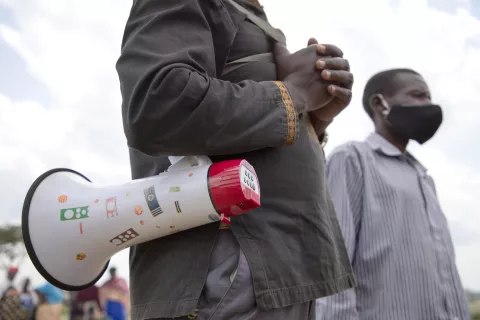
“When the vaccines get to the district, we announce on radio and through different leadership structures, politicians, religious leaders, health workers to let the population know that the vaccines are here. We also tell them about the vaccination centres and the times the exercises will be conducted,” .
Mucunguzi reveals that the district which started with five COVID-19 testing centres now has 20 with an aim of bringing services closer to the people. “We have even gone to health centre IIs for as long as we have the required staff to support the vaccination. People now take vaccination against COVID-19 as something that is going to save them and help open up the entire economy,” he explains.
On rapid testing, the district health officer says that all health centre IIIs and above are testing for COVID-19 which has contributed to the reduction of the virus in the communities because positive patients are initiated on treatment immediately. “We continue to conduct testing, and this has helped us break through,” the district health officer further adds.
As of 24 November 2021, 33,100 people had been vaccinated while 347 tests have so far been conducted with 30 confirmed positive cases and 2 deaths.
Kamwenge, a refugee hosting district has been supported by UNICEF to respond to and contain COVID-19 in the community, health facilities, schools, refugee settlements and district premises.
With funding from the United States Bureau of Population, Refugees and Migration (US BPRM), UNICEF has supported Kamwenge District with infection prevention and control supplies, personal protective equipment.
“UNICEF is our biggest partner and we are very grateful. We get supplies from them in big numbers. This has stabilized the district. When we received PPEs from UNICEF, our health workers had their confidence gained and they comfortably continued to deliver their work,"
He notes that among the items received masks – surgical and N95; gloves – examination and surgical; supplies like disinfectant, chlorine, toilet soap, washing soap, handwashing stations, liquid soap, sanitizers, gumboats.
“If you move around the district premises, in schools, worshipping places, markets and most public places, most of the handwashing stations and supplies used are from UNICEF. What we need to do is re-enforce utilization of all these supplies and encourage communities to adhere to the standard operating procedures,” Mucunguzi.
At Rwamwanja Health Centre III, UNICEF also provided IPC supplies, PPEs and filled oxygen cylinders, thanks to US BPRM funding that made this possible. The health centres serves 87,304 refugees and nationals.