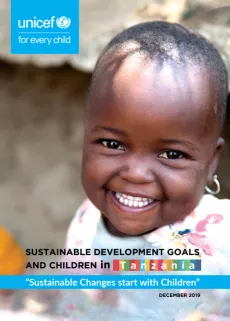
Sustainable Development Goals and children in Tanzania
Sustainable changes start with children
Highlights
In 2015, the 193 member states of the United Nations agreed on the 2030 Agenda for Sustainable Development consisting of 17 Sustainable Development Goals (SDGs) and 169 targets. The new agenda builds on the progress achieved towards the Millennium Development Goals between 2000 and 2015. The SDGs are an ambitious and universal “plan of action for people,planet and prosperity” and represent a historic opportunity to advance the rights and well-being of every child. Sustainable development is, by definition,development that can be carried on and sustained by future generations; making the right choices for children is critical to the SDG agenda. There can be no sustainable development, prosperity or peace without reaching all children.Tanzania actively participated in the formulation of SDGs by hosting two rounds of national consultations on what the focus should be of the post-2015 development agenda and its implementation. The Government of the United Republic of Tanzania also made contributions to the inter-governmental discussions on SDGs, the means of implementation and measuring SDGs. Compared with their predecessors, the Millennium Development Goals, SDGs go further in addressing the root causes of poverty and take a stronger stance on equity. Equity – a fair chance for every child to access the tools, services and skills they need to reach their full potential – needs to be a guiding principle in the implementation of the SDGs for children. Eliminating poverty remains the overarching goal while recognizing the critical importance of promoting equity to achieve this. The goals are linked by a pledge “that no one will be left behind…and we will endeavour to reach the furthest behind first.” In fact, the new targets cannot be achieved unless we make the most disadvantaged children a priority, adapting policies, programmes and public spending to promote greater equity.
Children are central to the 2030 Agenda and the SDGs: the importance of investing in children and their roles as agents of change have been explicitly referenced, encouraging countries to think holistically and consider the linkages between different policies and investments that impact children. Although all of the 17 goals and 169 targets of the agenda touch the lives of children in one way or another,14 goals and 95 targets are either directly (48 targets) or indirectly (47 targets) relevant to children.
This report focuses on 8 goals (1, 2, 3, 4, 5, 6, 8, and 16) that include commitments directly related to children, while also touching on goals that do not explicitly concern children, but which bear relevance to their direct living environment (10, 11 and 13). This report will also focus on 17 of the 232 global indicators for which UNICEF has been identified as the official custodian or co-custodian for purposes of global reporting, with the key indicators, which are crucial in the local context in Tanzania. The analysis of the general trends and status of goals
addressed in this report are framed by targets relevant to children’s well-being and their corresponding indicators that are both globally defined and country specific, depending on the data available. Data from different sources, including government reports, national surveys, administrative reports and global databases have been used to capture a comprehensive snapshot of where Tanzania’s children are at the start of Agenda 2030. The report begins with an overview of SDGs and their relevance for children, continues with an analysis of their status and national response to each of the 11 SDGs that are relevant for children and concludes with key conclusions and recommendations on the way forward.