Mobile clinics deliver life-saving health and nutrition services to remote communities in rural Hama
UNICEF in Syria supports skilled counselling on exclusive breastfeeding and micronutrient supplementation to vulnerable and earthquake-affected families

Ghawr Al-Assi village, Hama Governorate, Syria: “The demand in this area is remarkably high. The crowds of mothers and children waiting for our arrival highlight how much our help is needed,” says Oula, the paediatrician in the UNICEF-supported mobile clinic in Ghawr Al-Assi village in rural Hama.
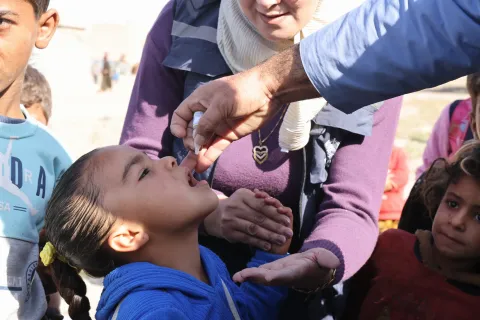
The UNICEF-supported mobile clinic regularly visits the village to provide essential health and nutrition care to families.
With the generous support of the Government of Kuwait, the clinic offers a range of nutrition services including nutrition screening for pregnant and lactating women, treating cases of severe acute malnutrition among mothers, providing multiple micronutrient powders for children under five, and iron-folate acid supplementation for pregnant and lactating women. The clinic also offers skilled counselling on exclusive breastfeeding during the first six months of an infant’s life and guidance on complementary feeding for children under two.

Thanks to the invaluable support of the Bureau for Humanitarian Assistance, the mobile team also provides primary health care services, including medical consultations and medicines for mothers and children.
“I appreciate the regular visits of the mobile team. The health workers treat our children and monitor their growth. We don’t have a health center in our village, and we can’t afford to travel to the nearby clinic,” says Marah, who came to the team with her daughter, Jawa, for a check-up.
“I appreciate the regular visits of the mobile team. The health workers treat our children and monitor their growth. We don’t have a health center in our village, and we can’t afford to travel to the nearby clinic.”

The team conducts individual and group awareness-raising sessions for caregivers on infant and young child feeding. “I provide educational sessions while mothers are waiting for their turn. These sessions guide mothers and caregivers on essential topics related to infant and young child feeding and emphasize the importance of breastfeeding for both the mother and child,” explains Pascale, a health educator with the team. “The malnutrition rate is rising, especially after the earthquake. Most families survive on very little income. I try to teach them how to feed their children using food alternatives available in rural areas,” she adds.
“These sessions guide mothers and caregivers on essential topics related to infant and young child feeding and emphasize the importance of breastfeeding for both the mother and child.”

Nouh, a two-year-old boy, is diagnosed with acute malnutrition. His mother, Maria, didn’t breastfeed him because she thought her milk lacked the necessary nutritional value. “After attending these sessions, I realized that I followed incorrect practices in feeding my son, which contributed to his malnutrition. I used to give him formula, cow milk, or boiled anise, leading to frequent digestive problems,” Maria says. “I am grateful for this useful information. Now I feel confident because I know how to feed him properly,” she adds.

“After attending these sessions, I realized that I followed incorrect practices in feeding my son, which contributed to his malnutrition. I used to give him formula, cow milk, or boiled anise, leading to frequent digestive problems.”
Maria, who recently gave birth to her baby Riham, is now breastfeeding her after attending the awareness sessions. “I started visiting the clinic when I was pregnant. Honestly, I wasn’t planning to breastfeed Riham because I thought my milk was insufficient, but after attending the breastfeeding sessions, I understood that my milk is the best and safest nutrition I could offer my baby,” Maria explains.
“After attending the breastfeeding sessions, I understood that my milk is the best and safest nutrition I could offer my baby.”

“Many mothers have misconceptions about breastfeeding. They don’t trust the nutritional value of their milk. It is our role to explain the benefits of breastfeeding for both mothers and children,” says Sidra, one of the health workers. “I am proud of Maria. She is committed to breastfeeding her daughter Riham until she turns two. This is the positive change we want to see,” she adds.

“Many mothers... don’t trust the nutritional value of their milk. It is our role to explain the benefits of breastfeeding for both mothers and children.”
Hala, who is eight months pregnant, visits the mobile clinic regularly for check-ups and is determined to breastfeed her baby. “I am expecting my first child, and I consider myself lucky to have the mobile team visiting us frequently. I listened carefully to the sessions on exclusive breastfeeding, and I can’t wait to experience breastfeeding,” she says.


“I am expecting my first child, and I consider myself lucky to have the mobile team visiting us frequently. I listened carefully to the sessions on exclusive breastfeeding, and I can’t wait to experience breastfeeding.”
In Syria, increasing food insecurity, collapsing health care systems, and the recent devastating earthquakes have led to a dramatic rise in malnutrition among children. Since malnutrition can cause irreversible physical and mental damage, UNICEF is making every effort to treat and prevent malnutrition in the country, ensuring that future generations have a healthy start.
Since 2023, UNICEF in Syria has reached 1.8 million caregivers with guidance on optimal infant and young child feeding practices. As part of its nutrition programme, UNICEF has screened more than 2.1 million children under five and pregnant and lactating women for malnutrition and has reached over 1 million mothers and children with micronutrients. Additionally, more than 12,200 children under five have been treated for severe acute malnutrition.
These activities were funded by the Bureau for Humanitarian Assistance (BHA/USAID); Governments of Australia, Austria, Canada, Kuwait, and Norway; the German Federal Foreign Office; United Nations Central Emergency Response Fund; Syria Humanitarian Fund; the Foreign Commonwealth and Development Office; King Salman Humanitarian Aid and Relief Center; the Swedish International Development Cooperation Agency (SIDA); and UNICEF’s National Committees for United Arab Emirates, Germany, Japan, Spain, Canada, Finland, Italy, and New Zealand.