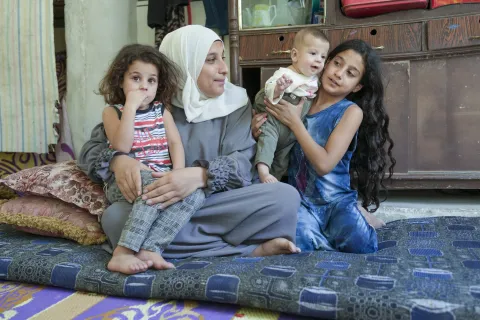
Breastfeeding: Zainab’s precious gift for her child
UNICEF encourages breastfeeding to improve health and nutrition of infants and young children in Syria

Hazzeh village, Rural Damascus, Syria: “I thought that mother’s milk doesn’t have enough nutritious value for babies," Zainab, a 38-year-old mother of seven, explained about her misconceptions regarding breastfeeding. “My six boys used to cry when I breastfed them. They were always hungry,” she clarified. Zainab had never breastfed her boys because she believed her milk was insufficient.
Due to the ongoing conflict in Syria, Zainab fled her town with her husband and children in 2011. They kept changing places until settling down two years ago in Hazzeh village, in Rural Damascus.
Zainab’s husband works in a dairy factory and his salary is never enough to cover their basic needs. “We often have one meal a day. Sometimes we have nothing to feed our children, except some oil and bread," she added. Due to the family’s difficult situation, Zainab used to feed her children inappropriate foods like boiled anise or cornstarch, in addition to cow’s milk when available.

“We often have one meal a day. Sometimes we have nothing to feed our children, except some oil and bread"
After delivering her youngest baby girl, Athinat, in 2022, Zainab heard about a UNICEF-supported mobile clinic visiting her village to offer health and nutrition services to mothers and children. She took her daughter immediately for a check-up.

"While waiting for my turn, a doctor explained the importance of breastfeeding," Zainab recalled. “The session was so enlightening. I didn’t know that mother’s milk is so important for the child’s health. Because of the session, I decided to commit to breastfeeding Athinat,” she said.
During this visit, Zainab consulted a gynaecologist about her concerns regarding breastfeeding. The doctor reassured her that mother’s milk is never inadequate for a baby. Despite her past unpleasant experiences, Zainab decided to continue breastfeeding Athinat with the help of the UNICEF-supported team. The team provided her with guidance on proper breastfeeding techniques and recommended foods to improve her milk. They also provided Zainab with appropriate treatment, as she was diagnosed with acute malnutrition.
“The session was so enlightening. I didn’t know that mother’s milk is so important for the child’s health. Because of the session, I decided to commit to breastfeeding Athinat.”

“I feel sorry for my eldest sons; they would have had a healthier childhood if I had breastfed them. However, I am grateful that I lived this experience at least once in my life," she said happily.
“During my regular check-ups, the gynaecologist emphasized that I need to maintain good health to continue breastfeeding,” Zainab said. “I didn’t want to lose the precious moments with my daughter, which made me follow her instructions meticulously. I wanted to recover from malnutrition to keep breastfeeding till the end,” she added.


Athinat was also screened by the health team and provided with food supplements to prevent malnutrition. Two months ago, Zainab fully recovered from malnutrition, and began the weaning process for Athinat, who has completed her second year. "Without the continuous support of the mobile team, I wouldn't have been able to accomplish this. Breastfeeding is a treasure that every mother and baby should benefit from," she concluded.
"Breastfeeding is a treasure that every mother and baby should benefit from."
Only 28% of mothers in Syria exclusively breastfeed their children in the first six months, and 3 in 4 children aged 6 months to 2 years are not receiving their minimum acceptable diet, putting them at risk of poor growth. UNICEF supports mobile clinics that encourage mothers to breastfeed their infants to nourish their children and prevent malnutrition.
Since 2023, UNICEF in Syria has reached 1.8 million caregivers with guidance on optimal infant and young child feeding practices. As part of the nutrition programme, UNICEF has screened more than 2.1 million children under the age of five and pregnant and lactating women for malnutrition and reached over 1 million mothers and children with micronutrients. Additionally, over 12,200 children under five were treated for severe acute malnutrition.
These activities were funded by the Bureau for Humanitarian Assistance (BHA/USAID); Governments of Australia, Austria, Canada, Kuwait, and Norway; the German Federal Foreign Office; United Nations Central Emergency Response Fund; Syria Humanitarian Fund; the Foreign Commonwealth and Development Office; King Salman Humanitarian Aid and Relief Center; the Swedish International Development Cooperation Agency (SIDA); and UNICEF’s National Committees for United Arab Emirates, Germany, Japan, Spain, Canada, Finland, Italy, and New Zealand.