South Asia Unites to Accelerate Action on Ending Violence Against Children
South Asia Unites to Accelerate Action on Ending Violence Against Children
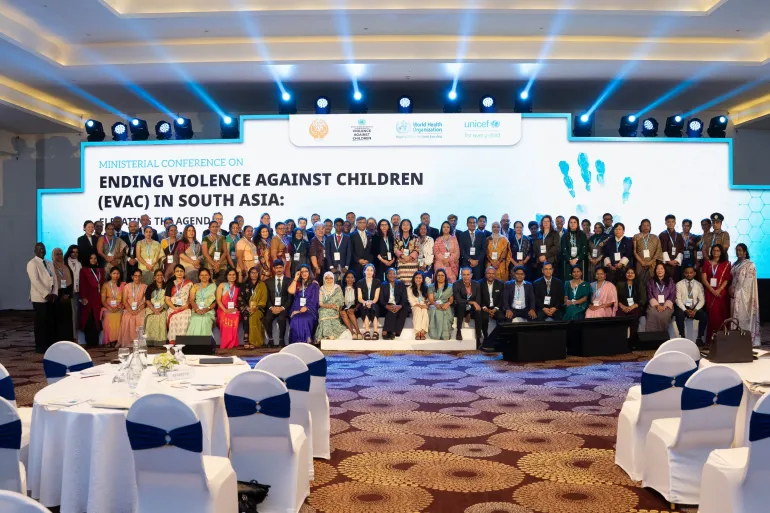
Kathmandu/Colombo, 24 June 2026: The South Asian Association for Regional Cooperation (SAARC), Government of Sri Lanka, UNICEF Regional Office for South Asia (ROSA), the World Health Organization Regional Offices for South-East Asia (WHO SEARO) and the Eastern Mediterranean (WHO EMRO), and the Office of the Special Representative of the United Nations Secretary-General on Violence Against Children (OSRSG-VAC), convened the South Asia Ministerial Conference on Ending Violence Against Children (SAMC-EVAC) in Colombo, Sri Lanka, from 23-24 June 2026.
The Conference brought together ministers, senior government officials, child protection leaders, development partners, and regional experts from across South Asia to strengthen regional commitment and accelerate collective action to end violence against children in all its forms.
Violence against children remains one of the most pervasive and harmful threats to the wellbeing and development of children in South Asia. Across the region, millions of children continue to experience physical, emotional, and sexual violence, including online. These experiences have lifelong consequences for children's health, education, protection, and future opportunities.
"Every child has the right to grow up free from violence, fear, and exploitation. Our shared responsibility is to build societies where every child is safe, valued, and given the opportunity to thrive with dignity and hope.", said Her Excellency, Dr. Harini Amarasuriya, Prime Minister of the Democratic Socialist Republic of Sri Lanka.
The Conference reaffirmed that ending violence against children is both a moral imperative and a development necessity. Participants emphasized that investing in prevention, social protection, family support services, and comprehensive child protection systems yield significant social and economic returns while contributing to stronger, healthier, and more resilient societies.
“Our regional fight is fundamentally tethered to the global promise of the United Nations 2030 Agenda for Sustainable Development. Let us be unequivocally clear: we cannot achieve the global goals if we fail our children.” said His Excellency, Ambassador Md. Golam Sarwar, Secretary General of SAARC.
Building on the momentum generated by the First Global Ministerial Conference on Ending Violence Against Children held in Bogotá, Colombia, in November 2024, and the Ministerial Information Sharing Meeting “Elevating the Ending Violence Against Children (EVAC) Agenda in South Asia” Kathmandu, held on 23 June 2025, delegates reviewed progress made by countries in implementing national commitments and pledges, including strengthening legal and policy frameworks, expanding child protection services, improving reporting and response mechanisms, and promoting positive parenting and violence prevention initiatives.
The Conference also highlighted the importance of the Child Protection Systems Strengthening Framework as a practical roadmap for coordinated action across sectors. The conference underscored the importance of effective multisectoral coordination to accelerate ending violence against children from important sectors including health, education, justice, and social welfare and development sectors.
In her opening remarks, Dr. Najat Maalla M'jid, Special Representative of the UN Secretary-General on Violence Against Children, said, "Ending violence against children requires multistakeholder and cross border cooperation. At a time of growing global divisions, multilateralism remains one of our strongest tools for connecting partners, and spearheading solutions within region and beyond, ensuring sustainable investment in child protection and wellbeing. Today’s conference in South Asia represents a key moment to continue working together and faster to keep our promise to end all forms of violence against children in all settings.”
The historic event also highlighted children’s voices from the SAARC region by 17 years old Sri Lankan student Sasindu Ranmith, President of National Children’s Council. “Violence does not happen in just one place. Many don’t even know where to go for help, and even when they do, they don’t trust the system”.
Another focus of the conference was the Call to Action to strengthen implementation of key strategies, monitoring progress, and enhance regional collaboration to accelerate efforts to end violence against children across South Asia applying whole-of-governments and whole-of-society approaches.
“Across South Asia, far too many children still live with violence in their everyday lives — at home, school, online, and in their communities, including through practices like corporal punishment that have lasting and damaging effects on their development and dignity. Governments across the region are showing important leadership by strengthening laws, expanding services, and investing in prevention. But we know that lasting change goes beyond legislation — it requires a shift in mindsets, in how children are raised, taught and protected. Ending violence against children is within our reach if we work together to support families, promote positive discipline, and challenge the norms that allow violence to persist, so that every child grows up safe, respected, and able to learn and thrive", said Emma Brigham, UNICEF Representative in Sri Lanka.
The Officer-in-Charge for WHO South-East Asia Region, Dr Catharina Boehme, said, “Violence against children is not inevitable. It is preventable. Every child has the right to grow up safe, healthy and free from fear. The decisions taken by South Asian countries today can help break cycles of violence, ill-health, and poverty for generations to come.”
Throughout the two-day meeting, countries exchanged experiences, innovations, and lessons learned in addressing violence against children through integrated approaches involving health, education, social welfare, justice, law enforcement, and community systems. Delegates underscored the importance of evidence-based interventions, and called for increased investments in data systems, workforce capacity, social protection programmes, and prevention services.
As South Asia moves forward, SAARC, UNICEF, WHO, and the Office of the Special Representative of the Secretary-General on Violence Against Children reaffirm their commitment to supporting governments and partners in translating commitments into concrete action and measurable results for children.
END
Media contacts
About the Organizers
About SAARC
The South Asian Association for Regional Cooperation (SAARC) was established with the signing of its Charter in Dhaka on 8 December 1985, and its Secretariat was inaugurated in Kathmandu on 17 January 1987. It brings together eight Member States — Afghanistan, Bangladesh, Bhutan, India, Maldives, Nepal, Pakistan, and Sri Lanka — united by geography and shared aspirations for regional progress. The Charter outlines SAARC’s objectives: to promote welfare and improve quality of life, accelerate economic growth and social development, and foster collective self-reliance. It emphasizes building mutual trust and collaboration across economic, social, cultural, technical, and scientific fields, while also strengthening global partnerships with other developing countries and international organizations. SAARC serves as South Asia’s primary platform for cooperation, unity, and collective advancement.
About UNICEF
UNICEF works in some of the world’s toughest places, to reach the world’s most disadvantaged children. Across more than 190 countries and territories, we work for every child, everywhere, to build a better world for everyone.
UNICEF’s Regional Office for South Asia (ROSA) works with UNICEF Country Offices in Afghanistan, Bangladesh, Bhutan, India, the Maldives, Nepal, Pakistan and Sri Lanka to help to save children’s lives, defend their rights, and help them fulfil their potential. For more information about UNICEF’s work for children in South Asia, visit www.unicef.org/rosa and follow UNICEF ROSA on Instagram, Twitter and Facebook.
About WHO
Dedicated to the well-being of all people and guided by science, the World Health Organization leads and champions global efforts to give everyone, everywhere, an equal chance to live a healthy life. Working with 194 Member States across six regions and on the ground in 150+ locations, the WHO team works to improve everyone’s ability to enjoy good health and well-being.
About OSRSG-VAC
OSRSG-VAC serves as a global independent advocate promoting the prevention and elimination of all forms of violence against children. Read more: https://violenceagainstchildren.un.org/