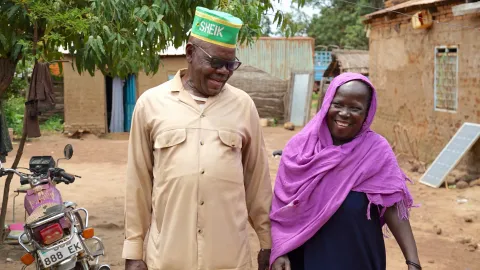
Helping adolescent girls and women, in conflict-ridden South Sudan, emerge strong and independent
Awareness, counselling and vocational skills are enabling several girls and women to substantially improve their quality of life
AWEIL, South Sudan – It was another regular day. She woke up early, went to school and was walking back home, under the scorching mid-day sun, to do her household chores. Just as she stepped into the house, 17-year-old Ameena’s* younger sister ran to her and pushed her to their secret spot.
Breathlessly, she blurted out all she’d heard her parents discuss a plan of having the local trader, from whom they regularly borrowed items to cook, forcefully pick Ameena up while she was returning from school. He could then consummate the ‘marriage’ and come back later to pay the bride’s price.

“When my sister was talking to me, there was a single thought racing through my mind. I will commit suicide, but I will not go with the trader.”
At the Women’s Center in Aweil in the north west of the country, Ameena speaks slowly to a counsellor in English, cautiously stringing her words together so that she’s not misunderstood.
Ameena had heard about the women’s center from a radio talk show that described how it could help women who are forced to marry early, those who are raped or denied resources. “They also announced that girls would be trained in skills that will help them earn a livelihood,” explains Ameena. “I wanted to run away from my house and earn my own money to pay my school fees.”
It took her four days to work up the courage to call the center’s hotline number from a friend’s phone. “When I explained my situation over the phone, the counsellor calmed me down and asked me to come to the center,” she says.
“The only thing she asked was for me to not take any hasty decisions until I met her.”
With the pretext of finding out about the skilling programme, Ameena arrived at the center the next day. “I cried and cried until the counsellor told me that she too was forced to marry early, but had protested and, in fact, succeeded. She made me realize that my situation is common. That I could help myself.”
Ameena was encouraged to seek the support of an elder from a family both she and her parents trusted. She lost no time in seeking refuge in her uncle’s house. Besides taking her in with his own children, he also promised to convince her parents to let her study until she completed the remaining two years of secondary school.
“When he took me to my mother and told her that I’m interested in studying and not getting married, she yelled and nearly kicked me,” says Ameena. “Then, becoming aware that I had the support of my uncle, she calmed down, but she’s resentful even today. My parents don’t speak to me and refuse to pay my school fees. So, my uncle paid the fees for this term.”
She is now among the 10 girls undergoing training in the Center for Adolescent Girls and Women, in embroidery and handwork.
“I will do a good job and when these bedsheets are sold, I will be able to pay my school feels,” she says. “Maybe if I finish my school with good grades, my mother will agree to send me to the university.”
The UNICEF supported center, the only one of its kind in Northern Bahr el Ghazal state, is providing psychosocial support and building livelihood skills among adolescent girls and vulnerable women in the community.
“Cases of rape are extremely common. A lot of women are also abandoned by their husbands,” says Elizabeth Ajok, a counsellor at the center.
“Here, we counsel them and provide options to help them address the issues they face, whether it is seeking legal recourse, reporting to the police, seeking immediate medical care, or, in minor discords, settling it within the community.”

Since its creation in September 2017, the center has received hundreds of women and girls. Women from across the state call the center through the hotline that is promoted through awareness campaigns and radio shows.
Whether in person or on the phone, women and girls are provided information where they can access support. Regular follow-ups are conducted until their issue are resolved to their satisfaction. While the center also provides daily skill training sessions for all vulnerable women and adolescent girls, survivors of gender-based violence are given priority for enrolment in the courses, which include crafting traditional beaded-jewelry, embroidery, basket weaving, and designing furniture. Nearly 200 women have graduated.
Four social mobilizers also conduct outreach activities to spread awareness about the center and sensitize the community about the several aspects of gender-based violence. To encourage adolescent girls’ participation in the programmes, the center has also introduced weekly volleyball sessions, in which nearly 60 girls are currently active.
The women and girls then go on to promote behaviour change in the community, discussing with neighbours the negative effects early marriage and the risks associated with early pregnancy.

“It’s only now that I feel like I’m learning how to live.”
“If I knew all this, I would have educated myself and my girls. I wouldn’t have gotten them married off so early,” says 72-year-old Rosa. “I also just learned how to write my name. I can even add and subtract and plan my expenditure accordingly.”
UNICEF’s gender-based violence prevention and response programme, which is currently operational in 23 counties across all 10 states in South Sudan reached nearly 200,000 individuals in 2017.
(Grants for the protection and skilling of adolescent girls and women in provided by the German Development Bank-KfW and European Civil Protection and Humanitarian Aid Operations-ECHO)