From Flooding to Preparedness: Wal’s Journey in Fangak
With support from the Postcode Education Trust, UNICEF and the Government of South Sudan are helping schools and communities in Fangak strengthen climate preparedness, protect children’s learning and build resilience to recurring shocks.

In Fangak County, floods can keep children out of school for months. For 26-year-old Wal Gatjiok Teny, this is more than a recurring crisis. It is a reality he has lived, and a challenge he is now determined to confront.
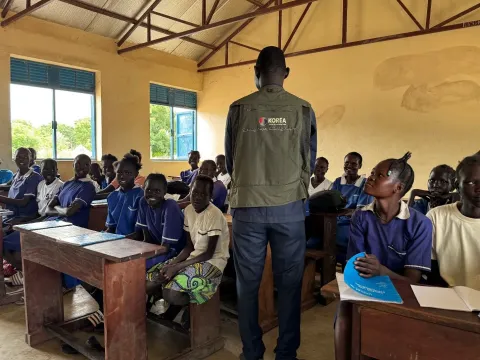
Born and raised in Fangak, Wal witnessed how annual floods disrupted education, destroyed livelihoods and isolated communities. In 2020, severe flooding forced him to leave Comboni Primary School in Old Fangak and relocate to Nyadin village. However, the floods did not end his commitment to education. He continued teaching at Nyadin Primary School, turning personal adversity into purpose. In 2025, he became the school’s headteacher and stepped into a leadership role with a mission shaped by the very challenges that once disrupted his own education.
Our children would miss school for months when the floods came. Roads became impassable, families lost their crops, and many learners could not return to school until the waters receded.
Today, Wal is helping his school prepare for those risks before they arrive.
The work is part of a wider initiative supporting schools and their surrounding communities in Fangak to strengthen resilience to climate-related shocks. So far, the initiative has reached 2,777 people directly, including 2,667 children (1,458 girls) . An estimated 14,000 additional people benefited indirectly through climate awareness activities, school and community planning, and locally led climate action. In a place where floods can keep classrooms empty for months, preparing today can help protect children’s opportunities to learn tomorrow.
UNICEF’s work in South Sudan is helping schools and communities to shift from reacting to climate-related disruptions to preparing for them before they occur. Children, teachers, school leaders and community members are gaining practical skills to identify local risks, develop preparedness plans and work together to protect learning when climate shocks strike.
For Wal, this marks an important step forward. Despite years of teaching, his recent participation in climate resilience and school planning training in Nyadin was his first formal training of this kind. The experience equipped him and his colleagues’ practical tools to assess the risk facing their school and turn that knowledge into concrete preparedness measures and action plans .
The climate resilience training has changed the way I think about the challenges facing our school.It helped me and my colleagues understand that we can prepare for these risks instead of only responding after they happen.
One immediate result was a climate action and preparedness plan for Nyadin Primary School and four neighbouring schools.
“Before the training, climate change felt like a problem beyond our control,” says Wal. “Now we have a plan. We know what risks to look out for and what we can do before they disrupt our school and our children’s learning.”
For Wal, the change is not only about an activity. It is about giving a school the ability to anticipate risks, plan and act before disruption reaches the classroom.

At Nyadin, climate preparedness is becoming more than a school priority – it is bringing teachers and communities together to protect learning from climate-related shocks.Wal works with fellow teachers to strengthen collaboration and teaching, while the initiative is helping position the school as a hub for learning, preparedness and community action.
This work is particularly important in a context where schools face significant resource and capacity constraints, and many teachers are volunteers without being on the government payroll.
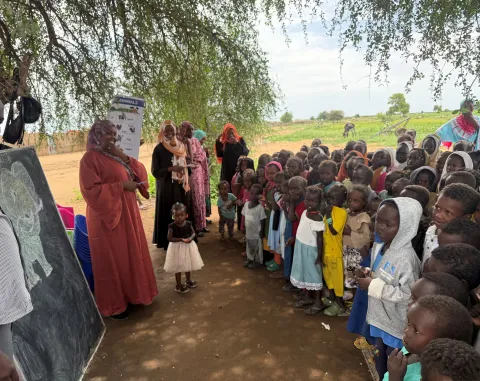
The impact of the initiative extends beyond the classroom. Through climate awareness activities community planning and locally led action, families and community members are becoming part of the effort to anticipate risks and respond collectively, strengthening the links between schools and the communities they serve.
The experience in Fangak is showing how school preparedness, community engagement and local education planning can reinforce one another, an important building block for stronger, more climate-resilient education.
When floods stop children from coming to school, their education suffers.If we can help communities prepare for these challenges, we are not only protecting schools, we are protecting children’s futures.
Tree planting offers a visible example of climate action taking root in everyday school life. But the wider goal is preparedness: ensuring that teachers, schools and communities have the knowledge, plans and confidence to act before climate-related shocks disrupt education.
Wal’s journey - from a teacher displaced by flooding to a Head Teacher helping his school prepare for future shocks shows what can change when schools are supported to anticipate disruption rather than simply respond to it.
And the value of the investment extends beyond Fangak. The experience is generating practical learning on how school preparedness, community participation and local education planning can work together. These are lessons that contribute to UNICEF’s wider work with government and partners to strengthen climate-resilient education in South Sudan.
Change starts with knowledge, planning, and working together.If our children understand how to protect their environment and their community, they will be better prepared for the future than we were.
For Wal, the goal is straightforward: to help his school prepare before the next flood arrives, so children can continue learning without having to wait for the waters to recede before returning to the classroom.
Through support from Postcode Lottery players, UNICEF has helped an initial five schools and their communities in Fangak strengthen climate preparedness, reaching 2,777 people directly, including 2,667 children, and an estimated 14,000 people indirectly. The experience is generating practical lessons on how school preparedness and community action can help protect learning and build resilience to future climate shocks.