UNICEF and WFP Reaffirm Support for Free Primary Education in South Sudan
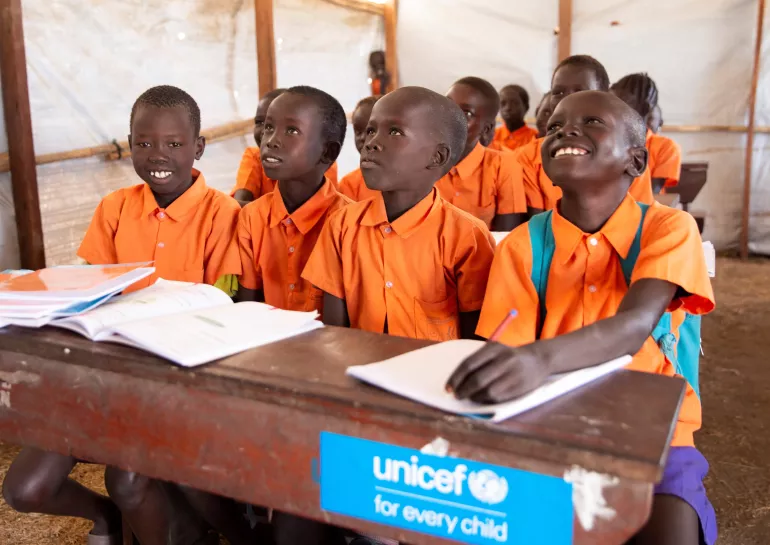
In February, President Salva Kiir directed relevant government ministries to ensure that primary and secondary education is free throughout the country. The directive is a welcome development considering that 2. 8 million, school age children are out of school in South Sudan, according to the Ministry of General Education and Instruction (MoGEI).
School fees and other costs are a major barrier to education in South Sudan and across Africa. But as school reopened in February for the 2023 academic year, many children and families still faced tuition fees and other costs to attend school. The directive could benefit millions of children in South Sudan to access education, for the first time in their life for some, but must be backed by adequate resources and support for schools to realistically offer free education.
With less than 22 percent of the teachers on the government payroll, contributions from learners are used to pay teachers and meet other administrative costs. To implement the directive, regular and timely payment of teacher salaries and incentives must be prioritised as well as the timely provision of school capitation grants. Payments must also be coupled with robust systems for accountability to ensure the resources reach the right beneficiaries and used for the right purposes.
UNICEF and World food Programme (WFP) commend this timely declaration by the President and his commitment to support children’s education. UNICEF and WFP also recognize recent efforts by the Ministry of General Education and Instruction (MoGEI) to pay teachers and transfer capitation grants to schools. UNICEF and WFP commit to work in partnership with MoGEI and all relevant stakeholders to support the President’s declaration to ensure all children have access to schooling. To complement the directive and support its implementation, it is also vital that there is funding available for programmes that incentivize families to send their children to school, such as the School Meals programme.
Both agencies are engaging with MoGEI to rollout a mobilisation campaign on free primary education. The campaign will target out-of-school children throughout the country to get as many children as possible enrolled in school.
UNICEF and WFP recognise that the effective implementation of the President’s decree will require all stakeholders to come together and support its implementation. UNICEF and WFP reaffirm their commitment to work collaboratively with all actors to ensure education services reach all children in South Sudan.
Media contacts
About UNICEF
UNICEF promotes the rights and wellbeing of every child, in everything we do. Together with our partners, we work in 190 countries and territories to translate that commitment into practical action, focusing special effort on reaching the most vulnerable and excluded children, to the benefit of all children, everywhere.
For more information about UNICEF and its work in South Sudan visit: www.unicef.org/southsudan
Follow UNICEF South Sudan on Twitter, Facebook, Instagram and YouTube