Without immediate food and aid, the lives of Gaza’s children hang in the balance
Treatment for malnutrition usually requires a steady six-to-eight-week diet of therapeutic supplements, foods, clean water, and specialized treatment.
- English
- العربية
Saad is ten months old. He was born when his mother had already fled their home—a bright spot in the early months of the war. “I was filled with joy and anticipation to meet him. He was like the moon,” says Najah, holding out an earlier photo of her baby.
But when Saad turned seven months, his features began to change. He became gaunt and weak. Like a forecasted 60,000 of children in the Gaza Strip between the ages of 6 to 59 months, Saad had developed acute malnutrition. The war has made it so difficult for Palestinians to get food, with the throttling of entrance routes to Gaza, decimation of markets, and the physical destruction of 70 per cent of farmland, that acute malnutrition has increased tenfold among the population.
Fewer trucks entered Gaza in October 2024 than in any month in the year since the war began. What is available in the market is exorbitantly expensive.

Treatment for malnutrition usually requires a steady six-to-eight-week diet of therapeutic supplements, foods, clean water, and specialized treatment. But Najah despairs of being able to find enough of the special formula that Saad needs. "We live in a tent. Nothing is stable. My husband is unemployed, and I need nutrition for myself because I am breastfeeding, and for Saad, who is malnourished."

The family has been displaced four times, fleeing their home in northern Gaza and other temporary shelters to escape bombardment and the Israeli military.
"We need everything—shelter, clean drinking water, milk, winter clothes, cleaning supplies, and medicine for Saad. We are lacking so much," Najah worries. "Every time I look at him, my heart aches, and I don’t know if I will lose him or find the right treatment."
NO FOOD AVAILABLE
Every day that passes without more food entering the Gaza Strip, lives are at risk. In some areas in the north, which is facing major access restrictions, famine is imminent, says the IPC Famine Review Committee, a specialized working group on food insecurity.
Famine occurs when one in five households have an extreme lack of food, one in three children suffers with acute malnutrition, and there are two adult deaths or four child deaths every day among every 10,000 people.

In October, UNICEF and its partners managed to get past the obstacles and mobilized the Ministry of Health, World Health Organization, UN Relief and Works Agency (UNRWA), and local community leaders to deliver nutrition support to 428,306 children, the highest ever reached in the Gaza Strip in a single month. Tens of thousands of children were provided with micronutrient powder, vitamin A supplements, and treatment for wasting. Pregnant or nursing mothers were given micronutrients and vitamins.

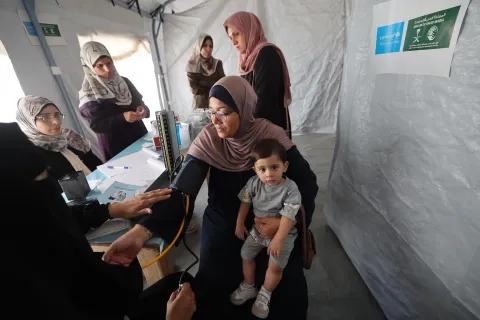
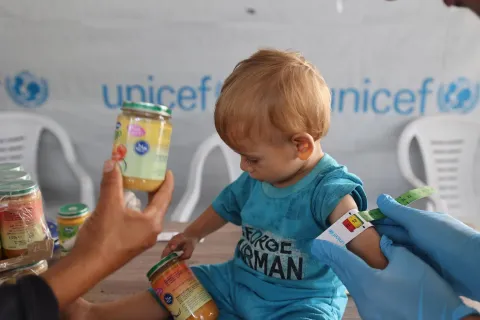
Saja and her six-month-old daughter Sham were seen at a UNICEF-supported pediatrician clinic in Deir al-Balah. There, Dr. Hadeel measured Sham’s middle-upper-arm-circumference (MUAC) as part of her nutrition screening. Saja says that she has had trouble breastfeeding Sham because of her own poor nutrition and the trauma of the war.
"The health conditions in the tents are extremely poor and my pregnancy was incredibly challenging and draining in these conditions,” Saja says. “I was so exhausted during pregnancy and now cannot breastfeed her naturally every day. Adding to this hardship, I was injured in a bombing while I was pregnant and was pulled out from under rubble. This deeply affected my mental health.”

Dr. Hadeel says that at her clinic alone, they diagnose approximately 30 children a week with acute malnutrition.
"The conditions inside the displaced camp are extremely dire,” she says, "and the circumstances are challenging for the children and their families—which is why we are here. Each child has her MUAC recorded and receives 14 packets of vitamins and directions to undergo a medical review every 14 days."
WHEN WILL IT END?
Currently, the IPC is forecasting that conditions are ripe for its worst-case-scenario predictions: famine spreading to the entire Gaza Strip and its two million people between November 2024 and April 2025. The potential banning of UNRWA, the agency that provides services to Palestinian refugees—most of Gaza’s population—is yet another factor tipping the situation towards complete catastrophe.
Eman, a 29-year-old mother of quadruples, also received ready-to-use formula from UNICEF’s partner.

"I've been displaced since the war began and gave birth in the middle of it. My pregnancy conditions were very bad because of lack of food and continuous illness from poor hygiene," Eman said.
“My children arrived after ten years of undergoing fertility treatments," she added. “I'm exhausted from sleeping on the ground and the continuous bombing. I hope for a better future for my children, where they find security and a decent life with basic necessities."

UNICEF, supported by the governments of Poland and Spain, continues to provide nutritional and health supplies for children and their families in the Gaza Strip. It expects to maintain a continuous pipeline for these vital supplies through at least June 2025.