Thirsty, Hungry, and Unable to Wash
Unprecedented Obstacles Stand Between Gaza’s Families and Enough Safe Water
- English
- العربية
Gaza’s families struggle every day to get enough water to drink and maintain the most basic hygiene.
But the odds are almost insurmountable. Key infrastructure has collapsed, and most of the Gaza Strip’s 2.1 million residents are on the move, forced to flee repeatedly by intense bombardments. By August 2025, 81 per cent of public water and sanitation facilities were out of reach, located in areas that were militarized or under displacement orders.
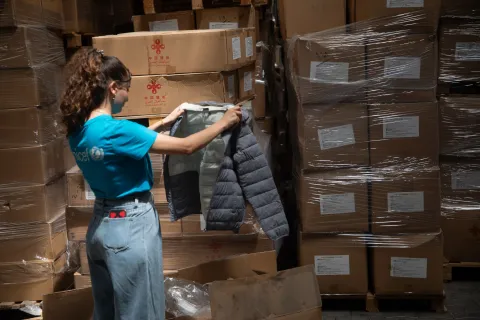
Meanwhile, UNICEF and other humanitarian organizations are prevented from bringing all the needed aid and support into the Gaza Strip to address the burgeoning crisis. Many spare parts, desalination units and generators to maintain and repair existing water production and treatment facilities are waiting to enter.
85% of families live within just ten meters of open sewage, human or animal waste, piles of garbage, stagnant water, or rodent infestations. The majority of families do not have adequate access to hygiene materials (because these items are not on the market and there are heavy controls on how much goods can enter Gaza). 63% of families don’t have soap, and half a million women and adolescent girls are without sanitary pads. Nearly half of all families do not have access to an adequate toilet that is safe and offers privacy.

"The most painful thing for me as a mother is not being able to wash my daughter’s face, not being able to cook a simple meal for my family and not even having enough safe water to give them to drink," says Riham. As the number of people in her makeshift camp grows, water becomes more scarce.
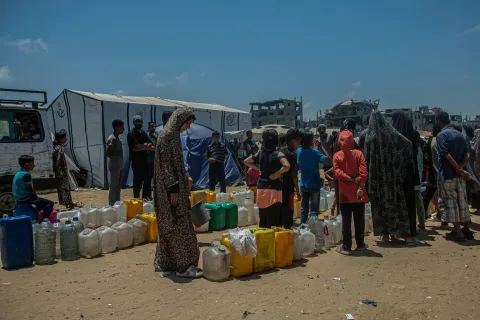
“Now I have to walk nearly two kilometres just to get some fresh water—and even then, it’s not guaranteed,” she says. “The water trucks that come to the camp aren’t enough for all the families waiting in line."
This dire situation threatens children’s health and puts more pressure on already vulnerable families.

UNICEF, with the support of the European Union and the European Union Humanitarian Aid (ECHO), the Minderoo Foundation, the Kuwait Fund, the Republic of Korea, and the governments of Australia, Canada, the Netherlands, Sweden, and Switzerland are ensuring the availability of drinking and domestic water at one point in time for more than 1.5 million people, including over 600,000 children.
By trucking water and increasing the production of private desalination plants and domestic water wells, UNICEF and its partners are doing everything to provide clean water every day.
They also contracted with 15 private desalination plants to provide them with potable water at a subsidised rate so they can truck it free of cost to Palestinians throughout Gaza. Still, this amount of water is entirely insufficient.

UNICEF also provided cleaning services and activities that promote hygiene for 12,200 people, including 4,000 children, internally displaced in Gaza City and Khan Younis. In July, UNICEF distributed 30,000 soap bars, five water tanks to hospitals, and cleaning materials for people in camps, benefiting around 16,000 of the most vulnerable people.
"Our struggle to access water has been going on for a long time,” says Alaa. “The water truck only comes once a day to our displacement camp. We have to reserve our place on the list a day in advance just to get a few litres."

Alaa goes on, "The water we use is often contaminated and unsafe to drink. Often, my family gets stomach aches because the water isn’t clean—but we have no other choice."
"One of the hardest moments for me was going to my neighbours at night to ask for water, only to find none. I went to bed thirsty. Another time, I walked three kilometres just to find water so my son Basel could have a sip to drink."