The terrible living conditions of displaced families
in the Gaza Strip
- English
- العربية
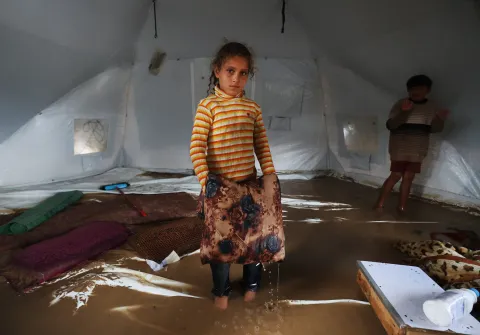
Mays is 13 years old. She lives in a makeshift tent near an UNRWA shelter in the Gaza Strip. Her journey, like many others, is one of suffering and grief. “Her family was displaced from their home due to heavy bombardments, seeking what they thought would be a safer shelter. Tragically, it was in the shelter that Mays's life took a devastating turn.
“Their laugh is the last thing I remember from that night,” Mays whispers. That night, in the shelter, Mays lost her two sisters, killed in a bombing. She was injured. Her leg is broken, held together by pins. She also has partial facial paralysis. Today, she lives with her sister Nihal and her mother Malak.

“Every time she goes into any closed space, she panics, and we have to take her out immediately.”, says Malak.
Life in the shelter is a daily struggle. Access to basic needs like water is limited. “Sometimes a truck comes, and we each get a small amount to drink. Otherwise, we have to drink from the water we use for washing,” Mays explains. The cold is another relentless adversary. Displaced people like Mays and her family have ran without anything but clothes on their back. With temperatures of barely 10 degrees at night, just a couple of covers, the children are freezing. 1.7 million people are displaced in the Gaza Strip, facing similar conditions.

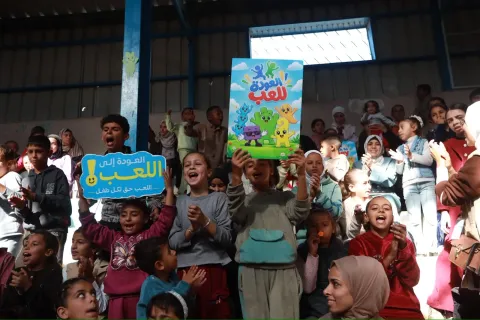
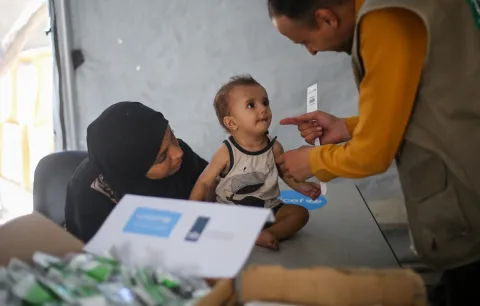
Since the beginning of October, UNICEF and its partners, thanks to the support of the EU Humanitarian Aid, CERF, and the Governments of Germany, Switzerland and Sweden have been pivotal in providing support to these families and their children. UNICEF has delivered thousands of covers and tarpaulins. Winter clothes have also been distributed to more than 36,000 children. Considering the immense mental health impact of this war, UNICEF is delivering psychosocial support services to over 55,000 people, including nearly 45,000 children. This includes in-person structured support, educational sessions on Explosive Remnants of War, and recreational activities for children and adolescents. But this is not enough. More aid is terribly needed and the conditions for aid distribution must be met.
“I am so tired. I cannot handle this anymore. I need it to end.” Her words resonate with a deep desire for peace, and the return to a normal life.
UNICEF urgently calls for a long-lasting humanitarian ceasefire as it is the only way to put an end to the suffering of children.