Life hangs tenuously in the balance in the Gaza Strip
As families return to devastation, concerns grow over access to clean water
- English
- العربية
After a ceasefire went into effect in the Gaza Strip in January, hundreds of thousands of Palestinians streamed back to where their homes used to be in the northern and middle areas of the Gaza Strip.
What they found was utter devastation. Jabaliya refugee camp, once a jumbled but teeming community, lies entirely flattened, rebar and plastic pipes protruding dangerously from concrete rubble and grey dust.
Still, families found shelter by digging out rooms and setting up tents where their homes had stood.

But without clean water—an estimated 1.4 million people in the Gaza Strip barely meet the minimum humanitarian standard of six liters of potable water per day— their situation gets more catastrophic every day.
Since the beginning of March, Gaza’s borders have been sealed to all humanitarian aid, including food, medicine, and fuel. Without fuel, water cannot be pumped to reach these families, and most of them are only able to obtain limited amounts of tankered desalinized water from UNICEF and other humanitarian actors.
The recent severing of power that had been re-established to the UNICEF-supported Southern Gaza Desalinization Plant in November 2024, has again reduced the plant’s production capacity by 80 per cent, cutting in half the availability of potable water to the one million people living in middle and south Gaza.
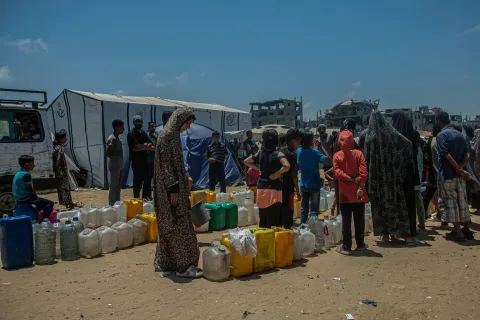
Without access to pumped water, children usually need to find and carry heavy water jerrycans back to their makeshift shelters.

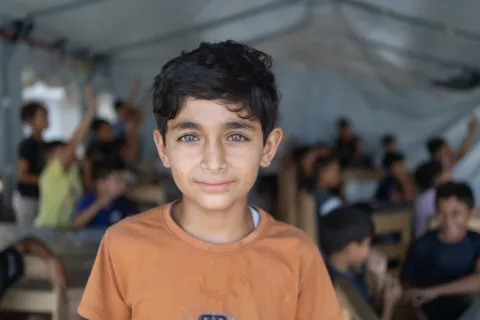
Teenager Mais Abu Saif was displaced from her home in Jabaliya refugee camp early in the war, fleeing to Rafah in the south. “I was very scared at that time—the sight of death and destruction around me, and the soldiers at the checkpoint.”
When military operations took place in Rafah, in April 2024, Mais’ family fled again to Khan Younis. “Life there was extremely difficult,” she says. “I lost everything—my school—and my life was confined to a tent, where my main concern was finding water and firewood.”

Like many, she was elated when a ceasefire was declared in mid-January and her family could return to their own home. “But we found nothing except completely torn clothes. Now, I spend my time searching for water and helping my family.”
“I hope life returns to how it was before the war,” she says wistfully.
On March 18, massive airstrikes killed hundreds of Palestinians – including more than 180 children in one single day - indicating a breakdown in the ceasefire and once again triggering the displacement of families like Mais.
The conflict has had a widespread impact on WASH (Water, Sanitation and Hygiene) infrastructure. Aid organizations monitoring the situation estimate that over 80% of WASH facilities— including desalination plants, water wells, piped networks, and other critical infrastructure—have been destroyed or damaged since October 2023. In areas where families returned during the ceasefire, all household connections to the water and the sewage network and more than 65 per cent of wells have been completely destroyed.
Out of three desalination plants, only two are working at a reduced capacity. The South Gaza desalination plant located in Deir al-Balah and supported by UNICEF was reconnected to power in November 2024, enabling it to produce around 18,000 m³ per day and benefitting more than 600,000 people through water trucking and network distribution.
But since the plant’s power supply was cut off once again on March 8th 2025, its production has dropped by more than 80 percent to 3,000 m3 per day.
The result is life-threatening shortages in water for drinking and cleaning.
“Without aid entering the Gaza Strip, roughly one million children are living without the very basics they need to survive—yet again,” said UNICEF Middle East and North Africa Regional Director Edouard Beigbeder.
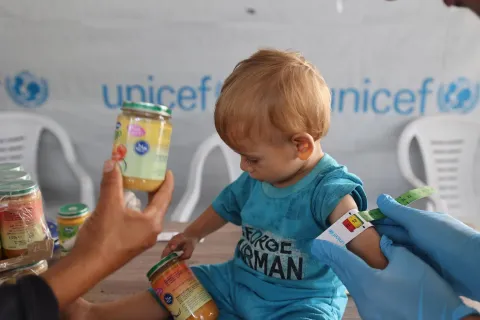
Toddler Adel al-Nijma has asthma, a condition that should be manageable with access to medical care. During a flare-up, his mother sought out treatment for him at Kamal Adwan hospital, only for the hospital to come under attack. Adel suffered burns from shelling, wounds that require a clean environment and regular dressing to heal.

After being displaced to the south, Adel’s family has returned to the site of their home in Jabalya refugee camp. Water is scarce here, however, and they sometimes have to walk over a kilometer to find water to drink and wash with.
For children like Adel, the threat of infection and disease is dire as long as access to clean water is limited by the closure of Gaza’s crossings, and the destruction of Gaza’s infrastructure.

As a major actor in the water sector, UNICEF played a key role in sustaining and increasing gradually the water production through the support of the repair and maintenance of wells and water systems, the delivery of fuel for wells, desalination plants and generators for mobile water desalination plants as well as the distribution of water treatment chemicals, and an extensive water trucking operation throughout Gaza. In 2024, up to 2.6 million people benefitted from safe water for drinking and domestic needs at one point in time.
UNICEF with the Palestinian Water Authority (PWA) have been able provide Gaza residents with lifesaving water and sanitation support through the support of the European Union; the UK Foreign, Commonwealth and Development Office (FCDO); the governments of Australia, New Zealand, Norway, Netherlands, and Republic of Korea; Minderoo Foundation; and flexible humanitarian funding.