I lost my childhood. My little brothers and sisters now call me ‘Mama’
Samar, a teen girl taking care of all her younger siblings in the midst of war, famine and mass displacement
Currently, 82% of the Gaza Strip is under evacuation or military orders. Between 14 August and end of September alone, nearly 400,000 people were displaced again, the vast majority from Gaza City. Most of the Gaza Strip’s one million children have already been displaced many times over, lost their homes, belongings, family members, and access to services.
Thousands of children are still living in Gaza City, among the destruction and desolation, but they lack the resources to move elsewhere – and, even if they did, there are no adequate spaces left in the Gaza Strip for families to go to. In the meantime, hundreds of thousands of children are living in awful hygiene and sanitation conditions in the south.
Samar is a 17-year-old from northern Gaza who recently fled to Khan Younis. Her father died before the war and her mother is missing since a strike hit her entire family, injuring Samar, her five brothers and sisters and her mom on 4 December 2023. Today, Samar is alone to care for her younger siblings, Saeed (8), Mais (10), Sameer (12), Sama (13), and Samer (14).

When the war started, Samar was only 15 years old, just a child. Those carefree days are now long gone. “My father had passed away before the war. My mother was our caretaker, and on 4 December 2023, I lost her too, and her fate is still unknown to this day. Since then, I became responsible for my siblings. I am no longer a child. I lost my childhood. My little brothers and sisters now call me ‘Mama’.”
Following the strike the children not only had to cope with the disappearance of their mother, but they were injured themselves too, with Mais and Saeed sustaining serious injuries. Saeed couldn’t walk, and Mais suffered third-degree burns all over her body. Samar herself injured in her back.

“Since the war began, and within the first two months, I lost my mother, and my younger siblings were seriously injured, especially Mais and my brother Saeed I struggled to care for them, especially since there were no medicines available. Mais needed diapers due to the severity of her injuries. And I couldn’t find bandages to cover my own wounds, leaving my back wounds remained uncovered.”
Today, the six are staying with their older sister Kefah in Khan Younis. In addition to hosting her displaced siblings from the north, Kefah herself already carries the immense burden of looking after her own two children Zayuna (3) and Malak (7), without her husband, and after her 6-year-old son Mohammed was killed in an airstrike. To support the siblings, UNICEF has provided them with emergency cash assistance—enabling them to buy food and essential items for survival.
Like almost all of the one million children in the Gaza Strip, Samar and her siblings urgently need mental health and psychosocial support, beyond assistance to meet their physical needs.

With limited to non-functioning child protection and social services systems, UNICEF has focused its support on prevention, including the prevention of family separation, and has helped identify at-risk children and their caregivers, and provided them with relevant emergency services. Currently, more than 150,000 children receive mental health and psychosocial support, and UNICEF supported 565 children with family reunification with the support of donors contributing to the Flexible Humanitarian Funding. But it remains not enough to address the scale of the needs.
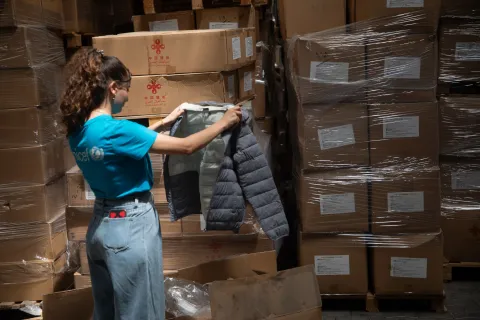
Since famine was declared in Gaza City at the end of August, UNICEF has urgently scaled up its Emergency Famine Response—delivering nutrition supplies to children, as well as life-saving assistance and mental health and psychosocial support (MHPSS). UNICEF has also been ensuring the detection, treatment, and prevention of acute malnutrition among 180,000 vulnerable children, as well as pregnant and breastfeeding women. This response has been made possible with the support of donors including the European Union Humanitarian Aid and the Governments of Canada, France, Japan, the Netherlands, and Sweden.
The aid provided, especially to northern Gaza, remains a trickle of what is really needed. Much more aid must be allowed inside Gaza, and a long-lasting ceasefire must be achieved to allow children like Samar and her siblings to have a chance to start recovering and return to the childhood they deserve.