Empowering futures: rolling out the adolescent girls’ curriculum in Somalia
Locally adapted program driving female leadership, safety and opportunity

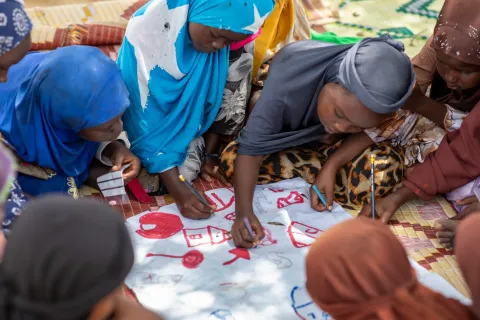
In communities across Somalia, adolescent girls are stepping into spaces of learning, leadership and empowerment—thanks to a newly developed curriculum tailored to their unique needs. Spearheaded by UNICEF in collaboration with its local partners, the curriculum rollout marks a significant milestone in empowering females.
“Adolescence is such a critical stage and years of a woman’s life. The things she learns can shape her entire future. It’s the time all girls require help, knowledge and support,” a participant highlighted why this work is so important.
Listening First: Inclusive Consultations
Before starting work on curriculum development, Child Protection Specialists facilitated a series of consultations with local partners—including youth- and women-led organisations—across the country, and gathered feedback from adolescent girls. These consultations aimed to ensure the curriculum was grounded in the girls' lived realities and unique needs.
Co-Creating Change: Developing a Core Curriculum
The result of these consultations was a 13-session curriculum—streamlined to be accessible, relevant, and implementable across diverse cultural regions in the country over shorter periods of time. It focuses on key life skills and knowledge related to trust, socio-emotional skills, health—including sexual and reproductive health and rights—safety against violence, solidarity and future planning. The curriculum is based on the content and spirit of the International Rescue Committee’s global ‘Girl Shine: Curriculum for Adolescent Girls.’ These adapted versions for Somalia identified priority themes and incorporated learnings from other adapted versions in the region from countries with similar contexts, as well as from local partners’ self-developed curricula.

Building Capacity: Training Facilitators to Deliver the Curriculum
“One thing I learnt was how to facilitate sessions with these girls in a way that I can connect with them than before. I also feel more confident in my ability to connect with them,” says Sahro, a youth mobilizer from Northern Frontier Youth League (NOFYL).
Huda from WAAPO, who joined the training in her capacity as supervisor of facilitators, also shared the value of this training for her:
In July, UNICEF held a training in Mogadishu for the local partners’ facilitators and their supervisors. The training’s objective was twofold: 1) review and provide further feedback on the curriculum, and 2) equip participants with the tools and confidence to deliver the curriculum effectively and with sensitivity.
“Supervising the rollout of the Girl Shine Life Skills Programme in Mogadishu has been a profound privilege. Witnessing the extraordinary dedication of my team and their seamless embrace of the modules filled me with pride. At the same time, it highlighted areas where they—and I, as their supervisor—can grow, reminding me of the importance of continuous support and learning.
On a personal level, this experience deepened my awareness of how linguistic nuances and accents can shape understanding, especially among Somali girls from diverse backgrounds. It reinforced the need for patience, clarity, and adaptability in communication to ensure every voice is heard and every message lands with meaning,” says Sahro.

Looking Ahead, piloting and sustainability
Adolescent girls and partners will continue to play a key role in shaping the content; the curriculum is now being piloted with 6 partners in 6 regions across the country, in different contexts and target groups. Strong monitoring and evaluation are taking place, gathering direct feedback on the curriculum from both adolescent girls and facilitators. This feedback will help review the curriculum, ensuring it resonates with adolescent girls’ experiences and aspirations everywhere.
UNICEF continues to work with partners to ensure that every girl—regardless of her background—has access to safe, empowering, and transformative learning experiences. Thank you to the Government of Canada, the Government of Germany, BMZ and the US Government for supporting this work.
The adolescent girls’ curriculum is more than a set of lessons—it’s a pathway to empowerment, protection, and opportunity for girls. As Tannistha Datta, UNICEF Child Protection Manager, puts it: “When we invest in girls, we invest in a better future for everyone.”