Somalia unites for a polio-free future on World Polio Day 2026
The Ministry of Health, WHO and UNICEF call for sustained investment in polio eradication and vaccination to protect every child.
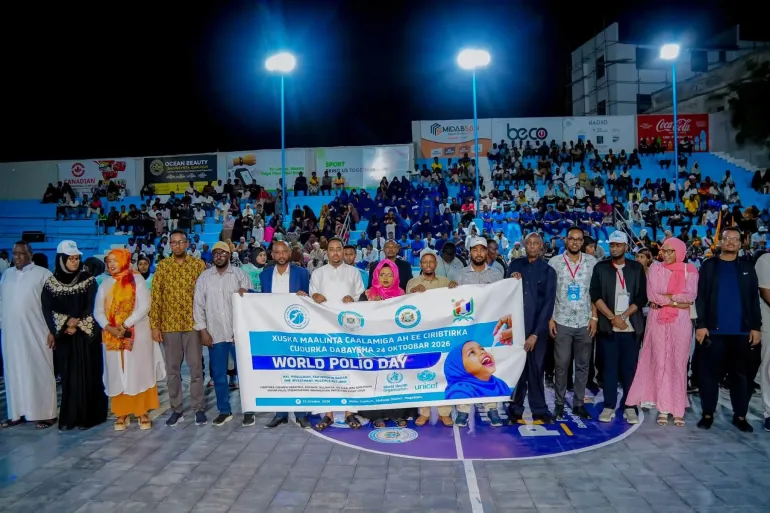
24th October 2026, Mogadishu, Somalia – The Federal Government of Somalia, through the Ministry of Health and Human Services, in partnership with UNICEF and the World Health Organization (WHO) is commemorating World Polio Day 2026 with nationwide advocacy and community engagement activities to renew commitment to polio eradication, strengthen routine immunization and ensure every child is protected against vaccine-preventable diseases.
Nationwide activities brought together government leaders, health partners, religious leaders, young people and communities to mark and promote vaccination and support a polio-free Somalia. In Mogadishu, a women’s national basketball championship match took place on 23 October at WISH Basketball Stadium, drawing senior government officials and development partners to raise awareness about polio eradication. Similar activities across Somaliland, Puntland, Galmudug, Hirshabelle, Southwest State and Jubaland are mobilizing communities to vaccinate children and strengthen routine immunization.
The 2026 theme, “One Investment, Multiple Returns: Advancing Polio Eradication and Strengthening Immunization for Every Child,” highlights the broader benefits of investing in polio eradication. These efforts also strengthen disease surveillance, improve routine immunization services, and help build health systems better equipped to protect communities against other vaccine-preventable diseases.
“Protecting every child from polio is not only a public health priority; it is a national responsibility and a commitment to Somalia’s future. No child should suffer from a disease that can be prevented through vaccination. As a government, we are determined to strengthen cooperation with Federal Member States, health partners, religious leaders, and communities to ensure that life-saving vaccines reach every child, wherever they live. I call upon every parent to vaccinate their children and every community leader to champion immunization and counter misinformation. Our goal is clear: to leave no child unprotected, no community behind, and to build a healthier, polio-free Somalia for generations to come”, said Dr Ali Haji Adam, Federal Minister of Health of Somalia.
Somalia’s efforts to end polio require sustained investment and action to reach every child. WHO is working with the Ministry of Health, UNICEF and partners to close vaccination gaps, strengthen surveillance and protect children in remote, displaced and mobile communities.
“Every missed child leaves a gap poliovirus can exploit. This year’s theme, ‘One Investment, Multiple Returns,’ underscores the need to invest in stronger surveillance and vaccination to reach children in remote and mobile communities and stop polio transmission in Somalia,” said Dr Humphrey Karamagi, WHO Representative in Somalia.
The Ministry of Health, WHO and UNICEF are working together to end polio in Somalia through stronger disease surveillance, high-quality vaccination campaigns and routine immunization services. This joint effort aims to reach every child, close immunity gaps and strengthen health systems to respond to other public health threats.
“Every child deserves the chance to grow up healthy and free from the threat of polio. The Ministry of Health, WHO and UNICEF are working together to end polio in Somalia through stronger disease surveillance, high-quality vaccination campaigns and routine immunization services. This joint effort aims to reach every child, close immunity gaps and strengthen health systems to respond to other public health threats”, said Sandra Lattouf, UNICEF Representative in Somalia.
Reaching every child requires sustained investment, high-quality vaccination campaigns and routine immunization services that reach underserved communities, including children affected by displacement and population movement. Community trust and the continued engagement of parents, caregivers and local leaders remain essential to closing immunity gaps and preventing the spread of poliovirus.
The nationwide advocacy and communication activities are supported through Gates Foundation-funded work led by UNICEF, in collaboration with government counterparts and other key partners from the Global Polio eradication Initiative (GPEI), to strengthen public awareness, political commitment and community participation in polio eradication and routine immunization.
Media contacts
About UNICEF
UNICEF promotes the rights and wellbeing of every child, in everything we do. Together with our partners, we work in 190 countries and territories to translate that commitment into practical action, focusing special effort on reaching the most vulnerable and excluded children, to the benefit of all children, everywhere.
UNICEF has been working in Somalia since 1972 when its first office opened in Mogadishu. Today UNICEF has over 300 staff working in Mogadishu, Baidoa, Dollow, Garowe, Hargeisa and also Nairobi, Kenya. Together with 200 international and national NGOs and community-based organizations, UNICEF delivers services in Health, Nutrition, WASH, Education and Child Protection, and responds to emergencies and supports peace-building and development.