By 2036, children in Somalia want every child learning, better livelihoods for young people, equal opportunities for girls and boys and their voices heard
On World Children’s Day, children across Somalia share their priorities, take over the radios and classrooms, and join a national football celebration
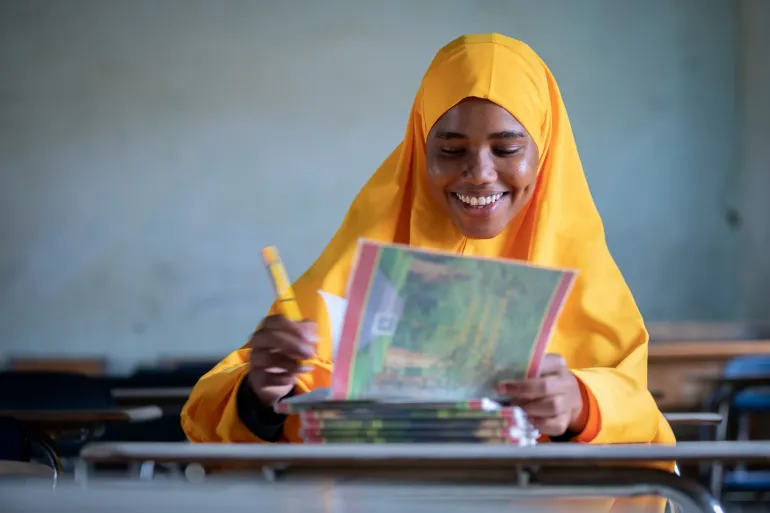
MOGADISHU, 19 November 2026 – Education for every child tops the hopes of children in Somalia for the next decade, according to a U-Report poll of more than 10,000 children under the age of 18 conducted ahead of World Children’s Day. Asked what they want their country to look like by 2036, 22 per cent chose every child learning, followed by better livelihood opportunities for young people (20 per cent), equal opportunities for girls and boys (19 per cent) and young people’s voices being heard (10 per cent). Nearly 5 per cent called for children to be able to grow up free from violence.
Asked about the biggest challenge facing their communities, 55 per cent of child respondents named limited jobs and livelihood opportunities. Others pointed to poor access to education (18 per cent), poverty and hunger (9 per cent) and conflict and displacement (8 per cent).
When asked what UNICEF’s top priority in Somalia should be, 40 per cent chose skills development and livelihood opportunities, followed by quality education (23 per cent) and child protection (8 per cent). Around 7 per cent each called for more opportunities for girls and for safe water and sanitation.
“Children in Somalia have told us clearly what they need: the skills to earn a living, a good education, equal chances for girls and boys, and a say in the decisions that shape their lives,” said Sandra Lattouf, UNICEF Representative in Somalia. “These are not just numbers. They are the priorities of a generation. Today, we urge leaders and partners to listen, to act and to show children how their voices are shaping change. The future of Somalia must be built with children, not just for them.”
World Children’s Day marks the anniversary of the adoption of the Convention on the Rights of the Child by the United Nations General Assembly on 20 November 1989. This year’s global theme is “My Day. My Rights. My Future.” In Somalia, children are leading the day under the banner “Our Voices. Our Future. Our Somalia.” Activities include:
A national football celebration in Mogadishu. A football tournament and World Children’s Day booths bring together children, families, communities, partners and media. Children and adolescents are speaking directly with officials from the Federal Government and Federal Member States, as well as community and religious leaders, about their rights, health and protection. These leaders are being invited to make public commitments for children.
A Kids Takeover of the radios. Children are taking over Shabelle TV and Radio and Dalsan Radio and TV as presenters and interviewers, exercising their right to be heard under Article 12 of the Convention on the Rights of the Child.
School takeovers in Somaliland and Southwest State. Students are running workshops for their classmates and swapping roles with principals and teachers for the day, taking part in decisions about their own schools.
Landmarks go blue. The Lido Beach lighthouse in Mogadishu, the National Museum in Hargeisa and the Town Hall in Garowe are being lit in UNICEF blue in support of children’s rights.
Young people’s own messages. U-Reporters across Somalia are sharing short videos about their hopes and expectations for the future.
World Children’s Day also starts the countdown to UNICEF’s 80th anniversary, which will be officially marked on 11 December 2026 with a year-long call to choose a future for children. In 2027, UNICEF will also mark 55 years of working in Somalia.
“Over five decades, Somalia has made real progress for children: child deaths have halved and far more families have access to safe water,” said Lattouf. “But children are facing converging crises, from insecurity and climate shocks to funding cuts to essential services. As UNICEF marks 80 years, we must choose children and invest in their futures, so that every child in Somalia can learn, be protected and thrive.”
# # #
Notes for editors
About the poll: U-Report is UNICEF’s free SMS and social media platform, through which nearly 200,000 young people in Somalia share their views on issues that matter to them. The poll was conducted between 5 and 12 November, among U-Reporters in Somalia; of the approximately 18,000 respondents, 10,138 (56.1 per cent) were under 18, and the results presented here are from this group. U-Report polls are not representative samples of the population.
Media contacts
About UNICEF
UNICEF promotes the rights and wellbeing of every child, in everything we do. Together with our partners, we work in 190 countries and territories to translate that commitment into practical action, focusing special effort on reaching the most vulnerable and excluded children, to the benefit of all children, everywhere.
UNICEF has been working in Somalia since 1972 when its first office opened in Mogadishu. Today UNICEF has over 300 staff working in Mogadishu, Baidoa, Dollow, Garowe, Hargeisa and also Nairobi, Kenya. Together with 200 international and national NGOs and community-based organizations, UNICEF delivers services in Health, Nutrition, WASH, Education and Child Protection, and responds to emergencies and supports peace-building and development.